.avif)


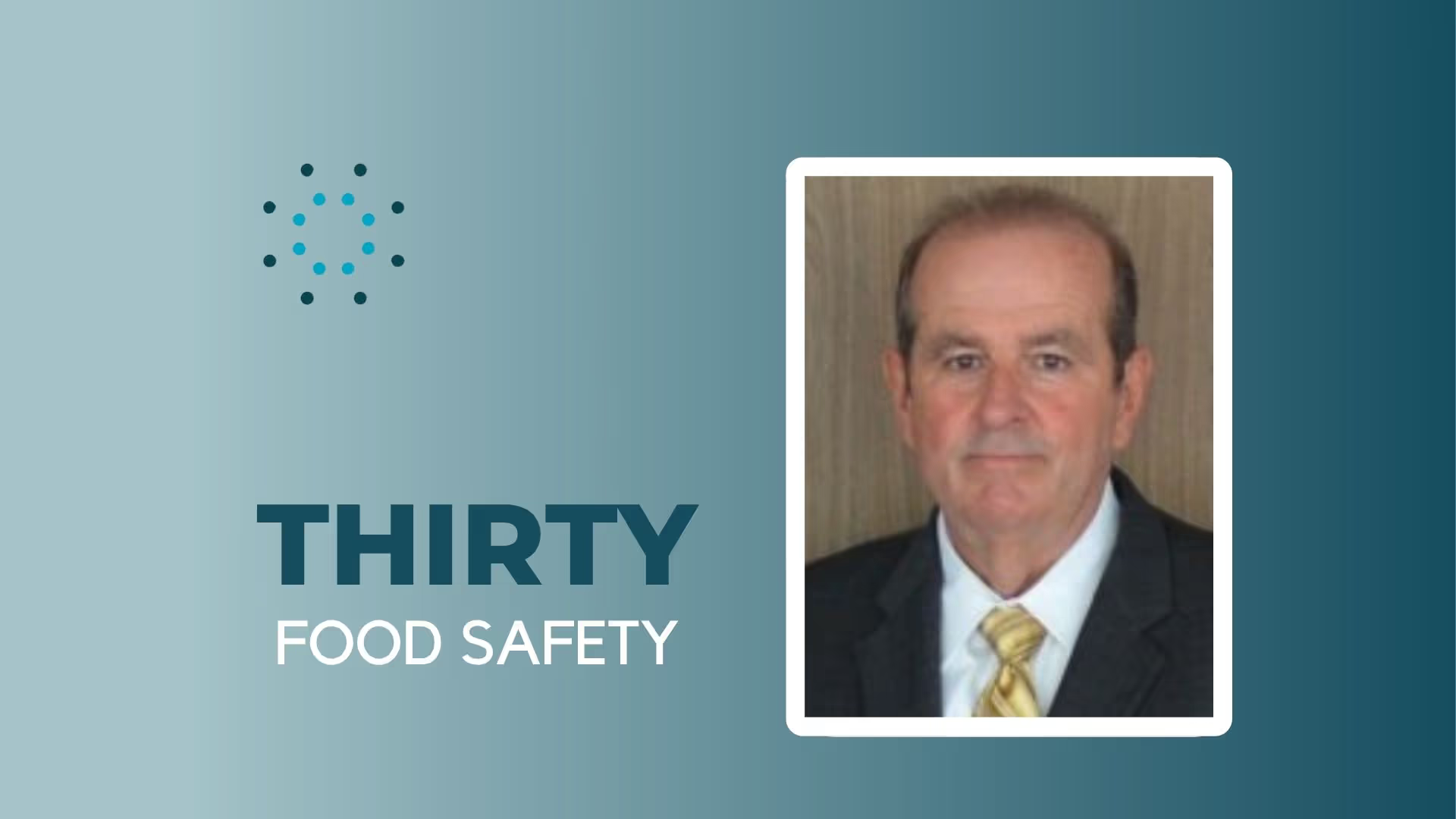
30 Food Safety with Peter Begg





In this engaging conversation on 30 Food Safety, host Paddy McNamara sits down with Peter Begg, a food safety leader with over 30 years of experience in the industry. Peter's unique path from chemical engineering to food safety leadership offers valuable insights for professionals at every stage of their career.
How an Engineer Found His Calling in Food Safety
Peter Begg didn't follow the traditional path into food safety. With a chemical engineering degree from Penn State, he started his career at Kraft Foods doing process engineering—nowhere near the quality or food safety departments. But Kraft had a distinctive approach that would shape his entire career trajectory.
"The OG Kraft, the old Kraft before all the mergers... they made everyone—engineers, scientists, R&D—everyone had to take a course on microbiology and food safety. It did not matter; if you were coming into the company, they made you learn about food safety."
This company-wide commitment to food safety education stemmed from a pivotal moment in Kraft's history: a Listeria recall involving ice cream novelty bars in the mid-1980s that resulted in illnesses. That incident fundamentally changed how the company approached food safety, setting a precedent that would benefit professionals like Peter for decades to come.
Why Food Safety Captivated an Engineer's Mind
What drew Peter away from traditional engineering projects and into the fast-paced world of quality and food safety? The answer reveals something fundamental about what makes great food safety leaders.
"As an engineer, I think about solving problems. And every day in quality and food safety, there's a problem. Most of them are minor thankfully. But the thing with quality and food safety is every day is unique."
Unlike year-long engineering projects that could become repetitive, food safety offered real-time problem-solving that kept Peter engaged. The variety and immediacy of challenges appealed to his engineering mindset, while the business implications added another layer of complexity that required both technical expertise and strategic thinking.
The Baptism by Fire: Leading Quality in Europe
Peter's transition to full-time quality and food safety leadership came in 2008 when he accepted an international assignment as Director of Quality for Kraft Foods Europe. Based in Switzerland, he suddenly found himself responsible for operations across all EU countries during a period of explosive growth.
The timing was challenging—the team expanded from 25 to 100 people within three years as Kraft integrated the LU Biscuit business and acquired Cadbury. The Cadbury acquisition brought a new level of complexity: chocolate manufacturing, where there's no kill step after the cocoa beans are roasted.
"Chocolate, there's no kill step. The cocoa beans are roasted, but once you make that chocolate, there is no kill step. So lots of learnings, lots of experiences."
Working across different countries and languages taught Peter crucial lessons about clear communication. He learned to speak slowly, avoid slang and euphemisms, and remember that even when English is the business language, many team members are translating into their native language while listening.
The Biggest Challenge: Not Being the Expert
Despite his engineering background and problem-solving skills, Peter readily acknowledges his biggest professional challenge: not being a microbiologist himself.
"I know I don't know everything there is to know about microbiology. So I rely on the experts. But what I try and do then is say, okay, well, let's take all the facts. Let's get the facts on the table because people tend to get emotional."
This approach—gathering facts, relying on experts, and cutting through emotion—has served Peter well throughout his career. Whether dealing with half a million dollars of product on hold or navigating potential Salmonella contamination in chocolate, his engineering discipline of working from data has been invaluable.
The Regret: Not Pushing Hard Enough, Soon Enough
When asked about mistakes and regrets, Peter points to a common industry problem that still frustrates him today: the reactive nature of food safety investments.
"Some of the things as I look back, it's pushing harder on the company to make the changes necessary to move from reactive to proactive. We tend to be very reactive in food safety and quality. A crisis happens and all of a sudden a company will throw a ton of resources—'how many more people do you need and what equipment changes do we need to make?' But we need to be doing that ahead of time."
This pattern—waiting until after a crisis to invest in people and equipment—is something Peter has witnessed repeatedly across the food industry. It's a cycle he's determined to break in his current role at Lions Magnus, where he's focused on building a strong food safety culture from the start.
Building Food Safety Culture: The Lion's Pride
At Lions Magnus, Peter has taken a proactive approach to culture-building that reflects lessons learned throughout his career. The company created a logo and tagline—"Lion Food Safety: The Heart of Our Pride"—as a communication vehicle to engage the entire employee base.
But culture-building isn't just about branding. It's about creating an environment where employees feel empowered to speak up without fear of punishment. Peter shares a recent success story:
"Two weeks ago in one of our facilities, an employee saw that the wrong ingredient was brought to the cook deck where we mix all the ingredients. We celebrated that because that's what you want. That's the type of culture you want is where people are being proactive."
This proactive mindset extends beyond day-to-day operations. Peter's team is developing an asset replacement list—identifying equipment with potential food safety risks and incorporating them into capital plans before problems occur.
Standing Your Ground: The Evolution of Leadership
Reflecting on how his approach has changed over 15 years, Peter emphasizes the importance of conviction and courage in food safety leadership.
"I think it's being stronger and standing your ground. And if the company—thankfully we work in a country where you have choice—if it gets to the point where you're putting together the data, you're saying it, and then they continue to disagree, well, you can always go work someplace else."
He's quick to clarify that he's not encouraging people to leave their jobs, but rather emphasizing the importance of knowing your values and working for companies that prioritize people and food safety. At Lions Magnus, where he reports directly to the CEO, Peter has found alignment on these priorities.
"In my role, it stops with me. I report to the CEO, so thankfully he's aligned with what we want to do. At some point in your career when you get to certain roles, there's no one else you can go tell to, 'hey, can you go get this done for me or can you push this forward?'"
Hall of Fame Moment: Transforming a Factory from Worst to Best
When asked about his proudest achievement, Peter recalls a remarkable turnaround story from his time at Mondelēz. Working with a small SWAT team dedicated to raising standards across global facilities, they identified a factory in India with one of the worst audit scores Peter had ever seen.
"Let's just say there were a number of criticals. An auditor would have been floored. By the time we—a couple years later with organization changes in the facility but also just teaching them what good looks like—that factory got a really good audit three years later. That is when you're proud as someone in quality and food safety, that you can take a factory that literally was a high-risk factory and really raise it up to the point that you'd almost put it up against some of your best factories around the world."
The success came from a three-pronged approach: getting the right people in place, building strong programs, and making necessary investments—all underpinned by developing the right culture.
The AI Question: Promise vs. Reality in Food Safety
In an era where artificial intelligence dominates industry conversations, Peter offers a measured perspective that might surprise some technology enthusiasts.
"I don't know if people disagree, per se, but AI—artificial intelligence—it's going to solve every problem we've ever had according to the news. I don't know if that's necessarily the case. You still need people to program the AI, to create the programs that AI uses."
Peter sees value in AI for data analysis and aggregation, particularly when dealing with thousands of certificates of analysis or supplier documents. But he's skeptical about its ability to replace human expertise in food safety.
"In the food industry especially, you're dealing with agricultural crops. A computer isn't going to grow crops for you. AI could help maybe tell you the right time to plant the crops and maybe the right location, but you're still dealing with nature, you're still dealing with agriculture, and then you still need people to harvest those."
At Lions Magnus, the company is "scratching the surface" with AI, primarily using it for data analysis through their lab information systems and supplier databases. The focus is on using AI to supplement human work, not replace it.
What Keeps a Food Safety Leader Up at Night
Ask any food safety professional what concerns them most, and you'll get a familiar answer from Peter: "Everything."
More specifically, Peter worries about products with inherent risks—chocolate with no kill step, fresh deli sandwiches, ready-to-eat meals, and the fruit products that Lions Magnus handles for customers.
"As I've learned over the last 20 years of being in the space, microorganisms don't care who you are. They're going to find their way if you don't take the right steps to mitigate them."
But Peter's second concern reveals the human side of leadership:
"How do you create a strong team and then keep them? People are still at the heart of what we do, and making sure that you can retain your talent is probably the other thing that keeps me up at night."
The MAHA Challenge: Moving Faster Than Supply Can Follow
Looking at current regulatory challenges, Peter points to the "Make America Healthy Again" agenda, particularly the push to eliminate artificial colors. While the intent may be right, he's concerned about execution.
"The CEO of Sensient said, 'Yeah, it's great in theory, but many of the ingredients require crops to be grown to make the natural colors. If everyone switches at the same time, there's just not going to be enough supply. It's going to take three years of growing the right crops, getting the right acreage before there will be enough supply of the natural colors.'"
This example illustrates a broader lesson Peter has learned: sometimes well-intentioned regulatory changes don't fully consider the practical implications of implementation.
Advice for the Next Generation of Food Safety Leaders
For those starting their careers in food safety, Peter offers two pieces of wisdom drawn from his unconventional path.
"You have to do what you love. If you're waking up and you're dreading going to work or going to the plant or going to whatever meeting, you're probably not in the right role."
His second piece of advice reflects his own journey:
"Try different things. Coming out as a chemical engineer, I never thought I'd be leading quality and food safety 30 years later. But I do think there's something to be said for having a couple different experiences in your career. Even if your passion is quality and food safety, doing something maybe in another function—whether it be R&D or engineering or operations—just to gain a little bit of that different perspective will just help you that much better as a leader."
Key Takeaways for Food Safety Professionals
Peter Begg's journey offers several crucial lessons for food safety professionals:
- Build culture proactively, not reactively - Don't wait for a crisis to invest in people, equipment, and programs
- Lead with facts, not emotion - Especially during high-pressure situations with product holds or potential contamination
- Rely on experts while bringing business acumen - You don't need to know everything, but you need to know who does and how to make sound business decisions
- Stand your ground on safety issues - When you reach leadership levels, the responsibility stops with you
- Embrace diverse experiences - Cross-functional experience makes you a better food safety leader
- Remember that people are still at the heart of food safety - Technology and AI can help, but humans grow crops, operate equipment, and catch mistakes
- Communicate clearly across cultures - Especially in global roles, slow down and avoid jargon
Peter's career demonstrates that food safety leadership isn't just about technical knowledge—it's about problem-solving, building teams, standing firm on values, and continuously pushing organizations toward proactive risk management.
Want to hear more insights from food safety leaders? Subscribe to 30 Food Safety on Youtube and join the conversation about building safer food systems for everyone.
%20(1).png)
.avif)

.avif)
%20(1).avif)
.avif)