.avif)



ATP Testing for Food Manufacturers: Complete Guide


ATP testing is one of the fastest and most practical tools available to food safety teams for verifying the effectiveness of your cleaning and sanitation program. ATP results only mean something against a solid program. Start with our guide to cleaning and sanitation in the food industry. A single swab and a luminometer give you a result in about 15 seconds. That is enough time to catch a sanitation failure before your production line starts. Understanding what ATP testing actually measures, how to set meaningful pass/fail thresholds, and how it maps to your FSMA or GFSI compliance requirements is where most facilities run into gaps.
This guide covers everything you need: the science behind the test, a step-by-step testing procedure, a zone-based swabbing framework, RLU threshold methodology, the critical limitations that food manufacturers often overlook, and a full clause-level mapping of ATP requirements under FSMA 21 CFR Part 117, SQF, BRCGS, and FSSC 22000.
What Is ATP Testing?
ATP testing is a rapid hygiene monitoring method that detects adenosine triphosphate (ATP) on a surface. Because ATP is present in all living organisms and organic matter, finding it on a surface after cleaning signals that organic residue remains, meaning your sanitation process was incomplete. The test produces a numerical result in Relative Light Units (RLUs), which you compare against your established pass/fail thresholds to determine whether a surface is ready for production.
No other sanitation verification method gives you that answer in 15 seconds. That speed is why ATP testing has become the standard pre-operational verification tool across food manufacturing, processing, and distribution.
What Is Adenosine Triphosphate (ATP)?
Adenosine triphosphate is the primary energy currency of living cells. Every plant, animal, bacterium, and yeast cell uses ATP to power biological processes. When a surface carries food residue (proteins, fats, sugars, and microbial cells), it also carries residual ATP from those organic sources. Even after cells die, ATP persists briefly in the debris.
For food safety purposes, ATP functions as a proxy for contamination. A high ATP reading does not tell you what is on the surface or whether pathogens are present. It tells you that organic matter is there, which means your cleaning protocol did not fully remove it. That signal is what you act on.
How the Bioluminescence Reaction Works
When a swab sample contacts the reagent inside an ATP test device, the ATP from the surface reacts with luciferase and luciferin enzymes, the same biochemical mechanism fireflies use to produce light. The reaction emits photons in proportion to the amount of ATP present.
A luminometer counts those photons and converts the measurement into Relative Light Units. Higher RLU means more ATP, which means more organic residue. The luminometer returns that number in 10 to 15 seconds, which is why ATP testing is so well suited to pre-operational verification where decisions need to happen before production begins.
How to Perform an ATP Test: Step-by-Step Procedure
The testing process itself is straightforward. Where facilities run into problems is usually inconsistent technique, improperly stored swabs, or undertrained staff. A standardized procedure applied consistently across your team protects the integrity of your data and gives your trending records meaning over time.
Equipment You Need
Three things are required for an ATP test:
- A luminometer (ATP meter): Common options include the Hygiena SystemSURE Plus, Neogen AccuPoint Advanced, and Charm Sciences novaLUM II. Each brand uses a proprietary RLU scale, and readings are not interchangeable across manufacturers. Pick one system and standardize on it.
- Pre-moistened surface swabs: These are sterile, single-use swabs pre-loaded with luciferase/luciferin reagent. Store them per the manufacturer's instructions. Most require refrigeration or controlled room temperature, and improper storage degrades the reagent and produces artificially low (false-pass) results.
- A recording system: Every result must be recorded with the date, test site, RLU result, and operator name. Whether you use a paper log, a spreadsheet, or food safety software, that record is what auditors will request.
The 4-Step ATP Testing Process
- Swab the target surface. After cleaning and sanitizing, but before production begins, swab the designated test site with firm, consistent pressure. Cover a defined area (typically 10 cm x 10 cm for flat surfaces) using a systematic pattern, such as a Z-stroke.
- Activate the swab. Snap or squeeze the device to release the reagent and mix it with the sample. The exact activation technique varies by brand, so follow your specific manufacturer's instructions.
- Insert into the luminometer and read. Slide the activated swab into the reader and wait for the result. Most devices return an RLU reading within 15 seconds.
- Record and compare. Log the result against your established pass/caution/fail thresholds for that specific test site. Take immediate action based on the outcome: pass means proceed, caution or fail means stop and re-clean before production begins.
When to Test: Pre-Op vs. Post-Sanitation
Pre-operational testing is the most common application. You test after cleaning is complete, before production starts, to confirm the surface is ready for food contact. This is the verification step that FSMA and GFSI auditors look for when they review your sanitation records.
Post-sanitation trending is a different use case. Rather than making a go/no-go production decision, you collect ATP data over time to evaluate whether your cleaning process is improving, holding steady, or gradually degrading. Trending data is what separates a basic ATP program from one that actually drives corrective action and long-term hygiene performance.
Both applications are valuable. Most facilities benefit from building both into their documented sanitation SOP.
ATP Testing Zones: Where to Swab in Your Facility
One of the most common weaknesses in ATP programs is an unstructured swabbing approach, where a few familiar surfaces get tested without a documented rationale or systematic coverage strategy. A zone-based framework gives your program the risk-based structure that FSMA and GFSI auditors expect to see.
The Four Environmental Zones (Zone 1 to Zone 4)
The four-zone model categorizes surfaces based on their proximity to food and their potential to introduce contamination into product:
- Zone 1: Direct food-contact surfaces. The highest priority. Cutting boards, conveyor belts, blades, fillers, and any surface that directly touches product. Test Zone 1 daily, pre-op, at a minimum.
- Zone 2: Non-contact surfaces adjacent to food. Surfaces that do not touch food but are close enough that contamination could migrate through drips, splashes, or condensate. Examples include conveyor frames, drip shields, and equipment undersides above Zone 1. Test at least weekly.
- Zone 3: Non-contact surfaces more distant from food. Floors, walls, drains, and structural elements within the production area. Monthly testing is typical for sanitation trending purposes.
- Zone 4: Remote areas outside production. Warehouses, hallways, locker rooms, and break areas. Less frequent, but relevant to documenting your overall facility hygiene program.
Building a Swab Site Map
A swab site map is a floor plan or facility diagram showing every labeled test site with its zone designation, assigned testing frequency, and responsible operator. In a GFSI-certified facility, this document is part of your sanitation program and is not optional.
Start by walking the facility and identifying every surface you plan to include in your program. Label each site on the floor plan with a unique identifier (for example, Z1-01, Z1-02, Z2-01). Record the zone, frequency, assigned person, and threshold for each site in your FSMS or sanitation SOP. Rotate test sites periodically so your data reflects a broader view of facility hygiene rather than the same always-clean spot week after week.
Your GMP audit documentation checklist should cross-reference this zone map so auditors can trace your swab sites back to your GMP sanitation requirements.
How Many Sites Should You Test?
There is no single regulatory minimum that applies universally, but a common starting point is 5 to 10 Zone 1 test sites per active production line. The right number depends on your facility size, product risk level, and the complexity of your equipment.
As your program matures, you need enough data per site to calculate meaningful trending statistics. Typically, at least 20 to 30 data points are needed before drawing conclusions about a specific location. If you are starting fresh, focus on breadth first (covering all high-risk areas) before optimizing for data depth at individual sites.
How to Set Your Pass/Fail RLU Thresholds
This is the question QA managers ask most often, and the one that existing resources answer least well. Most guides acknowledge that pass/fail levels exist and are equipment-specific. Few explain how to actually establish them for your facility in a way that will hold up under audit scrutiny.
Why There Is No Universal RLU Pass/Fail Number
The most important thing to understand about RLU thresholds is that they are not transferable between systems. A pass threshold of 30 RLU on a Hygiena device is not the same as 30 RLU on a Neogen device. Each manufacturer uses a proprietary reagent formulation, photomultiplier sensitivity setting, and calibration algorithm. You cannot compare results between brands or set thresholds based on a number you found in a competitor's SOP.
Surface type matters as well. Aged plastic conveyor belting has a different baseline profile than new stainless steel. Porous surfaces retain more organic matter than polished smooth surfaces. FSMA and GFSI standards do not prescribe specific RLU values. They require your facility to validate and document its own thresholds based on demonstrated data from your specific equipment and surfaces.
Establishing Baseline Data
The methodology for setting thresholds starts with data collection on known-clean surfaces. Here is a practical baseline process:
- Perform your standard cleaning and sanitation procedure on the test surface, verified as complete by your sanitation team lead.
- Run ATP tests on that same surface on at least 6 to 10 separate production days following verified cleaning.
- Calculate the mean RLU and the standard deviation across those readings.
- Set your Pass threshold at approximately the 95th percentile of your clean-surface data set. This accounts for natural variation in the cleaning process without setting a threshold so tight that normal fluctuations generate constant false failures.
For your Caution and Fail tiers, many facilities use 1.5x and 2x the Pass threshold as starting points, then adjust based on operational experience. Document your entire baseline process in your sanitation SOP so auditors can verify that your thresholds are validated rather than arbitrary.
For additional methodological guidance, Cornell University ATP monitoring guidelines (2024) provide a solid academic reference framework, and Neogen's resource on establishing facility-specific RLU pass/fail limits offers a practical industry perspective on threshold-setting methodology.
Three-Tier Threshold Framework
Most programs benefit from three action levels rather than a binary pass/fail:
- Pass: The surface is adequately clean. Proceed to production.
- Caution: The result is above your pass threshold but below your fail threshold. Re-clean the surface and retest before allowing production to begin.
- Fail: The result is at or above your fail threshold. Stop production for that line, re-clean, retest, and document a corrective action record before production restarts.
The Caution tier is not a modified pass. It is a warning that your cleaning process is trending in the wrong direction. Facilities that routinely treat Caution results as acceptable because they never reached the Fail threshold will find that pattern documented in their audit non-conformance records.
Common Starting Reference Ranges (by Surface Type)
These ranges are illustrative starting points only. Use them as a reference benchmark when beginning your baseline data collection, not as validated thresholds for your facility:
| Surface Type | Pass Range (Starting Reference) |
|---|---|
| New stainless steel, food-contact | 0–30 RLU |
| Aged plastic conveyor belting | 0–75 RLU |
| Polished food-contact equipment (slicers, blades) | 0–40 RLU |
Your validated thresholds may be higher or lower depending on your specific equipment, cleaning chemicals, water hardness, and product residue profile. Collect your own baseline data before finalizing any numbers and document the validation rationale in your sanitation SOP.
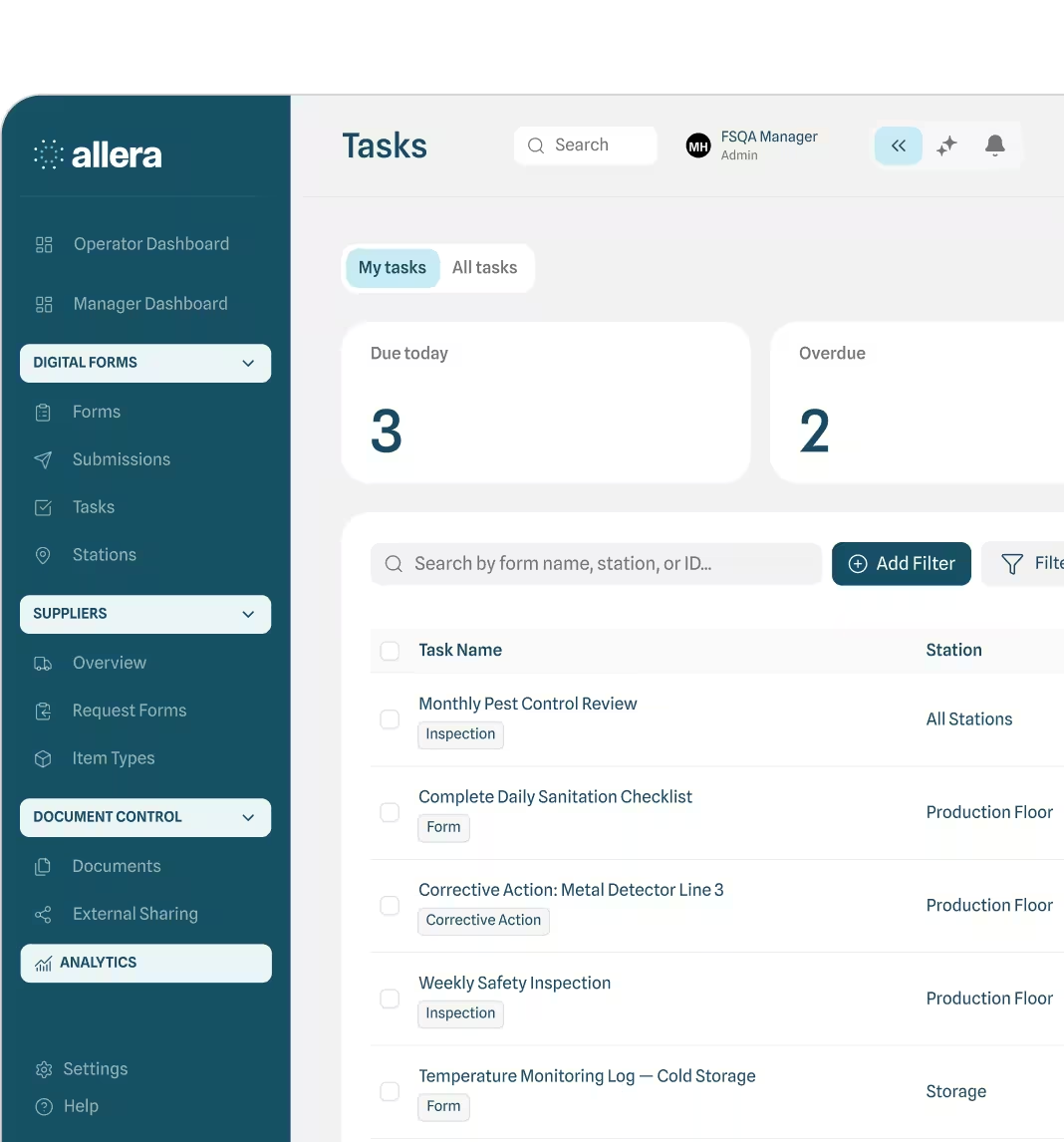
Struggling to document your ATP thresholds and sanitation records in one place? Allera helps food manufacturers centralize their environmental monitoring logs, corrective actions, and audit-ready reporting. See How It Works
What ATP Testing Can and Cannot Detect
Understanding the limits of ATP testing is as important as understanding what it measures. Using ATP as your only hygiene verification method without accounting for what it misses creates compliance gaps that show up during GFSI audits and FSMA inspections.
What ATP Testing Detects
ATP testing detects the presence of organic residue on a surface. That includes food particles (proteins, fats, carbohydrates, sugars), microbial cells (bacteria, yeast, and mold), and residual organic soiling that was not fully removed during cleaning. When your sanitation process works effectively, organic matter is removed and ATP readings fall within your pass range.
As a real-time indicator of cleaning effectiveness, ATP testing is fast and reliable. For a broader view of where ATP testing fits within your overall hygiene monitoring strategy, see our overview of food safety testing methods used in food manufacturing.
What ATP Testing Cannot Detect
ATP testing does not identify the type of contamination present. That distinction matters for several categories food manufacturers must manage separately:
- Specific pathogens: A high RLU reading tells you organic residue is present, but not whether Listeria monocytogenes, Salmonella, or E. coli are contributing to that reading. Pathogen identification requires microbiological testing.
- Allergens: ATP detects organic residue but cannot identify specific proteins. A surface may return a passing ATP result while still carrying enough residual gluten, milk protein, or peanut allergen to trigger a consumer reaction. Allergen validation requires ELISA or lateral flow immunoassay testing.
- Viruses: Viruses contain nucleic acids (RNA or DNA) but carry no ATP. Norovirus and hepatitis A will not produce elevated RLU readings. ATP testing provides no detection coverage for viral contamination.
- Bacterial spores: Spores contain minimal metabolically active ATP and are frequently undetected at typical luminometer sensitivity levels. Facilities producing shelf-stable or low-moisture products need additional controls for spore-forming organisms.
- Degraded ATP (ADP and AMP): Heat, acids, and enzymatic cleaning activity can degrade ATP into ADP and AMP. A surface exposed to high-temperature or caustic cleaning may carry degraded adenylates (residual organic contamination) that a conventional ATP test reports as clean. This is a meaningful gap for facilities using aggressive CIP protocols.
The A3 Test (Total Adenylate): The Next Generation
The A3 test, also called the total adenylate test, addresses the degraded ATP limitation by measuring ATP plus its breakdown products (ADP and AMP) simultaneously. It uses pyruvate kinase (PK) and pyruvate phosphate dikinase (PPDK) enzymes to convert ADP and AMP back into ATP before measurement, giving a complete picture of adenylate contamination on a surface.
This matters in food manufacturing environments where cleaning chemicals or process temperatures degrade ATP before testing occurs. A conventional ATP test can return a false pass on a surface that is actually contaminated with degraded adenylates. The A3 test catches what conventional ATP misses. For a detailed breakdown of the technical differences, how the A3 total adenylate test improves on conventional ATP is worth reviewing alongside the peer-reviewed analysis of ATP testing methods (Bakke, 2022) published in the Journal of Food Protection.
BRCGS Issue 9 now references A3-style monitoring in the context of high-risk and allergen environments. If your facility operates under BRCGS and handles allergens, conventional ATP testing may no longer be the appropriate tool for your highest-risk surfaces.
Implications for Your Allergen Control Program
ATP testing can support your allergen sanitation verification process, but it cannot stand alone as allergen validation evidence. The Food Allergy Research and Resource Program (FARRP) guidance is direct: validate your allergen sanitation SOP with ELISA testing first, then use ATP as an ongoing monitoring indicator within a validated procedure.
In practice, this means if you are using ATP to verify allergen changeovers, you need documented evidence showing that surfaces passing your ATP threshold also consistently pass ELISA allergen testing. Without that correlation established in your validation records, ATP results are not sufficient evidence of allergen removal under a GFSI or FSMA allergen control program.
ATP Testing vs. Microbiological Testing: When to Use Each
ATP testing and microbiological testing are complementary tools. Treating them as alternatives, or assuming ATP alone is sufficient, creates gaps in your environmental monitoring program that auditors are trained to identify.
Side-by-Side Comparison
| Factor | ATP Testing | Microbiological Testing |
|---|---|---|
| Time to result | 10–15 seconds | 24–72 hours (plate counts) |
| What it detects | Organic residue (proxy for cleanliness) | Specific organisms (indicator or pathogen) |
| Cost per test | Low ($0.50–$3 per swab) | Higher ($5–$50+ per sample) |
| Primary use case | Pre-op verification, real-time cleaning feedback | EMP trending, regulatory compliance for RTE foods |
| FSMA requirement | Verification tool (not mandated by name) | Required for RTE facilities with environmental pathogen hazard |
| Skill required | Minimal; field operable by production or sanitation staff | Lab handling or contract lab required |
The Complementary Approach: Use Both
The strongest environmental monitoring programs use ATP for daily pre-op verification and microbiological testing for periodic program validation and incident investigation. ATP gives you real-time feedback at the frequency needed to drive daily sanitation behavior. Microbiological data gives you organism-specific evidence that regulatory bodies and GFSI auditors require.
A case study on ATP monitoring improving facility hygiene outcomes demonstrated that combining ATP and microbiological indicator testing in a food production facility led to measurable, sustained improvements in surface hygiene over 12 months. The ATP program provided the daily feedback loop; the microbiological program provided the validation data confirming the program was working at the organism level.
When designing or improving your environmental monitoring program, start by mapping which method serves which purpose. Document both in your SOP with appropriate frequencies, action thresholds, and corrective action protocols for each.
ATP Testing Requirements Under FSMA and GFSI
This is the section that no existing competitor resource covers. If your facility operates under FSMA regulations or a GFSI-recognized certification scheme, your ATP testing program connects to specific written clauses that auditors and regulatory reviewers check.
FSMA 21 CFR Part 117: Sanitation Controls and Verification
FSMA's Preventive Controls for Human Food rule, codified at 21 CFR Part 117, establishes requirements for sanitation controls and their verification. The provisions most directly relevant to ATP testing programs are:
- §117.135(c)(3), Sanitation controls: Facilities must establish and implement sanitation controls that include procedures, practices, and processes to ensure the facility is maintained in a sanitary condition adequate to significantly minimize or prevent hazards. Surface hygiene verification via ATP testing directly supports this requirement.
- §117.165(a)(4), Verification of sanitation controls: FDA requires facilities to verify that sanitation controls are consistently implemented and are effectively minimizing or preventing the hazards they are designed to address. Environmental monitoring is explicitly listed as an appropriate verification activity.
- §117.190, Records requirements: All verification activities, including ATP testing results, must be documented and retained for a minimum of two years. Paper logs, spreadsheets, and FSMS software records all qualify, provided they are complete and retrievable on demand.
As noted in FSMA testing as a verification tool (IAFP, Food Protection Trends), verification testing demonstrates that your preventive controls are functioning as intended. Your ATP records are part of that evidence base.
For more on building a complete food safety plan under FSMA, including how sanitation controls and verification documentation fit into your preventive controls framework, see our full guide.
SQF (Safe Quality Food): What the Standard Requires
SQF Edition 9, Element 2.4.3.4 requires that cleaning and sanitation schedules be documented, implemented, and verified for effectiveness. The standard does not mandate ATP testing by name, but it is among the most widely accepted verification methods by SQF auditors across food manufacturing sectors.
What auditors look for during an SQF audit includes:
- A documented cleaning and sanitation schedule covering all food-contact and production-area surfaces
- Evidence that verification activities, including ATP testing, are performed at the documented frequency
- Historical ATP logs showing trending data, not just the most recent week's results
- Corrective action records tied to caution and fail results, with root cause and closure documentation
If you are preparing for a certification audit, your SQF audit checklist review should include a pull of ATP trending data and verification that all out-of-range results from the past 12 months have documented corrective actions.
BRCGS (Global Standard for Food Safety, Issue 9): Clause 4.11
BRCGS Issue 9, Clause 4.11.5 states that the effectiveness of cleaning shall be monitored and that cleaning procedures shall be validated. BRCGS guidance explicitly lists ATP bioluminescence monitoring as an acceptable verification method for satisfying this clause.
Issue 9 also strengthened requirements for allergen environments. The standard now references total adenylate (A3) monitoring as appropriate for high-risk allergen surfaces. This is a direct signal that conventional ATP testing may not be sufficient in your highest-risk zones if allergen cross-contact is a declared hazard in your facility.
Facilities working toward or maintaining BRCGS certification should review whether their current ATP testing method is appropriate for each zone classification in the facility, particularly in areas where allergen changeovers occur and in high-care or high-risk production zones.
FSSC 22000 / ISO/TS 22002-1: Prerequisite Program Requirements
FSSC 22000 is built on ISO 22000 combined with sector-specific prerequisite program (PRP) standards. For food manufacturing facilities, the relevant PRP standard is ISO/TS 22002-1.
ISO/TS 22002-1, Clause 11.2 requires that cleaning programs be documented and include appropriate verification methods to confirm effectiveness. ATP testing is consistent with this requirement as a practical, documented verification tool. FSSC 22000 Version 6 (released 2023) strengthened the Additional Requirements (Part II, Section 2.4.1) by tightening expectations around environmental monitoring in food production environments, including sanitation verification.
For FSSC 22000-certified facilities, your food safety management system documentation should explicitly connect your ATP testing SOP to the PRP requirements under ISO/TS 22002-1 Clause 11.2 and reflect any updates made to align with FSSC Version 6.
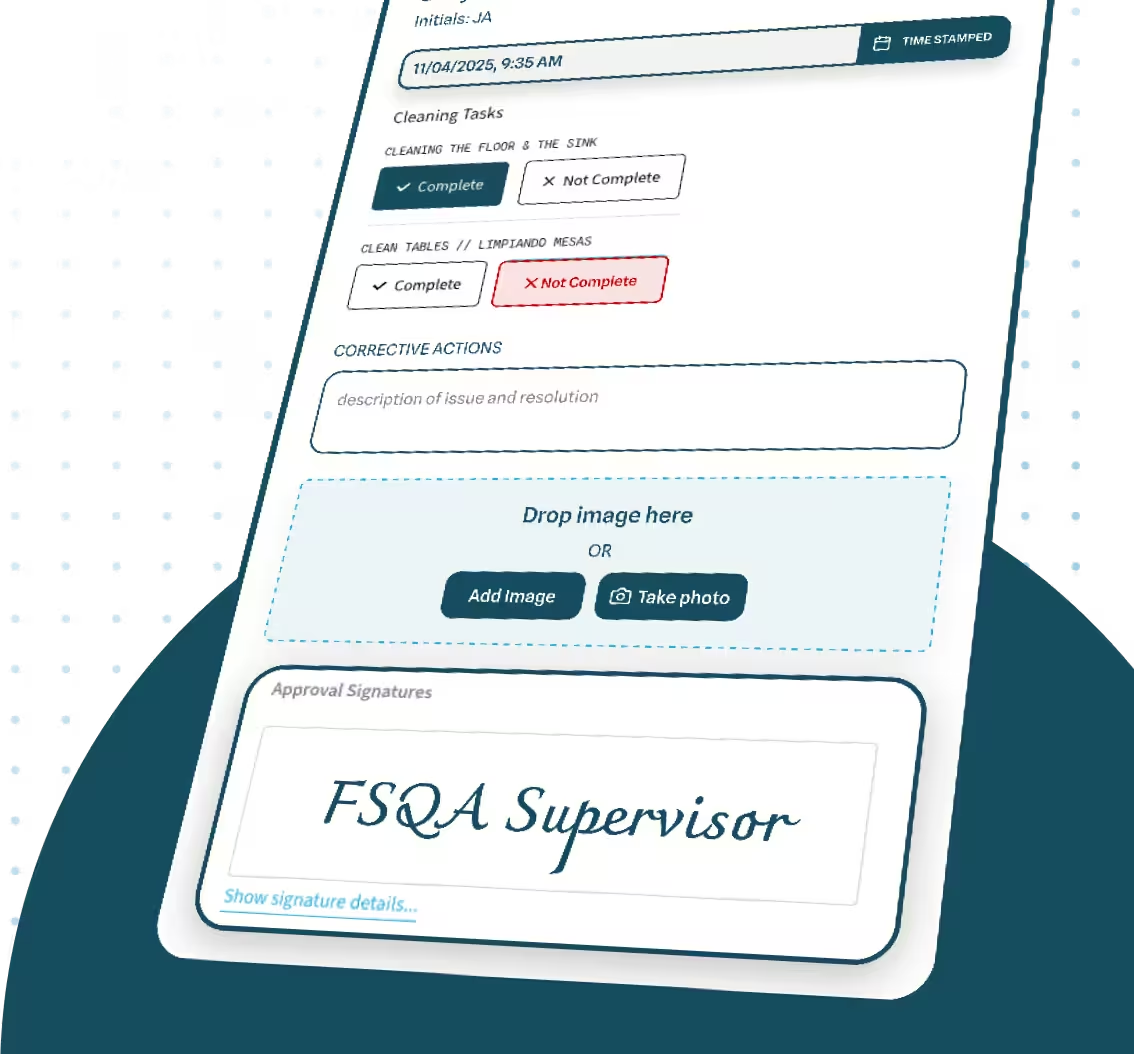
Getting ready for your next SQF, BRCGS, or FSMA audit? Allera gives your QA team the tools to build a compliant, documented ATP testing program, without the spreadsheets. Book a 30-Minute Demo
How to Build an ATP Testing Program for Your Facility
If you are formalizing an informal program or starting from scratch, this six-step framework covers what you need to put a documented, audit-ready ATP program in place.
Step 1: Map Your Facility and Assign Zones
Start with a facility floor plan. Walk every production area and identify all surfaces you will include in your program. Label each test site on the floor plan with a unique identifier and assign it to Zone 1 through 4 based on its proximity to food.
Prioritize Zone 1 sites. These are non-negotiable. Zone 2 through 4 sites expand your program's depth and provide the trending data that satisfies auditor expectations for a risk-based environmental monitoring approach. Your GMP sanitation requirements documentation should align with the zone designations you assign.
Step 2: Select Equipment and Standardize
Choose one ATP luminometer system and use it consistently across your entire facility. Mixing brands creates incompatible data sets. Your thresholds will be validated for one system, and results from a different brand will not be comparable.
Assign swab storage to a named responsible person and document the storage requirements in your SOP. Damaged or improperly stored swabs are one of the most common sources of unreliable ATP data, and the error is nearly invisible in the results. A false-pass reading looks identical to a true pass.
Step 3: Establish and Document Your Thresholds
Run the baseline data collection process described above before finalizing your pass/caution/fail thresholds. Collect a minimum of 6 to 10 data points per surface type after verified cleaning. Calculate your 95th-percentile pass threshold and set your caution and fail tiers from there.
Document the thresholds in your sanitation SOP and in your recording system. If you use food quality management software to manage sanitation records, configure the threshold values per site so results are automatically flagged for action. If you use paper logs or spreadsheets, print the thresholds on every recording sheet so operators do not need to look them up separately.
Step 4: Define Frequency and Responsibility
Assign a testing frequency and a named operator to each test site:
- Zone 1 (food-contact surfaces): Daily, pre-operational, by sanitation or production staff before the first production run
- Zone 2 (production-adjacent, non-contact surfaces): Weekly, by the sanitation team or QA technician
- Zone 3 (more distant, non-contact surfaces): Monthly, as part of environmental monitoring trending
- Zone 4 (remote areas): Quarterly, per your FSMS schedule or program requirements
When auditors review your records, they look at completion rates across all assigned sites. Consistent gaps in specific locations, particularly Zone 1 sites, are a finding waiting to happen.
Step 5: Corrective Action Protocol
Every out-of-range result needs a documented response. Write your corrective action protocol into your sanitation SOP before your program launches so operators know exactly what to do when a result falls outside the pass range.
- Caution result: Re-clean the affected surface using the standard sanitation procedure. Retest before releasing for production. Document the original result, the re-clean, and the retest outcome.
- Fail result: Stop production for the affected line or area. Re-clean, retest, and document a formal non-conformance with root cause identified and corrective action closed out. Retain the corrective action record with your ATP log.
- Recurring fails at the same site: Trigger a root-cause investigation. Common causes include biofilm buildup, equipment damage creating harborage points, inadequate cleaning chemical concentration, or insufficient chemical contact time. Review your HACCP principles and sanitation documentation to ensure your corrective action process aligns with your HACCP prerequisite program requirements.
For guidance on how corrective action documentation integrates with your broader program, see our guide on how to build a HACCP plan.
Step 6: Trend Your Data
Raw ATP results tell you whether a surface passed today. Trended ATP results tell you whether your cleaning program is working over time. Review your data monthly or quarterly to identify patterns: sites that are gradually degrading, individual cleaners whose results are consistently better or worse than the team average, and equipment areas where post-cleaning ATP never quite reaches the pass threshold.
Trending catches problems before they become audit findings or, worse, food safety incidents. Sites with degrading performance should trigger a deep cleaning review or equipment inspection. Sites with consistently excellent performance can inform decisions about cleaning frequency adjustments.
Retain all ATP records for a minimum of two years to meet FSMA §117.190 record retention requirements. Your food quality management software should make historical record retrieval straightforward for auditors and make trend visualization accessible without building custom spreadsheet formulas.
Understanding how ATP data integrates with your food safety audit preparation process, and what auditors specifically request when they review sanitation monitoring records, will help you structure your program to be both operationally effective and audit-ready from day one.
FAQs

.avif)
.avif)
.avif)
.avif)
%20(1).avif)
.avif)
.avif)

%20(1).png)

.avif)


.avif)