.avif)



Master Sanitation Schedules | Full Guide with Examples

.avif)
Sanitation records are among the first things auditors pull during an SQF, BRCGS, or FDA inspection. Your master sanitation schedule (MSS) is the document that either proves your program is systematic and risk-based, or exposes it as a spreadsheet updated once a year and filed away. Most food manufacturers know they need one. Far fewer understand what a defensible one actually looks like under audit scrutiny.
This guide covers what an MSS must contain under each major standard, how to classify tasks across the three frequency tiers, how to set and validate cleaning frequencies, how MSS requirements differ across FSMA, SQF, BRCGS, and FSSC 22000, and how digital systems are replacing the spreadsheet approach. If you're building your MSS from scratch or auditing an existing one against a certification standard, this is the reference you need.
Your MSS sits within your prerequisite programs framework. It is one of the core PRPs that every GFSI-benchmarked scheme and FSMA both require in written, verified form. For the full picture of the program your MSS lives inside, see our guide to cleaning and sanitation in the food industry. Start there if you need context on how the MSS connects to your broader sanitation and food safety program.
What Is a Master Sanitation Schedule?
MSS Definition
A master sanitation schedule is a documented, facility-wide schedule that identifies every area and piece of equipment to be cleaned, specifies the frequency of each cleaning task, names the responsible person or role, and references the method or procedure to follow. It covers periodic and less-than-daily tasks that fall outside the scope of routine daily pre-op and post-op cleaning.
The MSS is a mandatory prerequisite program under GMP frameworks, FSMA sanitation controls, and every GFSI-benchmarked certification scheme. It is the primary document auditors use to assess whether your sanitation system is risk-based, complete, and consistently executed. The Codex Alimentarius General Principles of Food Hygiene (CXC 1-1969) establishes cleaning and disinfection as a foundational hygiene principle that all major food safety standards reference. The FAO's Introduction to Good Hygiene Practices reinforces that effective cleaning programs are non-negotiable at every stage of food production.
Your food safety management system connects the MSS to the broader set of controls that protect food safety, from hazard analysis through corrective actions and verification activities.
MSS vs. Daily Cleaning SSOPs: What's the Difference?
Daily sanitation standard operating procedures (SSOPs) govern pre-operational and post-operational cleaning of food-contact surfaces. These run every production day, are documented separately, and are typically monitored through pre-op inspections with pass/fail records. The MSS is everything beyond that scope.
The MSS picks up where daily SSOPs stop. It schedules cleaning for equipment internals that cannot be reached during normal post-op cleaning, facility structures like overhead pipes and drains, and areas that require periodic deep cleaning rather than daily attention. Both documents are necessary and they must be consistent with each other. No surface should fall through the gap between them.
Where daily SSOPs answer "what gets cleaned every day," the MSS answers "what gets cleaned and when for everything else." Auditors review both documents together, and gaps between them (areas covered by neither) are among the most common sanitation observations. A robust MSS treats daily SSOPs as the floor, not the ceiling, of your sanitation program.
The Four Required Elements of a Master Sanitation Schedule
Every MSS, regardless of which standard applies to your facility, must contain four core elements. AIB International identifies these as the foundational components that define a credible and auditable master cleaning schedule. Get these right and you have the structure; everything else builds on top.
1. Area or equipment to be cleaned
Every zone, surface, and piece of equipment in your facility must appear somewhere in the MSS. Production lines, packaging equipment, ingredient receiving areas, dry and cold storage, utility rooms, welfare areas, and facility infrastructure all belong here. "As needed" entries are not acceptable; if something gets cleaned, it belongs in the schedule with a defined frequency.
A complete MSS leaves no ambiguity about coverage. If an auditor can walk your facility and identify areas or equipment not represented in your MSS, that is a non-conformity. The walk-through step later in this guide explains how to build the inventory systematically so nothing gets missed.
2. Cleaning frequency
Each item must have an explicitly stated frequency: daily, weekly, bi-weekly, monthly, quarterly, semi-annually, or annually. The frequency must be risk-based and it must reflect the actual operational risk of that surface or piece of equipment, not just what is convenient to schedule. Frequency-setting is covered in detail in the step-by-step build section, including how to document your risk rationale.
Never use "as needed" as a frequency. Assign a defined maximum interval even for items cleaned infrequently. If the interval is questioned in an audit, you need to be able to point to the risk factors that justify it.
3. Responsible party
The MSS must name a specific role or individual for each cleaning task, not a generic "sanitation team" or "maintenance department." Role-based assignment works well. For example: "Sanitation Lead, Line 3" or "Facilities Maintenance Technician." It survives personnel turnover without requiring the MSS to be updated every time someone changes roles. Accountability must be traceable from the schedule through to the completion record.
When an auditor asks who was responsible for cleaning a specific piece of equipment on a given date, the MSS and the completion records together should give a clear, immediate answer. Vague or missing role assignments are one of the most common gaps auditors find.
4. Method or SSOP reference
Each MSS line item must reference the specific SSOP or work instruction that defines the cleaning method: chemical products, concentrations, contact times, rinsing procedures, and required PPE. Without this link, the schedule tells you that something was cleaned but not how, and "how" is what determines whether the cleaning was effective.
A fifth element worth including proactively: a sign-off or verification column confirming that each scheduled task was completed on the scheduled date and verified by a supervisor. BRCGS Issue 9 auditors look specifically for this evidence. Including it from the start is best practice regardless of which standard applies.
These four elements connect directly to the HACCP principles that underpin all food safety programs, specifically the prerequisite programs that control the production environment before HACCP critical control points become relevant.
The Three-Tier MSS Classification (Routine, PEC, PIC)
One of the most significant gaps in how food manufacturers document their sanitation programs is the failure to classify tasks by frequency tier. The FSMA Preventive Controls framework and USDA FSIS guidance distinguish between three categories of sanitation activity. Understanding this structure gives you the framework to set defensible frequencies, allocate sanitation resources correctly, and explain the risk rationale to auditors in terms they recognise.
Routine Daily Cleaning
Routine daily cleaning covers pre-operational and post-operational sanitation of food-contact surfaces in active daily use. These tasks run every production day, are governed by your daily SSOPs, and are monitored through pre-op inspections with documented pass/fail results. The MSS references that daily SSOPs exist but does not replace them.
The key point for your MSS is consistency: surfaces covered by daily SSOPs should not also appear in the MSS with a separate "daily" entry that creates duplicate or conflicting records. The MSS picks up periodic tasks; daily SSOPs own the daily tasks. Auditors who see the same surface addressed twice with different procedures will ask why, and you need a clear answer.
Periodic Equipment Cleaning (PEC)
Periodic Equipment Cleaning covers teardown cleaning of equipment that cannot be fully cleaned during routine daily operations. Think internal conveyor components, filler heads, pump internals, blenders, grinders, slicers, and any equipment with hard-to-access surfaces that accumulate residue over multiple production runs. These tasks require disassembly, typically take hours, and must occur during a scheduled production shutdown rather than mid-run.
Frequency for PEC tasks is driven by risk: product type (RTE versus raw), production volume, allergen changeover requirements, and environmental monitoring program (EMP) results from the surrounding zone. For meat and poultry processors, USDA FSIS Directive 5000.5 provides explicit requirements for documenting and verifying less-than-daily sanitation procedures for equipment in this category. Even if your facility is not subject to FSIS, Directive 5000.5 is a valuable benchmark for what regulators consider acceptable justification for extended cleaning intervals on food-contact equipment.
Never assign a PEC frequency without documented risk justification. If an EMP positive occurs in the zone served by that equipment, the frequency must be reviewed and potentially shortened, and your corrective action record must reflect that decision and the re-validation that follows.
Periodic Infrastructure Cleaning (PIC)
Periodic Infrastructure Cleaning covers facility structures: ceilings, overhead pipes and conduits, HVAC components and ventilation screens, light fixtures, floor drains, walls and corners, loading dock areas, and cold storage units. These areas accumulate contamination more slowly than food-contact equipment, but they represent significant cross-contamination vectors (particularly for Listeria monocytogenes in low-moisture or RTE environments) if neglected.
PIC tasks are typically scheduled monthly to annually depending on the zone and risk level. They often require production stoppage or facility shutdown windows, so they should be planned alongside maintenance schedules and seasonal production calendars. A drain on your MSS for quarterly cleaning that has missed its window three times in a row is precisely the kind of pattern that becomes a major non-conformity. Missed PIC tasks also tend to compound: a drain that wasn't cleaned on schedule becomes a higher-risk drain at the next scheduled interval.
| Tier | Scope | Typical Frequency | Trigger for Review |
|---|---|---|---|
| Routine (daily SSOPs) | Food-contact surfaces in daily use | Daily (pre-op / post-op / mid-shift) | Any sanitation failure or positive environmental test |
| Periodic Equipment Cleaning (PEC) | Hard-to-access equipment internals | Weekly–Monthly | EMP positive, product changeover, allergen change, new equipment |
| Periodic Infrastructure Cleaning (PIC) | Facility structures, drains, overhead | Monthly–Annual | Scheduled interval; pest activity; facility modification |
Your food safety plan should incorporate MSS tasks as part of the broader sanitation controls documented at the preventive controls level, particularly for FSMA-regulated facilities where sanitation controls are a named preventive control category.
Building Your Master Sanitation Schedule: Step by Step
Most MSS guides offer generic steps: assess your facility, assign responsibilities, and set a schedule. That approach produces a document, but not necessarily a defensible one. What follows connects each step to what auditors actually review, what regulations actually require, and what the output needs to look like at the end of the process.
Step 1: Conduct a Facility Walk-Through and Build Your Equipment Inventory
Start with a physical walk-through of the entire facility, not a review of previous records or the last version of the MSS. Walk every zone: production areas, packaging lines, ingredient receiving, dry and cold storage, utilities rooms, waste handling and disposal areas, locker rooms and welfare facilities, and all external access points including loading docks and external drainage.
Document every piece of equipment, every surface, and every structural area that requires cleaning. Group your inventory by zone using a consistent naming convention (Zone A: Production, Zone B: Packaging, Zone C: Cold Storage, Zone D: Utilities, and so on). Color-coded facility maps work particularly well for communicating zone boundaries and cleaning responsibilities to sanitation team leads in large or multi-building facilities. A zone map also makes a strong visual exhibit during an audit, demonstrating that your program is spatially comprehensive.
Do not build your MSS from someone else's template. Templates are useful as formatting references, but your MSS must reflect your specific facility layout, your specific equipment inventory, and your specific risk profile. An auditor who identifies equipment or areas in the facility that don't appear anywhere in the MSS will note it as a gap, and rightly so.
Step 2: Assign Cleaning Categories (Routine / PEC / PIC)
Review every item in your equipment inventory and classify it as Routine, PEC, or PIC using the tier framework described above. For equipment that appears in both daily SSOPs (e.g., the exterior belt surface of a conveyor) and the MSS (e.g., the internal belt support structures and undercarriage of that same conveyor), document both clearly and ensure the daily SSOP and the MSS line item cross-reference each other.
Consult equipment manufacturer manuals during this step. Manufacturers typically specify recommended cleaning frequencies, compatible chemical classes, disassembly procedures, and surfaces requiring particular attention. Using manufacturer recommendations as your baseline and then adjusting upward based on your specific risk factors gives you defensible documentation if a frequency is challenged during an audit. Keep copies of the relevant manual excerpts in your SSOP files and reference them when the frequency rationale is documented.
Step 3: Establish Risk-Based Frequencies
Frequency-setting is the step most facilities handle poorly. The tendency is to default to round numbers: weekly, monthly, without connecting them to a risk rationale. Auditors who probe this will ask: "How did you determine that monthly is the right frequency for this piece of equipment?" You need a documented answer that references the actual risk factors you assessed.
The key risk factors to evaluate for each MSS item:
- Food-contact vs. non-food-contact surface: food-contact surfaces require higher frequency and more rigorous validation
- Product type: RTE products require higher sanitation rigor than raw product processing environments
- Allergen risk: equipment used across different allergen profiles may require more frequent cleaning or allergen-specific changeover procedures
- Environmental monitoring history: a zone with a history of EMP positives warrants higher frequency than a clean zone
- Production throughput: higher production volume accelerates contamination accumulation
- Accessibility for inspection: equipment you cannot visually inspect between cleanings needs a frequency short enough that contamination cannot accumulate undetected
Never use "as needed" for any item. Define a maximum interval even for infrequently cleaned infrastructure. The FSMA Preventive Controls for Human Food final rule requires sanitation controls to be risk-based and includes monitoring and verification requirements that only function if cleaning intervals are explicitly defined. A vague frequency makes monitoring and verification impossible.
Your Good Manufacturing Practices (GMPs) provide the regulatory floor for what must be cleaned and at what minimum standard. A risk-based approach to frequency-setting goes beyond the GMP minimum and produces a more defensible, auditable document.
Step 4: Reference Your SSOPs (or Create Them)
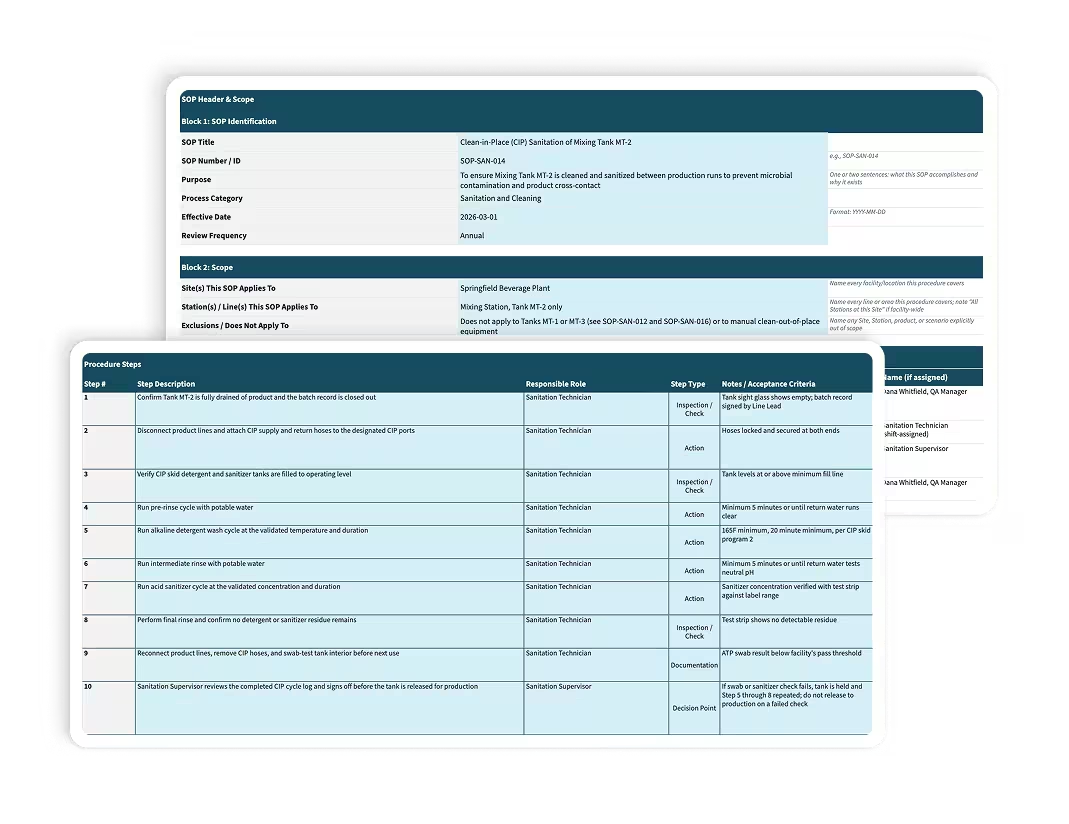
Every MSS line item must link to a specific SSOP or work instruction that defines the cleaning method: which chemicals to use, at what concentrations, with what contact time, what rinsing procedure follows, and what PPE is required. If an SSOP does not exist for a particular area or piece of equipment, write one before adding that item to the MSS schedule.
A common audit finding is an MSS that schedules cleaning for an area but has no corresponding procedure document. This creates a gap between what the schedule says should happen and what the sanitation team actually knows to do. It also raises questions about training: if there is no procedure, how were employees trained, and what exactly did they do? Strong document control ensures your SSOPs are version-controlled, accessible to the people performing the work, and linked clearly to the MSS line items they govern.
When an SSOP is updated (new chemical supplier, changed concentration, updated PPE requirement), the version control record should capture the change date and the reason. Auditors reviewing validation records will check whether the SSOP in effect on a given date matches the procedure that was validated.
Step 5: Assign Responsible Parties and Sign-Off Procedures
Name a specific role for each MSS task. Role-based assignment (e.g., "Sanitation Lead, Zone B" or "Facilities Maintenance Technician") is more sustainable than naming individuals, because it survives turnover without requiring constant MSS updates. What matters is that accountability is traceable from the schedule to the completion record and from the completion record back to the individual who performed the work.
Build in two levels of sign-off: employee completion sign-off and supervisor verification sign-off. These are distinct activities. Employee sign-off confirms the task was completed. Supervisor verification confirms the output met standards, typically through a visual inspection, ATP test result, or pre-op check. Both records matter in an audit and both should be retained as part of your MSS completion record file. BRCGS Clause 4.11 specifically looks for evidence of both performance and verification.
Step 6: Build the Schedule Document and Communicate It
The MSS document itself should be readable as a calendar-style view, organized by zone. A monthly grid (rows for tasks, columns for weeks or specific dates, cells for completion sign-off) is typically the most practical format for both the sanitation team using it daily and the auditor reviewing it quarterly. Whatever format you choose, it must be legible, complete, and version-controlled.
Post physical copies in relevant work areas or provide digital access via a tablet or terminal. The schedule must be accessible to the people who are responsible for executing it, not filed in a QA office binder. An MSS that no one on the sanitation team has seen is not a functioning sanitation program.
Once built, communicate the schedule to sanitation team leads, production supervisors, and facility management. Walk team leads through the schedule during onboarding and when the MSS is updated. Your food quality management software can automate this communication, but the underlying requirement stands: the people doing the work need to know what the schedule requires of them, regardless of the tool.
MSS Compliance Across GFSI Standards: Side-by-Side Comparison
This is the section every certified food manufacturer needs and cannot find in a single place anywhere else in this topic area. If your facility holds or pursues multiple GFSI certifications, or operates under FSMA while targeting SQF or BRCGS certification, the table below maps the exact clause-level requirements across all major schemes.
| Standard | Relevant Clause | What Is Required |
|---|---|---|
| FSMA (21 CFR § 117) | Subpart C: Sanitation Controls | Written procedures, monitoring, corrective action, and verification for sanitation controls in the food safety plan |
| SQF Code (Ed. 9 / Ed. 10) | Element 11.2: Cleaning and Sanitation | Documented master cleaning schedule; cleaning and sanitizing procedures; effectiveness verification; records of completion |
| BRCGS Food Safety (Issue 9) | Clause 4.11: Housekeeping and Hygiene | Master cleaning schedule covering all areas, equipment, and utensils; cleaning frequencies; methods; sign-off records |
| FSSC 22000 (Version 6) | ISO/TS 22002-1, §11: Cleaning and Disinfecting | Written cleaning and disinfection procedures for all surfaces; monitoring of effectiveness; PRP documentation |
| ISO 22000:2018 | Clause 8.2: PRPs | PRPs must cover cleaning and disinfection; documented, monitored, and verified |
FSMA-Specific MSS Requirements
Under FSMA's Preventive Controls for Human Food rule (21 CFR Part 117, Subpart C), sanitation controls are a distinct named category of preventive control. Your MSS is the primary evidence document for this category. The rule requires written sanitation procedures that address food-contact surfaces, equipment used in manufacturing and processing, allergen cross-contact prevention, and employee hygiene practices.
Monitoring, corrective action, and verification records must accompany your written procedures. Your MSS completion logs, ATP testing results, pre-op inspection records, and any corrective actions taken for missed or failed cleanings all form part of your FSMA sanitation controls compliance record. The FDA draft guidance on sanitation programs for low-moisture RTE foods provides additional direction on documenting and validating sanitation controls for high-risk product categories, including how to establish and justify cleaning frequencies for pathogen-sensitive environments.
SQF Edition 10: What's Changing for Sanitation Documentation
SQF Code Edition 10 is rolling out through 2025 and 2026, and it introduces enhanced verification requirements for cleaning effectiveness. Facilities certified under Edition 9 should review the changes to Element 11.2 carefully. The updated code places greater emphasis on demonstrating that your cleaning procedures actually achieve the intended sanitation outcome, not just that tasks were completed on schedule.
The SQFI SQF Fundamentals for Manufacturing documentation outlines the current code requirements at the element level. Your SQF code requirements guide covers the full SQF certification framework if you need context on how Element 11.2 sits within the broader SQF program. When preparing for an SQF audit, also review your SQF audit checklist to confirm your MSS records meet what auditors will specifically request.
BRCGS Issue 9: Sanitation Requirements
BRCGS Global Standard for Food Safety Issue 9, Clause 4.11, explicitly names a master cleaning schedule as a required document. This is one of the most specific MSS references in any GFSI scheme. The standard uses the term "master cleaning schedule" by name and requires it to cover all areas of the site, all equipment, and all utensils.
BRCGS auditors conducting a BRCGS certification assessment review four things against your MSS in particular: that the schedule is complete with no areas or equipment missing, that sign-off records exist for all scheduled tasks across the audit period, that the chemicals used in each procedure have approval documentation (safety data sheets and food-grade or food-safe approval), and that ATP or microbiological verification results are on file. A common observation in BRCGS audits is an MSS that covers production and packaging areas thoroughly but has gaps in utility areas, welfare facilities, and external access points. The standard requires coverage of the entire site. Review the BRCGS Global Standard for Food Safety (Issue 9) for the full clause text and audit criteria.
FSSC 22000 Version 6: Cleaning and Disinfection PRP Requirements
FSSC 22000 Version 6 uses ISO/TS 22002-1 Section 11 as its cleaning and disinfection PRP standard. The requirements cover written procedures for all surfaces, monitoring of cleaning effectiveness, and (where applicable) documented Clean-In-Place (CIP) programs with verified parameters including temperature, flow rate, chemical concentration, and cycle time.
The FSSC 22000 Version 6 scheme documents are published at FSSC 22000 Version 6 Scheme Documents. For multi-scheme facilities, the FSSC 22000 PRP requirements are broadly compatible with what you'll build for SQF and BRCGS, but the specific clause references, audit evidence expectations, and terminology differ. Do not assume that satisfying one scheme's documentation requirements automatically satisfies another's. Cross-reference each clause before your certification audit.
How to Validate Your Master Sanitation Schedule
Validation is the step that separates a compliance document from a food safety tool. Most facilities have an MSS. Far fewer have documented evidence that their cleaning procedures (at the frequencies assigned) actually achieve the sanitation outcome they are intended to deliver. This is where programs that look good on paper diverge from programs that would survive a product recall investigation.
What "Validation" Means for an MSS (and Why Auditors Ask for It)
Validation confirms that your chosen cleaning method at the assigned frequency achieves the intended sanitation outcome: the surface is actually clean and microbiologically safe after the procedure is executed correctly. This is distinct from monitoring (tracking whether the task was completed on schedule) and verification (checking whether a completed task achieved the required standard on a given day).
All three activities are required under FSMA and every GFSI scheme. Validation is the foundational science: you collected data to demonstrate that your procedure works when followed as written. Monitoring is the ongoing execution check. Verification is the ongoing outcome check. Auditors ask about validation because it is the element most facilities cannot document. They can show the schedule and the sign-off logs, but they cannot show the evidence base that justifies the cleaning method and frequency in the first place.
A missing validation record for your MSS is not just a documentation gap; it is a signal that your cleaning frequencies may be arbitrary rather than risk-based. That is a significant finding under any GFSI standard.
The Validation Process
Effective MSS validation follows a structured process tied to the specific cleaning tasks and surfaces you are validating. For new procedures or newly scheduled equipment, work through this sequence before relying on the schedule as your primary sanitation control.
Pre-cleaning baseline swabs: Before validating a cleaning procedure or frequency, take baseline swabs of the surfaces in question at the end of a production run to document the contamination load at the start of a cleaning cycle. This gives you a measurable reference point for how much contamination the procedure needs to address.
Post-cleaning ATP bioluminescence testing: ATP testing measures residual organic material on a surface after cleaning by detecting adenosine triphosphate present in biological residue. The CHAT framework (Chemical concentration, Heat, Agitation, Time) identifies the four variables that determine cleaning effectiveness for a given procedure. If you change any of these variables (new chemical supplier, different water temperature, shortened contact time), your existing validation may no longer apply and re-validation is required. Set pass/fail ATP thresholds based on surface type and food-contact status. Food Safety Magazine's Sanitation Controls Practitioner Program overview provides detailed guidance on structuring sanitation control validation protocols.
Microbiological swabbing: For RTE environments and zones with elevated pathogen risk, add microbiological swabbing (for indicator organisms like Enterobacteriaceae or, where your HACCP plan identifies the need, Listeria spp.) to confirm that ATP pass results correlate with actual pathogen reduction. ATP tests detect organic residue, but a low ATP reading does not automatically confirm the absence of viable pathogenic organisms. Micro swabbing provides the additional layer of evidence that risk-sensitive environments require.
Corrective action triggers: Define in advance what happens when a surface fails ATP or microbiological testing after cleaning. Your corrective action procedure should include: immediate re-cleaning of the affected surface, root cause investigation (was the SSOP followed? Was the chemical at the correct concentration? Was contact time sufficient?), documentation of findings and resolution, and a determination of whether the failure requires re-validation or frequency adjustment.
When to Re-Validate Frequencies
Validation is not a one-time exercise conducted at program launch and then filed permanently. A set of events should trigger re-evaluation and re-validation of relevant MSS frequencies:
- A positive environmental monitoring result in a zone served by the MSS item in question
- Equipment modifications, replacements, or new installations that change the surface geometry or material
- Changes in sanitation chemicals or methods: new supplier, reformulated product, changed concentration or contact time
- Any food safety incident linked to sanitation failure in the affected area
- Changes in production volumes, product types, or allergen programs that materially alter the contamination risk profile of a zone
- Annual MSS review, at minimum, even in the absence of the triggers above
Your GMP audit checklist covers the documentation that auditors will request when assessing your sanitation validation records, including whether re-validation was triggered and documented following relevant events. A food safety audit that finds no re-validation records despite a documented EMP positive in the same zone will treat that gap as a significant finding.
Managing Your MSS Digitally: From Spreadsheet to System
The way most facilities manage their MSS creates operational risk that the MSS is designed to eliminate. Static spreadsheets and paper completion logs are workable at small scale, but they introduce gaps that compound as your facility grows, your certification scope expands, and your audit frequency increases.
The Problem with Static MSS Spreadsheets
The version control problem alone is significant. When your MSS lives in a shared Excel file, there is always a question of which copy is current. Facilities that have added equipment, changed layouts, or updated chemical programs often find their MSS hasn't been updated to reflect those changes. The schedule still references the old filling line with the monthly teardown requirement. The new filling line that replaced it three months ago has no entry anywhere in the document.
The completion record problem is different but equally disruptive at audit time. When an auditor asks for all MSS completion records for a specific zone over the past six months, the answer should take minutes. Manual paper systems typically require someone to locate the right binder, find the right section, scan the relevant pages, and verify that nothing was misfiled. That process under audit conditions generates the impression of disorganization even when the underlying program is solid. The appearance of poor record management can color how an auditor views the rest of your program.
Scattered records also make trend analysis nearly impossible. Identifying that a particular piece of equipment has missed its scheduled cleaning three times in the past year and using that pattern to adjust frequency or assign a root cause requires pulling records from multiple months and cross-referencing them manually. Most facilities do not have the bandwidth to do this routinely, which means recurring issues go undetected until an auditor or an incident forces the review. The food safety software landscape has matured to address exactly this kind of operational gap.
What a Digital MSS System Should Do
A purpose-built digital MSS system should do more than replicate a spreadsheet on a screen. For facilities managing HACCP and sanitation compliance together, HACCP compliance software platforms often integrate MSS management with corrective action tracking, training records, and audit documentation in a single system. The specific capabilities that matter for food manufacturers operating under GFSI certifications or FSMA:
Automated task scheduling: The system should auto-schedule recurring tasks based on the frequencies you define. When a monthly task is completed and signed off, the next instance appears on the calendar automatically. Sanitation leads receive reminders ahead of due dates. Overdue tasks trigger alerts to supervisors. Nothing falls through because someone forgot to advance the spreadsheet or check the binder.
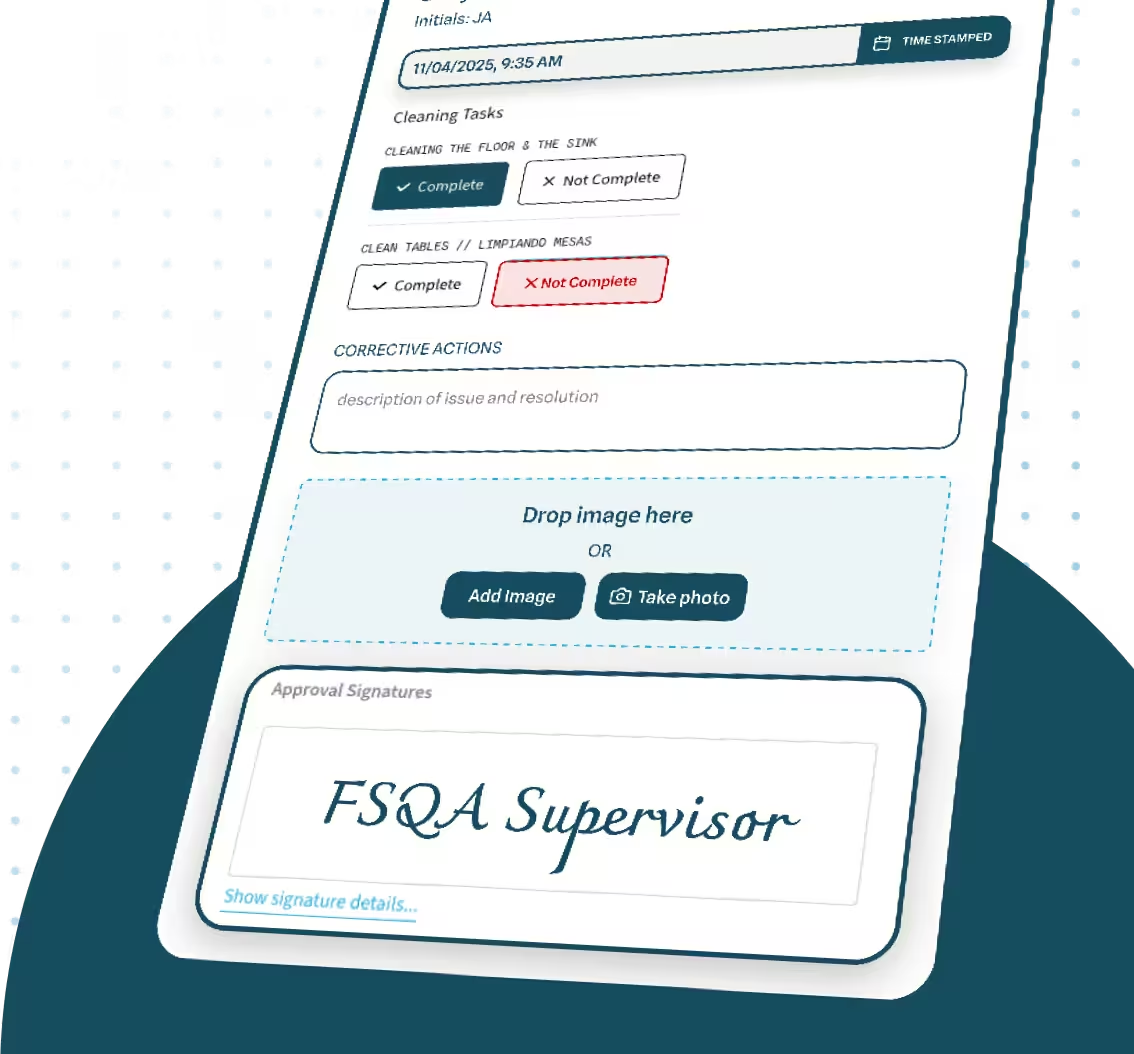
Mobile sign-off with timestamps: Sanitation team leads should be able to sign off on tasks from a mobile device at the point of completion. Each sign-off should be time-stamped and user-identified, automatically creating the two-level record (employee completion, supervisor verification) that auditors expect without requiring anyone to carry paper forms to a filing cabinet.
SSOP linking: Each MSS line item should link directly to the current version of the SSOP that governs it. When the SSOP is updated (new chemical, revised contact time, updated PPE requirement), the link in the MSS points to the new version automatically, and the version history is retained. There is no question about which procedure was in effect on a given date.
Real-time completion tracking and exception alerts: Supervisors should see at a glance which scheduled tasks are complete, in progress, or overdue for any zone and any date range. Exception alerts for missed tasks enable correction before the interval lapses completely, supporting proactive management rather than reactive corrective action.
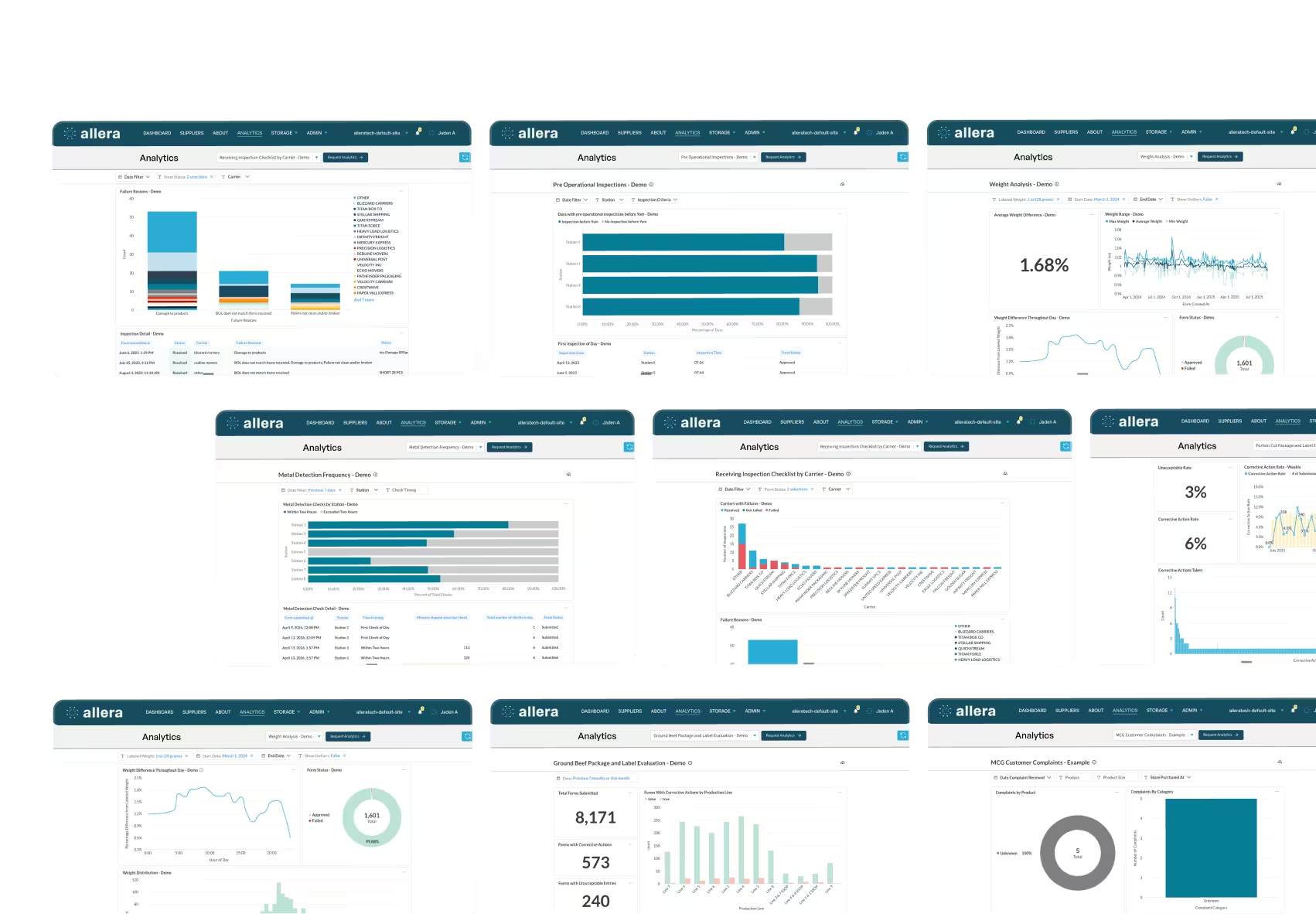
Exportable audit trail: When an auditor requests MSS completion records for a specific zone and date range, the system should export a clean, formatted report in under five minutes. The report should show the task, the scheduled date, the completion date, the sign-off user, and any notes or corrective actions attached. No binder archaeology, no photocopying, no hunting for misfiled forms.
Keeping MSS records inspection-ready across monitoring, corrective actions, verification, and training is a real operational challenge. See how Allera centralizes it.
FAQs
What is the 20/10 rule for cleaning?
The 20/10 rule is a time management concept sometimes applied to household or general facility cleaning: dedicate 20 minutes to cleaning and 10 minutes to organizing per session to build the habit gradually. It is not a food safety regulatory concept and has no application in food manufacturing compliance.
Cleaning frequencies in a food MSS must be risk-based, grounded in product type, allergen risk, environmental monitoring results, production volume, and regulatory requirements. Using a time-budget framework to set sanitation intervals is not defensible under FSMA, GMP standards, or any GFSI certification audit.
What are the four parts of a master cleaning schedule?
The four core parts are: (1) identification of the area or equipment to be cleaned, (2) the cleaning frequency, (3) the responsible party (named role or individual), and (4) the cleaning method or procedure reference (SSOP).
Some certification schemes, particularly BRCGS, also require a fifth element: documented sign-off and verification confirming that each scheduled task was completed and that the cleaning achieved the required standard.
What should a master cleaning schedule include?
At minimum, a master cleaning schedule must include: (1) the area or equipment to be cleaned, (2) the cleaning frequency, (3) the responsible employee or role, and (4) the method or SSOP reference defining chemicals, concentrations, contact times, and PPE.
Best practice also includes a sign-off and verification column confirming task completion and a supervisor verification record. BRCGS Issue 9 auditors look specifically for that fifth verification element, so including it from the start is worthwhile regardless of which standard applies to your facility.
What is a master cleaning schedule?
A master cleaning schedule (also called a master sanitation schedule or MSS) is a documented, facility-wide plan that identifies every area and piece of equipment in a food facility, defines how often each must be cleaned, assigns responsibility to a named role or individual, and references the procedure to follow.
It covers periodic and less-than-daily tasks that fall outside routine daily pre-op and post-op cleaning, and it is a required element of GMPs, FSMA sanitation controls, and all major GFSI certifications including SQF, BRCGS, and FSSC 22000. The MSS works alongside daily SSOPs (not in place of them) to ensure complete sanitation coverage across the facility.

.avif)
.avif)
.avif)
.avif)
%20(1).avif)

.avif)
.avif)

%20(1).png)

.avif)



.avif)