.avif)



Food Defense Plan for Food Manufacturers: Complete Compliance Guide


A food defense plan is a written document that identifies where your facility is most vulnerable to intentional contamination and describes the mitigation strategies, monitoring procedures, corrective actions, and verification activities in place to address those vulnerabilities. Under FDA's Intentional Adulteration Rule, it is a legal requirement for covered food facilities.
Unlike a food safety plan, which protects against accidental contamination, a food defense plan focuses on deliberate acts. Tampering, sabotage, and bioterrorism are the threats it addresses. As of April 2026, all compliance deadlines under the IA Rule have passed, including for very small businesses, making active FDA inspection a real risk for any facility that has not documented a compliant plan.
This guide covers all five required components, how to conduct a vulnerability assessment, the four security pillars auditors review, food defense requirements under SQF, BRCGS, and FSSC 22000, and the most common failures that trigger observations during FDA inspections.
What Is a Food Defense Plan?
A food defense plan is a written program that identifies a food facility's significant vulnerabilities to intentional contamination and documents the strategies used to minimize or prevent those vulnerabilities. It must cover your full production process from receiving through shipping and include written procedures for monitoring, corrective action, and verification.
The requirement comes from the FDA Food Defense program and the Intentional Adulteration Rule, finalized in 2016 as part of FSMA and codified at 21 CFR Part 121. The rule was designed to address threats intended to cause wide-scale harm to public health, not personal grievances or economic fraud. Those scenarios are addressed by separate programs.
A food defense plan is structured around five components: a vulnerability assessment, mitigation strategies, monitoring procedures, corrective actions, and verification procedures. Record-keeping ties all five together and is what FDA inspectors will examine first.
Who Needs a Food Defense Plan? (And Who Is Exempt?)
FDA IA Rule Coverage
The IA Rule applies to domestic and foreign food facilities required to register under Section 415 of the Federal Food, Drug, and Cosmetic Act. Very small businesses, defined as those with less than $10 million per year in average food sales adjusted for inflation, are exempt from the rule's requirements.
FDA phased in compliance dates by business size. Large businesses were required to comply by July 26, 2019. Small businesses with fewer than 500 full-time equivalent employees had until July 27, 2020. Very small businesses had a final compliance date that extended through April 2026. As of now, all covered facilities are expected to have a compliant food defense plan in place.
If your facility is registered with FDA and your annual food sales exceed the $10 million threshold, a written plan is required. That requirement is not contingent on whether FDA has inspected you yet.
USDA FSIS: Meat, Poultry, and Egg Products
USDA FSIS operates a parallel Functional Food Defense Plan framework for establishments it regulates. Unlike the FDA IA Rule, FSIS food defense plans are not mandated through parallel rulemaking, but FSIS strongly recommends them and evaluates their implementation during in-plant visits.
The FSIS framework uses a four-element approach: Develop, Implement, Test, and Review and Maintain. FSIS has published a standardized template (Form 5420-5) as a starting point, though facilities are not required to use it. Given that FSIS inspectors have continuous daily presence in many establishments, having a documented and practiced food defense program is a practical necessity regardless of the regulatory status.
GFSI-Certified Facilities
If your facility holds a GFSI-recognized certification, a food defense plan is mandatory regardless of your FDA IA Rule status. The GFSI Benchmarking Requirements include food defense as a required element across all recognized schemes, which means SQF, BRCGS, and FSSC 22000 all mandate a documented food defense program as a condition of certification.
This matters especially for smaller facilities that may be technically exempt from the FDA IA Rule but still pursue GFSI certification for customer requirements or retailer approvals. An exemption from the IA Rule does not exempt you from your certification scheme's food defense requirements.
Does your facility need a food defense plan? Ask three questions:
- Is your facility registered with FDA under Section 415 of the FD&C Act? If yes and your annual food sales exceed $10 million, the IA Rule applies.
- Do you process meat, poultry, or egg products under USDA FSIS oversight? FSIS food defense plans are strongly recommended.
- Do you hold or pursue SQF, BRCGS, or FSSC 22000 certification? A food defense plan is required by your scheme.
If any answer is yes, you need a documented food defense program.
Food Defense vs. Food Safety vs. Food Fraud Prevention
These three concepts overlap in ways that confuse even experienced FSQA professionals. Understanding the distinctions helps you assign the right resources, use the right methodology, and satisfy the right regulatory requirements.
| Dimension | Food Safety Plan | Food Defense Plan | Food Fraud Prevention |
|---|---|---|---|
| Threat type | Unintentional | Intentional (wide-scale harm) | Intentional (economic gain) |
| Regulatory driver | FSMA Preventive Controls | FSMA IA Rule / 21 CFR 121 | GFSI / BRCGS / SQF / ISO 22000 |
| Core methodology | Hazard Analysis (HACCP) | Vulnerability Assessment | VACCP / Food Fraud Assessment |
| Primary concern | Pathogen, allergen, CCP | Mass harm / terrorism | Economically motivated adulteration |
| Records required | Yes (21 CFR 117) | Yes (21 CFR 121) | Yes (SQF/BRCGS scheme) |
A food safety plan uses hazard analysis and HACCP principles to control biological, chemical, and physical hazards that enter the food supply accidentally. A food defense plan addresses deliberate tampering or contamination by actors trying to cause harm at scale. Food fraud prevention targets economically motivated adulteration, where a product is misrepresented or diluted for financial gain.
The three programs are not interchangeable, but they share infrastructure. Your food safety management system provides the documentation framework that all three programs run on. Many of the same personnel, records systems, and audit trails serve all three requirements simultaneously.
The 5 Required Components of a Food Defense Plan Under FSMA
The FSMA Intentional Adulteration Rule specifies five written components that every covered facility must maintain. Safe Food Alliance guidance provides practical context for how each requirement is applied.
1. Written Vulnerability Assessment
A vulnerability assessment is a systematic process to identify significant vulnerabilities at each step in your food manufacturing process. "Significant" means the combination of the severity of harm that could result from an attack and the likelihood that an actor could access that point to cause that harm.
The output of your vulnerability assessment is a list of Actionable Process Steps (APS). These are the specific points in your process where significant vulnerabilities exist and where mitigation strategies must be applied. Common examples include bulk liquid receiving docks, mixing and blending tanks, open-product conveyors, liquid storage tanks, and ready-to-eat finishing areas where product is exposed before final packaging.
You are also required to document your rationale for any step you determine is not an APS. FDA inspectors specifically look for this documentation, and steps you exclude need a written justification, not just a blank on the form.
2. Mitigation Strategies
Mitigation strategies are the measures you put in place to significantly minimize or prevent the significant vulnerabilities at each APS. They must be science-based, meaning you need a reasonable basis for believing they will work as intended.
FDA distinguishes between broad-based mitigation strategies that apply to the facility as a whole and element-specific strategies targeted to each APS. Examples by APS type include restricted access controls at bulk receiving stations, tamper-evident seals on liquid storage tanks, dedicated CCTV coverage in blending areas, and dual-authorization procedures for access to critical processing points.
Mitigation strategies are not the same as CCPs in a HACCP plan. They do not require the same critical limit framework, but they must be documented, implemented as written, and demonstrably effective.
3. Food Defense Monitoring Procedures
Monitoring procedures specify how each mitigation strategy is checked, how frequently, and by whom. These are scheduled checks to confirm that mitigation strategies are functioning as intended, not open-ended surveillance.
Your monitoring records should capture the date, time, location, name of the person performing the check, the observation made, and that person's signature. FDA will look for completed records during an inspection, not just the written procedures. A procedure that says "check bulk tank access controls daily" is useful only if signed monitoring records show it actually happening.
4. Corrective Action Procedures
When a mitigation strategy is not properly implemented, corrective action procedures define what happens next. These procedures must address two things: how you will handle any product that may have been affected during the period the strategy was not in place, and how you will identify and correct the root cause of the failure.
Corrective action records must be retained and must show evidence of closure. An open corrective action with no resolution is a finding waiting to happen during an inspection.
5. Verification Procedures
Verification confirms that your monitoring is occurring as planned and that your mitigation strategies remain effective. At minimum, verification should include a review of monitoring records for completeness and accuracy. Verification activities should be scheduled, assigned to a responsible individual, and documented.
Reanalysis of the full food defense plan is required at least every three years under the FDA IA Rule. It must also occur if you make significant changes to your facility or process, if new information about vulnerabilities becomes available, if a mitigation strategy is found to be inadequate, or following an actual food defense incident. GFSI certification schemes require annual reanalysis.
Record-Keeping Requirements
All food defense plan documents and associated records must be kept onsite or accessible from onsite. The retention period is two years from the date of creation. If FDA requests records during an inspection, you must produce them within 24 hours. This 24-hour production requirement has direct implications for how your records are organized and where they are stored. A paper binder in a locked office is not the same as records that can be retrieved on demand.
How to Conduct a Vulnerability Assessment
The vulnerability assessment is the foundation of your food defense plan. Getting it right determines whether your plan is genuinely protective or just paperwork that will not hold up under a comprehensive inspection.
Step 1: Assemble Your Food Defense Team
Your team should include representatives from QA and food safety, operations, security or facilities, procurement and supply chain, HR, and IT if you have digital access control systems. The team needs to cover the full range of your facility's operations, not just the production floor.
Appoint a Food Defense Coordinator who owns the vulnerability assessment process, maintains the plan, coordinates training, and serves as the primary contact during an FDA inspection. PCQI training programs offer coursework that covers food defense plan development alongside preventive controls content, which is useful if your food defense coordinator also manages your food safety plan.
Step 2: Map Your Process
Create a process flow diagram that covers every step from receiving through shipping. For each step, identify whether product is accessible, exposed, or partially exposed. Flag liquid handling, bulk receiving, open-processing points, and ready-to-eat stages as your highest-risk categories.
This step does not need to be elaborate. A clear, accurate process flow that your team agrees represents actual production is more useful than a detailed diagram that does not match what happens on the floor.
Step 3: Choose a Vulnerability Assessment Methodology
| Method | Best For | Who Accepts It |
|---|---|---|
| CARVER+Shock | Large facilities; broad process scope | FDA IA Rule |
| FDA Plan Builder | Any covered facility | FDA IA Rule |
| TACCP | UK / BRCGS-aligned operations | BRCGS, FSSC 22000 |
| VACCP | Food fraud and defense overlap | BRCGS, FSSC 22000, SQF |
| Hybrid / site-specific | Multi-standard compliance | SQF, BRCGS, FSSC 22000 |
CARVER+Shock evaluates each process step across six factors: Criticality, Accessibility, Recuperability, Vulnerability, Effect, Recognizability, and Shock value. It produces a numerical score for each step, which makes the rationale for APS identification and exclusion straightforward to document.
TACCP (Threat Analysis Critical Control Points) mirrors HACCP in structure but applies to intentional threats. If your facility already operates under a HACCP-based system, TACCP integrates naturally with your existing documentation framework.
The FDA Food Defense Plan Builder (FDPB) v2.0 is a free desktop tool that guides facilities step-by-step through a compliant vulnerability assessment and generates the written plan document. Use of the FDPB is not legally required, but it is accepted by FDA as sufficient to meet the IA Rule's requirements and is a practical starting point for facilities approaching food defense planning for the first time.
Step 4: Score Each Process Step and Identify APS
Apply your chosen methodology to each step in the process flow. Steps that score above your threshold under CARVER+Shock, or that qualify as significant vulnerabilities under your TACCP analysis, become your Actionable Process Steps. Document your scoring for every step, including those that do not qualify as APS. The written rationale for excluded steps is required by 21 CFR 121.130 and is one of the first things FDA inspectors ask for.
Step 5: Select Mitigation Strategies for Each APS
For each APS, select mitigation strategies from one or more of these categories:
- Physical security: restricted access doors, keycards, locks, security seals on tanks
- Monitoring technology: CCTV in critical areas, motion sensors, tamper-evident indicators
- Personnel controls: background screening procedures, buddy systems for access to bulk storage, authorization protocols for visitors and contractors
- Tamper-evident measures: seals on finished goods, traceable lot documentation
Choose strategies that are practical for your operation and that you can actually monitor. A mitigation strategy you cannot monitor consistently is a compliance liability, not a protection measure.
The Four Security Pillars of a Food Defense Plan
Whether your program is aligned to the FDA IA Rule, USDA FSIS functional framework, or a GFSI certification scheme, food defense auditors and inspectors evaluate your program across four categories. Knowing these categories helps you organize your plan in a way that auditors can follow and verify.
1. Outside Security Measures
Outside security addresses your facility's perimeter and the controls you use to manage who and what enters. This includes fencing, lighting, vehicle access controls, and gate procedures. Visitor management is a core element: your plan should define sign-in procedures, identification requirements, and escort policies for anyone who is not a regular employee.
Parking layout matters more than most facilities recognize. Visitor and contractor vehicles should be separated from employee parking, and neither should have uncontrolled proximity to loading docks or processing areas. Finished goods trucks leaving your facility should have security seals applied before departure and documented in your outbound shipping records.
2. Inside Security Measures
Inside security controls access to your processing areas and protects product and ingredients from tampering once materials are on-site. Key elements include restricted access controls using keycards or locks, secured storage for bulk ingredients and liquid tanks, and CCTV coverage of critical processing areas, receiving docks, and liquid storage.
Your water supply, if it is not a municipal connection, requires documented protection measures. Ingredients that could serve as a vehicle for adulteration, particularly liquids, need specific attention in your inside security controls and in your vulnerability assessment scoring.
3. Personnel Security Measures
Personnel security covers hiring, training, and ongoing vigilance regarding the people working in your facility. Your plan should define screening procedures for new hires, including background check policies, and address how temporary staff and contractors are managed differently from permanent employees.
Food defense training is required for all employees assigned to work at Actionable Process Steps and for their direct supervisors. This training must be documented with signed records that capture the training date, content covered, trainer name, and trainee signature. Awareness training for the broader workforce, covering how to recognize and reporting suspicious behavior, supports your insider threat posture. Building this into your food safety culture means security vigilance becomes a normal part of how your team works rather than an occasional reminder.
4. Incident Response and Recovery Procedures
Incident response procedures define what happens when a food defense event occurs or is suspected. Your plan must specify the internal notification chain, including who has the authority to initiate a product hold or withdrawal. It should also address your obligations to notify FDA in the event of a confirmed or suspected intentional adulteration incident.
Evidence preservation is a requirement that many facilities overlook until they need it. Your procedures should instruct staff not to disturb the scene of a suspected tampering event before authorities arrive. Post-incident, a formal reanalysis of your food defense plan is required. Strong food traceability records are essential at this stage, since lot identification for product hold or withdrawal decisions depends entirely on the quality of your traceability documentation.
Food Defense Plan Requirements by Certification Scheme
If your facility operates under a GFSI-recognized certification scheme, your food defense plan requirements extend beyond the FDA IA Rule. Each major scheme has its own specific requirements, and they differ in methodology expectations, review frequency, and documentation depth.
SQF Edition 9: Section 2.7
The SQF Edition 9 Food Defense Guidance Document requires a written food defense plan under Section 2.7. The plan must be based on a risk assessment of your site and cover facility security, access control, personnel security, and incident response.
SQF requires documented annual review of the food defense plan, with security inspection records maintained as evidence. The methodology is more flexible than BRCGS or FSSC 22000 in that SQF does not mandate a specific assessment framework, but the assessment must be documented and risk-based. SQF auditors will look for evidence that the review actually happened and that any identified gaps were addressed before the audit visit.
BRCGS Food Safety Issue 9: Clause 4.2
BRCGS food defence requirements under Issue 9 Clause 4.2 are more prescriptive. BRCGS requires a documented food defence risk/threat assessment procedure that uses a defined methodology. TACCP is the recommended approach, though CARVER+Shock is also accepted.
The BRCGS assessment must evaluate all three threat categories: fraudulent activities (economically motivated adulteration), sabotage, and terrorism. This three-category requirement makes BRCGS food defence more demanding than the FDA IA Rule, which focuses primarily on wide-scale harm scenarios. Your BRCGS certification audit will include a review of the threat assessment, the mitigation measures identified, and the monitoring and review documentation.
Annual review is required, and review must also be triggered by any significant change to your facility or process.
FSSC 22000 Version 6: Additional Requirements
FSSC 22000 Version 6 requires a documented food defense threat assessment using a defined methodology. Accepted methods include TACCP/PAS 96, CARVER+Shock, the FDA Food Defense Plan Builder, or a custom methodology that meets the standard's requirements.
FSSC 22000 requires a multidisciplinary team for the threat assessment, covering HR, security, QA, IT, production, and facility management. The risk matrix uses a likelihood-times-consequence scoring approach, similar to HACCP, making it compatible with your existing risk assessment documentation. Our FSSC 22000 Version 6 guide covers these additional requirements in more detail.
Cross-Standard Comparison
| Requirement | FDA IA Rule (21 CFR 121) | USDA FSIS Functional Plan | SQF Ed. 9 §2.7 | BRCGS Issue 9 §4.2 | FSSC 22000 V6 |
|---|---|---|---|---|---|
| Written plan required | Mandatory (covered facilities) | Recommended | Mandatory | Mandatory | Mandatory |
| Vulnerability/threat assessment | Mandatory | Recommended | Mandatory | Mandatory (TACCP) | Mandatory |
| Mitigation strategies | Mandatory (per APS) | Recommended | Mandatory | Mandatory | Mandatory |
| Monitoring procedures | Mandatory | Recommended | Mandatory | Mandatory | Mandatory |
| Corrective actions | Mandatory | Recommended | Mandatory | Mandatory | Mandatory |
| Verification | Mandatory | Recommended | Mandatory | Mandatory | Mandatory |
| Employee training | Mandatory (APS staff) | Recommended | Mandatory | Mandatory | Mandatory |
| Annual review | Min. every 3 years | At least annually | Annually | Annually | Annually |
| Record-keeping | Mandatory (2 years) | Recommended | Mandatory | Mandatory | Mandatory |
FDA Comprehensive Food Defense Inspections: What Auditors Review
From "Quick Check" to Full Compliance Inspections
FDA has transitioned from "Quick Check" food defense inspections, which only confirmed that a written plan existed, to comprehensive Food Defense Inspections conducted by a dedicated Food Defense Inspection Team. These teams consist of a supervisor and five Consumer Safety Officers trained specifically in food defense plan evaluation.
Comprehensive inspections do not just check that your plan is on file. They verify that what is written in the plan is actually happening on the production floor. About 9,800 covered facilities are within scope, and as of April 2026, all compliance deadlines have passed. There is no safe harbor remaining for facilities that have not built a compliant program.
What FDA Inspectors Will Actually Review
FDA inspectors will work through each component of your plan during a comprehensive inspection.
Vulnerability assessment: Is every process step evaluated and documented? Is the APS rationale recorded for both included and excluded steps? Does the methodology applied match what is described in the written plan?
Mitigation strategies: Are the strategies documented in the plan actually implemented on the floor? Are they science-based and consistent with the vulnerabilities identified? If the plan says something is in place, inspectors will go verify it physically.
Monitoring records: Are records complete, current, and signed? Are there gaps in the monitoring log? Do the records match the frequency and procedures specified in the written plan?
Corrective action records: When monitoring identified a problem, was a corrective action initiated? Does the record show root cause analysis and documented closure?
Verification activities: Are verification activities scheduled and documented? Is there evidence that someone is confirming monitoring is happening?
Training records: Are all employees assigned to APS trained and documented? Are their direct supervisors trained? Are training records complete with dates, content, trainer name, and signatures?
How to Prepare for a Food Defense Inspection
Conduct a mock inspection before an actual FDA visit. Walk your process as an FDA inspector would, checking each APS against the written plan and verifying that monitoring records are complete and current. Treat gaps as findings and close them before any inspection window opens.
Review your corrective action records specifically for open items. An observation without a resolution is a red flag. Your food defense coordinator should be able to explain the vulnerability assessment rationale for every APS, and for every step that was excluded, without looking it up during the inspection.
A strong food safety audit program that includes periodic internal food defense audits will surface gaps on your schedule rather than on FDA's. Build the internal audit into your annual plan and treat it with the same rigor you apply to GFSI third-party audits.
Common Food Defense Plan Failures (and How to Fix Them)
Vulnerability Assessment Not Updated After Process Changes
Facilities update their production processes regularly by adding new product lines, reconfiguring processing areas, or changing suppliers. When those changes happen without triggering a food defense reanalysis, the vulnerability assessment and APS list become misaligned with actual operations.
The fix is procedural: add food defense reanalysis as a required step in your management of change process. Whenever a change request is evaluated, include a checklist item asking whether the change affects any step in the process flow diagram used for the vulnerability assessment.
Actionable Process Steps Not Clearly Identified or Documented
FDA inspectors frequently encounter food defense plans that list mitigation strategies without clearly identifying which steps are APS and providing documented rationale. Without a clear APS register, there is no way to verify that all significant vulnerabilities have been addressed.
Create a dedicated APS register as part of your food defense plan documentation. For each step in the process flow, record the assessment result, the methodology score or rationale, the APS determination, and the justification. This document becomes the audit trail that supports your mitigation strategy selection.
Mitigation Strategies Listed But Not Implemented
One of the most common FDA findings in food defense inspections is a written plan that describes mitigation strategies that are not functioning in practice. A plan that says "CCTV covers the bulk receiving area" with no records showing the camera is operational and regularly reviewed is not a mitigation strategy. It is a documentation gap.
Every strategy in your plan needs a corresponding monitoring record demonstrating it is being checked. If the strategy cannot be monitored, it should be reconsidered or supplemented with a strategy that can be verified.
Monitoring Records Incomplete or Missing Signatures
Monitoring records missing signatures, dates, or observations are common. They occur most often when monitoring tasks are assigned informally without a standardized form or a clear expectation of what the record must contain.
Assign specific, named personnel to each monitoring task. Create standardized monitoring forms that prompt for all required fields. Review completed records at least monthly to catch gaps before they accumulate. Both APS-assigned employees and their direct supervisors must receive training and be documented.
Food Defense Training Not Documented
Training that happens but is not recorded is functionally the same as training that never happened from an inspection standpoint. FDA requires documented training for all personnel who work at APS and their supervisors.
Maintain signed training records that include the training date, content covered, trainer name, and trainee signature. Keep these records in the same system as your other food defense documentation so they are retrievable within 24 hours if requested.
Plan Not Reviewed on Schedule
The FDA IA Rule requires reanalysis at least every three years. GFSI schemes require it annually. Many facilities let these review cycles slip without a formal tracking mechanism in place.
Assign the review schedule to a named food defense coordinator and put the due dates in your CAPA or task management system. When a review is completed, document it with a dated record showing who conducted the review, what was evaluated, and what changes, if any, were made to the plan.
How to Manage Your Food Defense Plan with Software
The record-keeping requirements under 21 CFR Part 121 are substantial. Monitoring records, corrective action documentation, verification activities, training records, and reanalysis documentation all must be retained for at least two years and produced within 24 hours of an FDA request. For most facilities, managing this on paper is a genuine operational challenge.
Paper-based systems create specific risks. Version control is the most common: when the food defense plan is updated after a reanalysis, old versions of monitoring forms, procedure documents, or SOPs can remain in circulation if document distribution is manual. An inspector who finds employees using outdated monitoring forms will flag that as a verification failure, even if the current plan is correct.
Record accessibility is the second problem. Paper records stored in filing cabinets are difficult to retrieve on demand, particularly for facilities with high production volume or multiple shifts. The 24-hour production requirement is not negotiable.
A food safety software platform built for FSQA operations addresses these challenges by design. In a digital food safety management system:
- The food defense plan and all associated SOPs are version-controlled and accessible to the right people at the right time, with automatic retirement of superseded versions
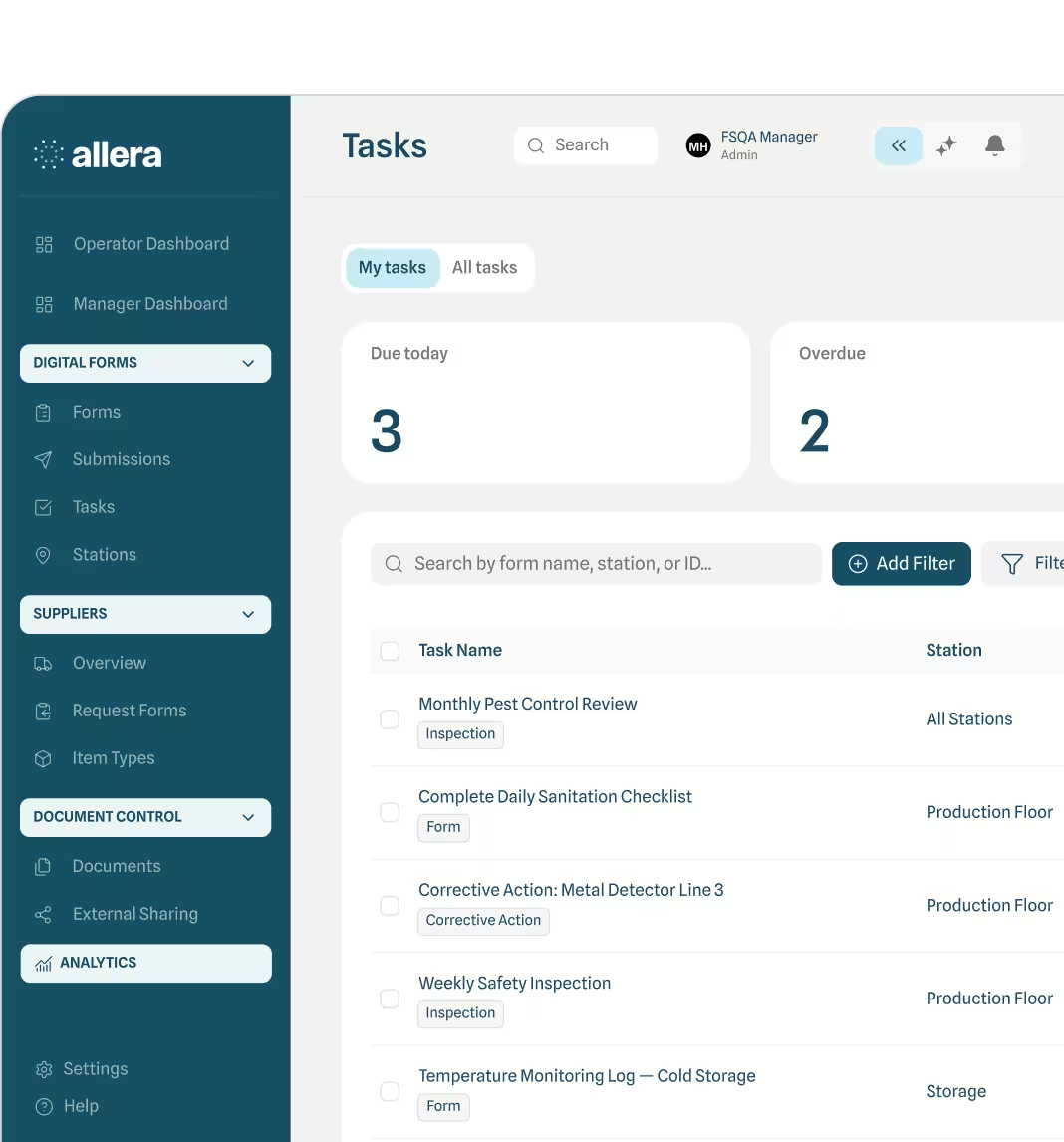
- Monitoring tasks are assigned with due dates, completion is tracked, and overdue tasks generate alerts before they become record gaps
- Corrective actions are linked directly to the monitoring events that triggered them, with closure documentation attached to the same record
- Training records are maintained alongside employee profiles, with completion status visible at a glance
- Reanalysis triggers can be configured for both calendar-based reviews and event-based triggers tied to your management of change process
The intersection with your broader FSMS matters here. Food defense records do not live in isolation. They sit alongside your HACCP records, allergen controls, GMP documentation, and supplier records. Managing them in one platform with one audit trail is more sustainable than maintaining a separate food defense binder that exists outside your FSMS.
Document control is the foundation this all runs on. Without a system that controls which version of a procedure is in use and who has accessed it, your food defense plan documentation cannot meet the standard that FDA comprehensive inspections now expect. For a broader look at how best food quality management software supports multi-program compliance, that guide covers the evaluation criteria most FSQA teams use when selecting a platform.
Keeping food defense records inspection-ready across monitoring, corrective actions, verification, and training is a real operational challenge. See how Allera centralizes it.
FAQs
What is the first step of the food defense plan?
The first step in developing a food defense plan is assembling your food defense team. This team should include representatives from QA, operations, security or facilities management, HR, procurement, and IT if your facility uses digital access control systems. Appointing a designated Food Defense Coordinator to lead the process is a critical part of this step.
Once the team is in place, the next step is mapping your full production process and conducting a vulnerability assessment to identify your Actionable Process Steps. Starting with the right cross-functional team ensures your vulnerability assessment covers every part of the facility and reflects input from the people who know each step of the process best.
What are the 5 basic food safety rules?
The five basic food safety rules apply across every food handling environment:
- Wash your hands before and after handling food, especially after touching raw meat, using the restroom, or handling waste.
- Separate raw and cooked foods during storage and preparation to prevent cross-contamination.
- Cook to the right temperature using a calibrated thermometer to verify food reaches the internal temperature needed to eliminate pathogens.
- Chill food promptly by refrigerating perishables within two hours and maintaining cold storage at or below 41°F (5°C).
- Use clean equipment and surfaces by sanitizing food-contact surfaces and utensils before and after each use.
These rules align with FDA Good Manufacturing Practices and form the baseline of food safety training for all production and handling personnel.
What are the 5 steps of JSA?
A Job Safety Analysis (JSA) is a workplace safety process used to identify and control hazards associated with specific job tasks. The five steps are: (1) select the job to analyze, (2) break the job into its individual steps, (3) identify the hazards present at each step, (4) determine preventive or corrective measures to eliminate or control each hazard, and (5) document the findings and communicate them to the workers performing the job.
While a JSA is a general occupational safety tool rather than a food-specific compliance requirement, it can complement your food defense and food safety programs by identifying personnel-level risks at high-risk processing steps, particularly where Actionable Process Steps and worker access intersect.
How to make a food defense plan?
Building a food defense plan under FDA's Intentional Adulteration Rule involves seven core steps:
- Assemble a cross-functional food defense team from QA, operations, security, HR, and IT, and appoint a Food Defense Coordinator.
- Map your full production process from receiving through shipping.
- Conduct a vulnerability assessment using a recognized methodology such as CARVER+Shock or the FDA Food Defense Plan Builder.
- Identify your Actionable Process Steps (APS) and document your rationale for any steps you exclude.
- Select science-based mitigation strategies for each APS.
- Write monitoring, corrective action, and verification procedures for each mitigation strategy.
- Document food defense training for all APS-assigned personnel and their supervisors, and schedule reanalysis at least every three years.
What are the 5 C's of food safety?
The 5 C's of food safety are a practical framework for safe food handling: Clean, Cook, Chill, Cross-contamination (avoid it), and Cover. Clean means washing hands and sanitizing surfaces and equipment before and after food contact. Cook means reaching safe internal temperatures to eliminate pathogens, and chill means storing food promptly at correct refrigeration temperatures.
Avoiding cross-contamination means keeping raw and ready-to-eat products separate throughout storage and preparation. Cover means protecting food from environmental exposure during storage and transport. These five principles align with Good Manufacturing Practices (GMPs) and form the foundation of food safety training for production and handling staff.
What is an example of food defence?
Food defense measures are controls designed to prevent intentional contamination at the most vulnerable points in your production process. Common examples include restricted keycard access to bulk liquid receiving areas, CCTV surveillance in blending and open-processing zones, tamper-evident seals on liquid storage tanks, and background screening procedures for personnel assigned to high-risk steps.
At the facility perimeter level, examples include security fencing, controlled vehicle access, visitor sign-in and escort procedures, and security seals on finished goods trucks. Together, these measures form the four security pillars: outside security, inside security, personnel security, and incident response.
What is a food defense plan?
A food defense plan is a written program that identifies where your food facility is most vulnerable to intentional contamination and documents the mitigation strategies you have in place to address those vulnerabilities. It is required under FDA's Intentional Adulteration Rule (21 CFR Part 121) for facilities registered under Section 415 of the FD&C Act.
Unlike a food safety plan, which addresses accidental hazards like pathogens and allergens, a food defense plan specifically targets deliberate acts of tampering, sabotage, or contamination intended to cause wide-scale public health harm. Every covered facility must have a written, implemented, and verified food defense plan.


.avif)
.avif)
.avif)
.avif)
%20(1).avif)
.avif)
.avif)

%20(1).png)

.avif)



.avif)