.avif)



HACCP Verification: Monitoring vs Verification vs Validation

HACCP verification is everything you do, other than monitoring, to confirm that your HACCP plan is valid and that the system is running the way it was designed to run. It is Principle 6 of the seven HACCP principles, and it is the one most teams describe correctly in a procedure and then execute inconsistently on the floor.
The confusion is rarely about the definition. It is about the boundary between three activities that sound interchangeable and are not: monitoring, validation and verification. Teams that blur them end up with monitoring records nobody reviews, a validation file that was never revisited after the original commissioning study, and an auditor asking a question nobody in the room can answer.
This guide sets out the difference between the three, the verification activities that belong in your plan, how often each one needs to happen, and the single audit finding that comes up more than any other.
If you arrived here looking to check whether a HACCP certificate someone sent you is genuine, that is a different question with a quick answer: contact the training provider or certification body named on the certificate directly and ask them to confirm it against their register. The rest of this article is about Principle 6, the verification procedures inside a food safety plan.
Monitoring, Verification and Validation: The Difference in One Table
The three activities answer three different questions at three different points in time.
| Monitoring | Validation | Verification | |
|---|---|---|---|
| Question it answers | Is this control in spec right now? | Does this control actually work? | Is the system running as designed? |
| When it happens | Continuously or at set intervals during production | Before implementation, and again when something changes | After the fact, on a defined schedule |
| Who does it | The operator at the line | Technical or food safety lead, often with external expertise | Someone independent of the person who performed the task |
| Evidence it produces | Monitoring records, charts, logs | Scientific justification, validation study, literature | Reviewed records, calibration certificates, audit reports |
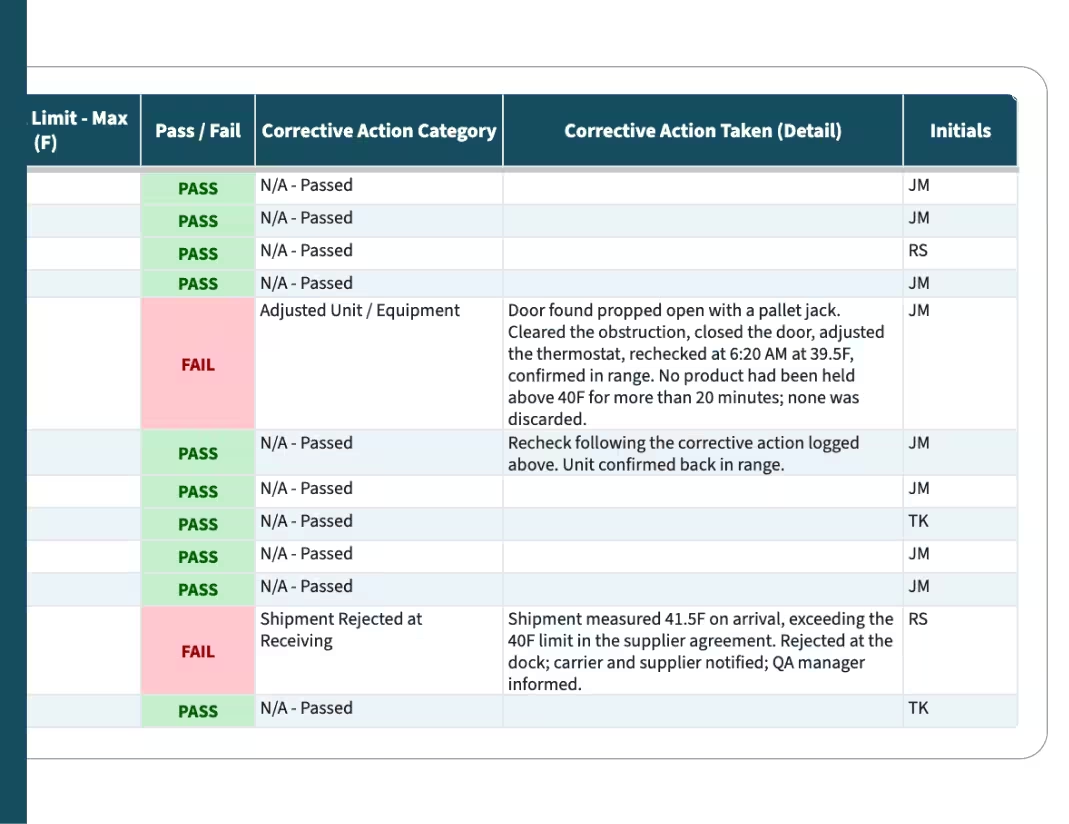
| What a failure means | Deviation. Hold product, apply corrective action | The plan is wrong. Redesign the control | The plan is right but not being followed. Fix execution |
Monitoring is the operator recording the metal detector test at start-up. Validation is the evidence that the reject sensitivity you chose will actually catch the fragment sizes you care about. Verification is the supervisor reviewing a week of those test records, confirming the detector was calibrated, and signing to say both are true.
You need all three. A plan with excellent monitoring and no validation is a plan that documents a control nobody proved works. A plan with both and no verification is a plan that will drift without anyone noticing.
What Is HACCP Verification?
The FDA's HACCP Principles and Application Guidelines define verification as those activities, other than monitoring, that determine the validity of the HACCP plan and that the system is operating according to that plan. The wording matters. Verification covers both questions: is the plan still correct, and is it actually being followed?
That definition comes from the National Advisory Committee on Microbiological Criteria for Foods and is echoed in Codex guidance and the FAO's HACCP toolbox, which treats validation and verification together as Step 11. The UK Food Standards Agency takes the same position in its MyHACCP guidance on Principle 6.
Verification sits at the end of the seven principles for a reason. It only makes sense once you have completed a hazard analysis, established your critical control points, set critical limits and defined monitoring. Our guide to the seven HACCP principles covers how the sequence fits together.
Where FSMA Uses the Word Differently
If you operate under FSMA preventive controls rather than a classical HACCP plan, be careful with terminology. The preventive controls rule uses "verification" as an umbrella that explicitly includes validation, monitoring review, calibration, product testing and environmental monitoring. Codex-style HACCP treats validation as a separate concept that verification confirms.
The practical effect is that a PCQI writing a food safety plan and a HACCP practitioner writing a HACCP plan can use the same word to mean slightly different scopes. When an auditor asks about your verification activities, clarify which framework you are answering under. Our comparison of HARPC and HACCP covers where the two diverge.
The Verification Activity Set
Verification is not one task. It is a set of activities that together give you confidence the system is working. Most plans draw from the same pool.
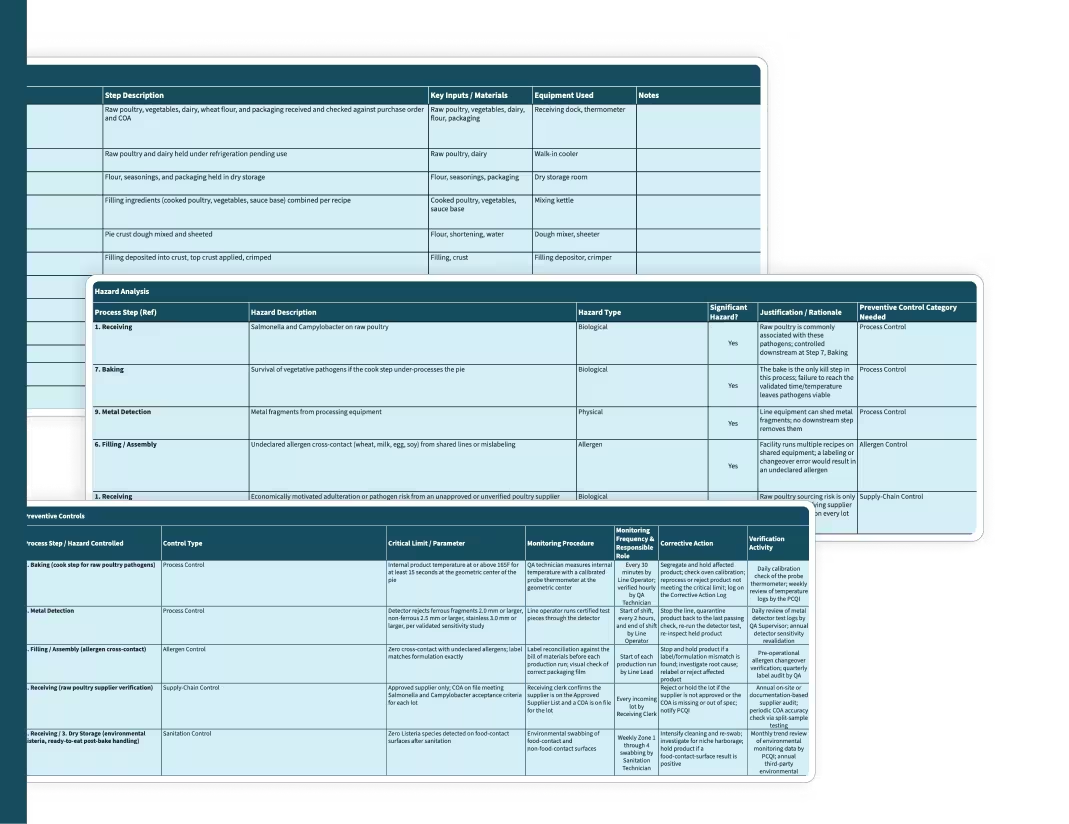
Record review. Someone other than the person who completed the record examines monitoring logs, deviation records and corrective action records. They are checking that entries are complete, legible, signed, within limits, and that every deviation has a documented response. This is the highest-value verification activity and the one most often skipped.
Calibration. Any instrument you rely on to monitor a critical limit has to be demonstrably accurate. That covers probe thermometers, pH meters, metal detector test pieces, scales and pressure gauges. Calibration records are verification evidence, and our guide to the thermometer calibration log covers frequency and method.
Direct observation. A supervisor watches the operator perform the monitoring check. This catches the gap between the written procedure and what actually happens at the line, which record review alone will never surface.
Targeted sampling and testing. Finished product testing, in-process micro sampling, allergen swabs and environmental monitoring all serve as verification that your controls are delivering the outcome you expect. Testing verifies the system. It does not control the hazard, and it is never a substitute for a working CCP.
Internal audit. A scheduled, systematic review of the whole food safety management system against the plan and the standard. Our guide to the food safety internal audit covers planning and scope, and ISO 19011 sets out the auditing principles most schemes expect you to follow.
Reassessment of the plan. A periodic review of whether the hazard analysis and the plan still reflect reality: the products you make now, the process as it currently runs, the equipment you have installed since.
Who Is Qualified to Perform Each
Verification has an independence requirement. The person verifying a record should not be the person who created it. In a small plant that is difficult, but the principle still has to hold in some form, usually by having a supervisor or the HACCP coordinator review operator records.
Plan reassessment and validation review normally sit with the HACCP team or a trained individual. Under FSMA, reassessment of a food safety plan must be performed or overseen by a PCQI. Under the meat and poultry rule in 9 CFR 417, reassessment must be conducted by an individual trained in accordance with the regulation.
How Often? A Frequency Table
Most guidance stops at "the HACCP team determines the frequency," which is true and unhelpful when you are building a schedule. The table below gives defensible starting points drawn from regulatory baselines and common scheme expectations. Adjust for your risk, your history and your scheme.
| Activity | Typical frequency | Regulatory or scheme anchor |
|---|---|---|
| CCP monitoring record review | Daily to weekly, before product release where practical | General expectation across schemes |
| Deviation and corrective action record review | Every occurrence, reviewed within days | Required wherever a deviation occurs |
| Instrument calibration | Per manufacturer, commonly daily checks with periodic formal calibration | Documented in the plan |
| Direct observation of monitoring | Quarterly per CCP, more often for new operators | Scheme dependent |
| Finished product or in-process testing | Risk based, defined sampling plan | Defined in the plan |
| Internal audit of the HACCP system | At minimum annually, often on a rolling programme | Annual minimum is the common baseline |
| Full plan reassessment | At minimum annually and whenever a significant change occurs | 9 CFR 417.4; the UF/IFAS Principle 6 guidance gives the same annual baseline |
The phrase to hold onto is "at minimum annually and whenever a significant change occurs." A significant change is not only new equipment. A new supplier, a new ingredient, a formulation change, a new pack format, a change in intended use or a change in the consumer population can all trigger reassessment.
Validation: Proving the Control Works
Validation asks whether your control is capable of doing the job at all. It happens before you implement, and it is evidence based rather than observational.
USDA FSIS guidance on HACCP validation describes validation as demonstrating that the HACCP system as designed can adequately control identified hazards, and splits it into two elements: the scientific or technical support for the plan, and in-plant evidence that the plan works as written under your actual conditions. You need both. A published thermal death time study is the first element. Data collected on your own line, with your own product, is the second.
Acceptable sources of scientific support include peer-reviewed literature, validated mathematical models such as predictive microbiology tools, challenge studies, guidance from a recognised process authority, and regulatory performance standards. The FAO's Step 11 guidance lists the same categories.
Revalidation Triggers
Validation is not a one-time file. Revisit it when any of these happen:
- A change to the process, equipment, formulation or packaging
- A new hazard emerges, or new science changes what is known about an existing one
- A recurring deviation at the same CCP, which suggests the limit or the control was never right
- An outbreak or recall associated with your product category
- A change to the regulatory performance standard or scheme requirement
A recurring deviation is the trigger teams miss most often. If the same CCP keeps failing, treating each failure as an isolated corrective action misses the real signal, which is that the control may not be capable in the first place.
Worked Example: One Metal Detector Through All Three
Take a metal detector at final pack on a ready meal line, operating as a CCP.
Validation happens before the detector goes into routine use. You establish, with evidence, that the chosen sensitivity will reliably detect ferrous, non-ferrous and stainless test pieces of the sizes your hazard analysis identified, through your actual product at your actual line speed and pack orientation. You record the test piece sizes, the product effect, the rationale for the sensitivity setting and who approved it. If you later change the pack size or the product formulation, that evidence no longer applies and you revalidate.
Monitoring is what the operator does in production. At start-up, at defined intervals and at end of run, they pass the test pieces through, confirm the detector rejects each one, confirm the reject mechanism physically works, and record the result. A failed test triggers a deviation: hold everything back to the last good check, investigate, and record the corrective action.
Verification happens afterwards and by someone else. The supervisor reviews the week's test records for completeness and for any missed check. They confirm the test pieces themselves are the right sizes and have a current certificate. They check the detector's calibration record is in date. Quarterly, they watch an operator run the test to confirm the procedure is followed as written. Annually, the internal audit examines the whole arrangement against the plan.
Three activities, three owners, three kinds of evidence. Our guide to metal detection in food packaging covers the sensitivity and test frequency decisions in more depth, and OPRP vs CCP covers when a detector is better classified as an operational prerequisite program.
The Audit Finding Nobody Writes About
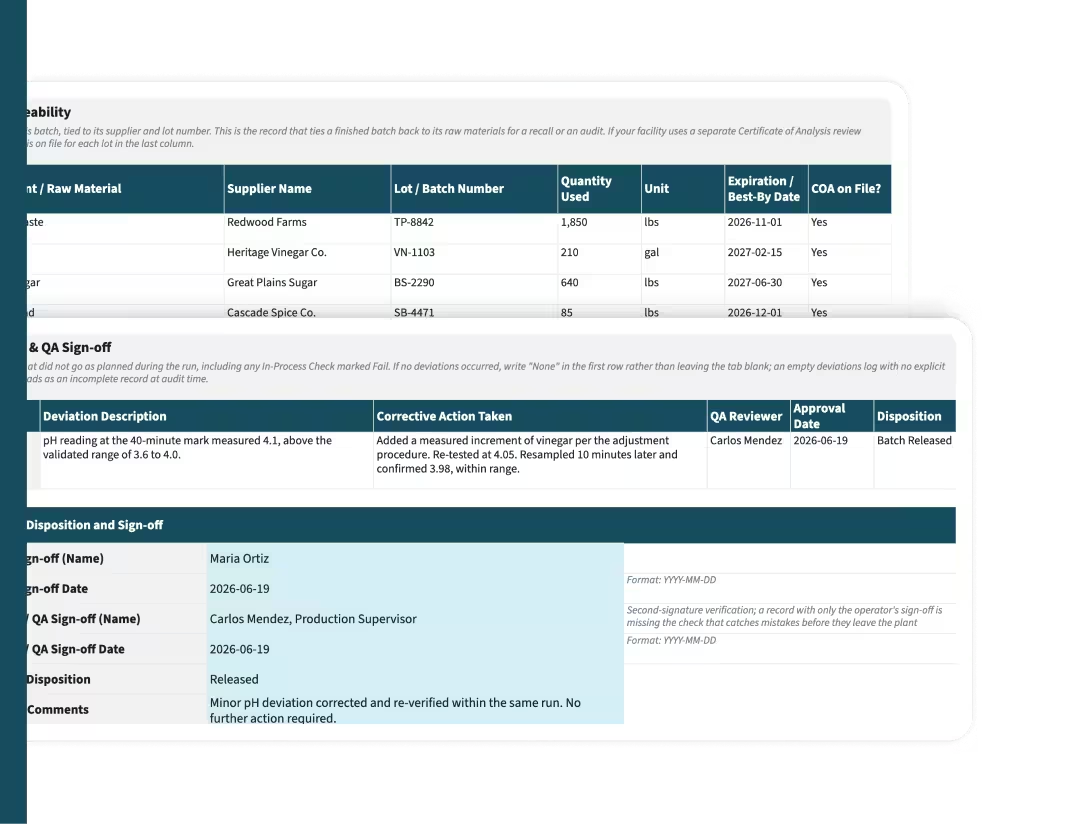
Here is the failure mode that shows up in real audits far more often than a missing procedure: the monitoring records are complete, the verification column has a signature, and nothing was ever actually reviewed.
It happens in a predictable way. The verification signature becomes part of the end-of-week routine. Someone signs a stack of records in one sitting, weeks after the product shipped. Nobody is reading for out-of-spec entries because the point of the signature has quietly shifted from checking the records to completing the paperwork.
An auditor finds this quickly. They pick a week, locate a deviation in the monitoring record, then look at whether the verification signature on that same sheet is accompanied by any evidence that the deviation was noticed and acted on. When it is not, you have a finding that goes to the integrity of the whole system rather than to one record.
The related finding is timing. Verification that happens six weeks after the fact cannot inform a hold decision. If your record review is meant to catch a problem before release, the schedule has to make that physically possible, and the records have to show when the review actually took place rather than only who signed it.
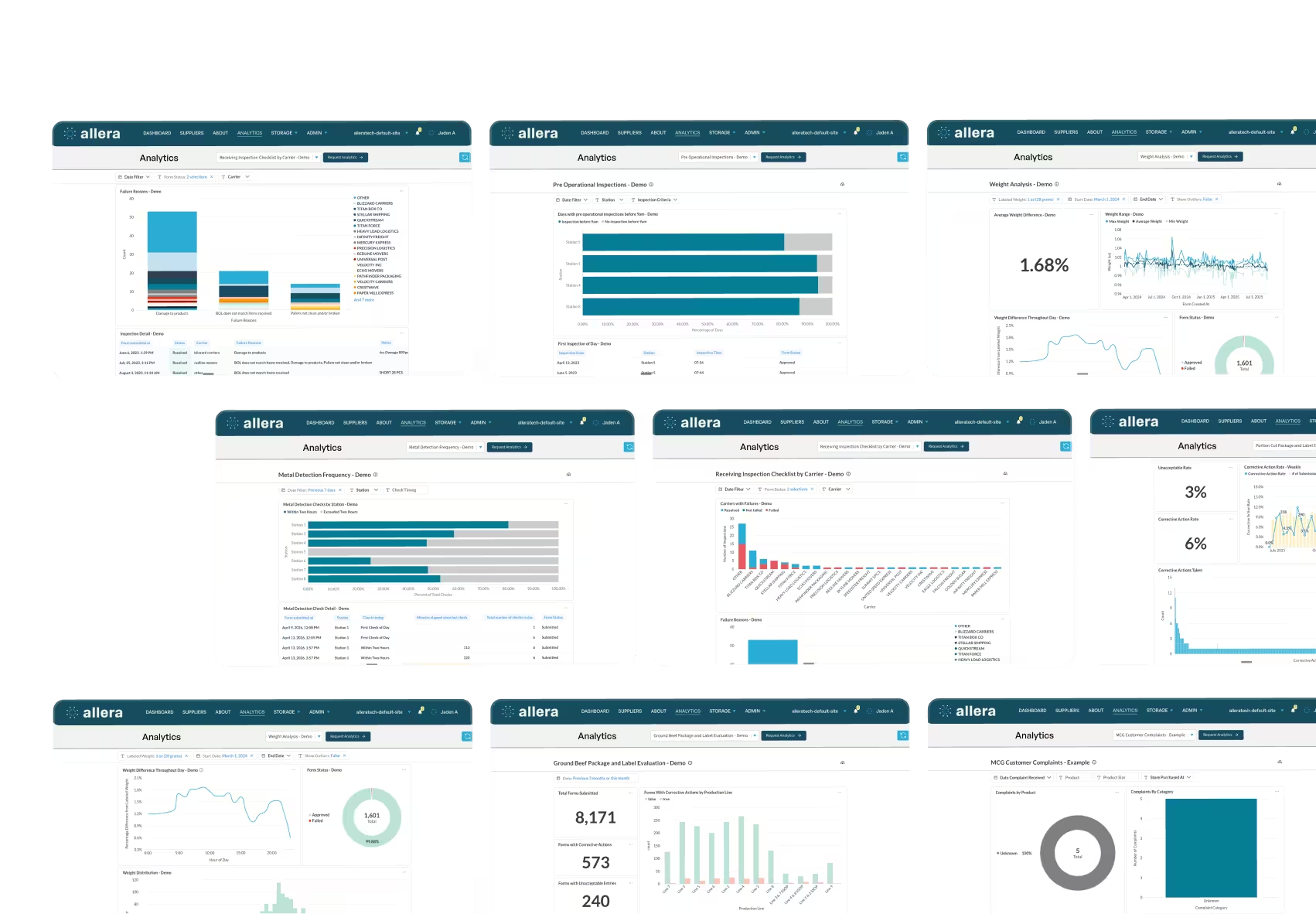
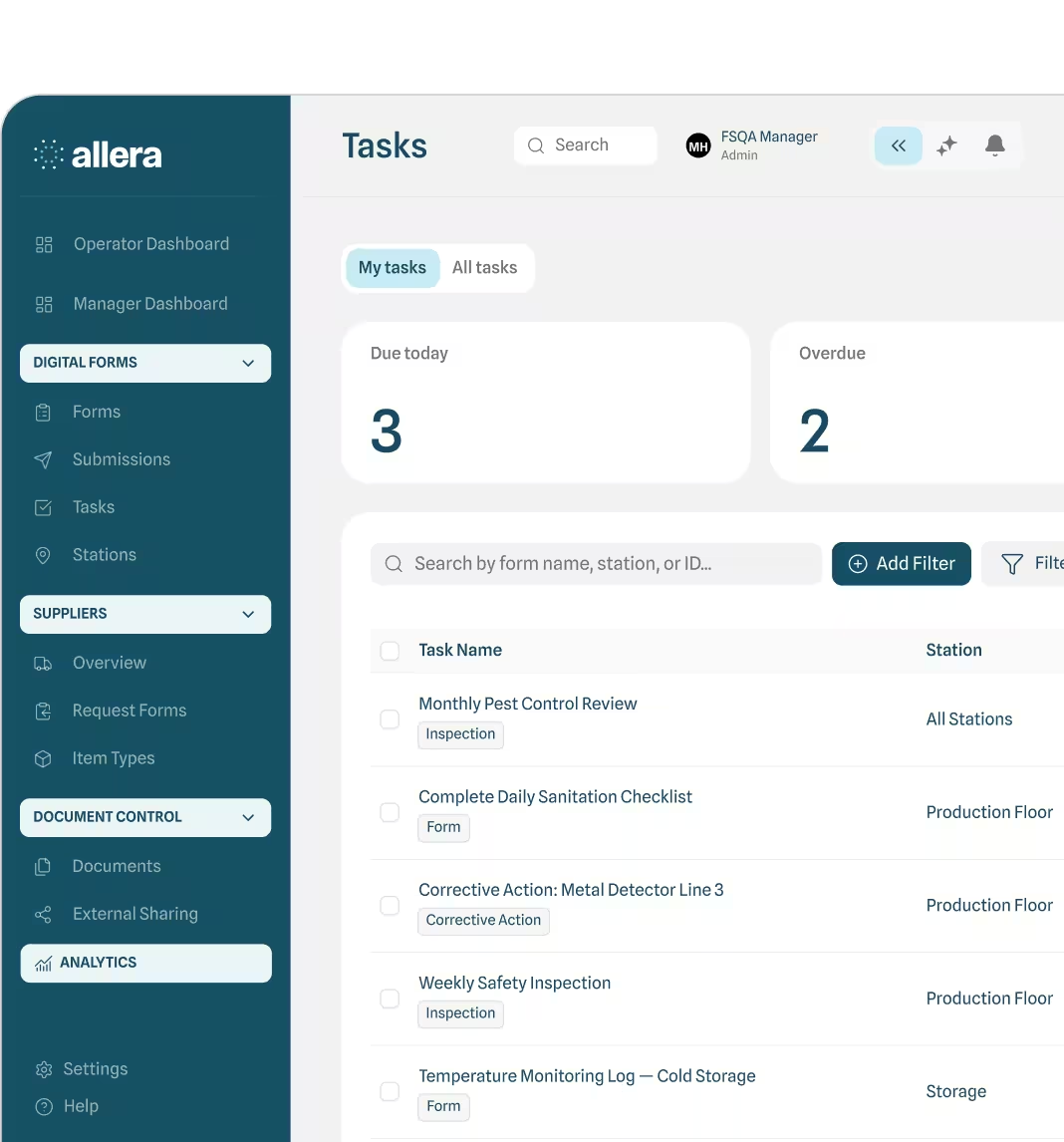
Both findings come down to the same root cause: verification treated as a document to complete rather than a scheduled task with an owner, a due date and a real outcome. Allera handles that side of it with recurring Task Instances, where each occurrence of a verification activity is tracked individually as Incomplete, Overdue, Completed On Time, Late or Skipped. The pattern of late and skipped instances is visible before an auditor finds it, not after.
What Each Scheme Expects
Certification schemes layer their own verification requirements on top of the HACCP baseline.
SQF Edition 10 requires verification of monitoring activities, verification schedules, and a documented verification of the effectiveness of corrective actions. Record review must be performed by someone other than the person who created the record, and the site has to hold a verification schedule showing who does what and when.
BRCGS Issue 9 requires the HACCP plan to be reviewed at minimum annually and after any significant change, with internal audits covering the HACCP system on a defined programme. It places specific weight on the traceability and mass balance exercise as a verification activity.
FSSC 22000 Version 6, built on ISO 22000, requires verification planning covering what is verified, by which methods, at what frequency, and by whom. It also requires analysis of the results of verification activities, which is a step beyond simply performing them. Our comparison of FSSC 22000 and ISO 22000 covers the structure.
The common thread across all three is that verification has to be planned, assigned, scheduled and analysed. A verification programme that exists only as a set of signatures on monitoring records will not satisfy any of them.
Building a Verification Programme That Holds Up
Start by listing every verification activity your plan and your scheme require. For each one, write down the frequency, the person or role responsible, the record it produces, and where that record lives. That list is your verification schedule, and most schemes will ask to see it as a document in its own right.
Then check the two things auditors check. Can you show, for any given week, that the review actually happened and when? And can you show what happened when a review found something wrong? If the answer to either is a shrug, the programme is not yet doing its job, regardless of how complete the procedure looks.
The mechanics matter more than the paperwork here. Scheduled verification tasks need owners and due dates, records need a review step that is separate from the person who wrote them, and the evidence needs to be retrievable without a filing hunt. If your monitoring records, calibration certificates and review sign-offs currently live in three different places, see how Allera's food quality management software keeps the verification chain in one system, with an exportable audit trail showing who reviewed what and when.
FAQs


.avif)
.avif)
.avif)

.avif)
%20(1).avif)
.avif)
.avif)

%20(1).png)

.avif)



.avif)