.avif)



Food Safety Compliance

Food safety compliance is the ongoing practice of meeting the laws, regulations, and certification-scheme requirements that govern how food is produced, handled, and documented, so that products are safe, accurately labeled, and traceable. For manufacturers, it means operating a documented food safety system and proving it on demand. That last part is where most of the work lives, because compliance is judged less by what you intend to do and more by what you can show an inspector or auditor on any given day.
This guide is built for the people who carry that weight day to day: quality managers, food safety directors, and compliance leads at manufacturing and processing facilities. It covers what food safety compliance actually means, the U.S. rules and global certification schemes that define it, the components of a compliant program, and how to run all of it without drowning in paperwork.
What Is Food Safety Compliance?
Food safety compliance means continuously meeting every legal and certification requirement that applies to how your facility makes, handles, labels, and records food. It spans federal regulation, customer and retailer expectations, and the voluntary-but-expected certification standards that buyers increasingly treat as a price of entry. For a manufacturer, the practical test is simple: can you produce the evidence that your controls are working, right now, without a scramble?
Compliance Is a State You Maintain, Not a Box You Check
Many teams still treat compliance as an event that happens once a year when the auditor arrives. That mindset is where citations come from. Regulators and certification bodies expect your hazard controls, monitoring records, and corrective actions to be live and current every single day of production, not reconstructed the week before an audit.
A facility that maintains compliance continuously looks different from one that prepares for it in bursts. Records are captured at the moment work happens, deviations are logged and resolved as they occur, and documents carry clear version history. The goal is a system that is always ready, so an unannounced FDA inspection is an inconvenience rather than a crisis.
This Guide Is Written for Food Manufacturers and Processors
A large share of "food safety compliance" content online is actually about restaurants and foodservice: the FDA Food Code, local health department inspections, and front-of-house hygiene. Those rules matter, but they are a different regime from the one that governs manufacturing. If you run a processing plant, your world is FSMA, preventive controls, and GFSI certification, not table-side temperature logs.
This distinction shapes everything that follows. Throughout this guide, "compliance" means the requirements that apply to facilities that manufacture, process, pack, or hold food for the supply chain. If you want the broader foundation first, start with our guide to food safety for food manufacturers, then come back here for the compliance specifics.
Why Compliance Is Getting Harder to Ignore in 2026
Compliance has always mattered, but the stakes in 2026 are sharper than they were even a few years ago. Enforcement is climbing, the cost of failure is rising, and the buyers you sell to are scrutinizing your food safety posture before they sign a contract. Treating compliance as a background task is getting more expensive by the quarter.
Enforcement Is Intensifying
FDA warning letters are trending upward, and the agency has signaled a more active enforcement posture across inspections, import refusals, and follow-up actions. A warning letter is not the end of the story; it is the start of a documented dialogue where you have to prove corrective action, often under a tight clock. Facilities that cannot quickly assemble records to demonstrate control are the ones that escalate from a letter to a consent decree.
You can track the agency's current priorities through FDA's food compliance and enforcement hub, which publishes warning letters, recalls, and import alerts. The pattern across recent actions is consistent: inspectors want to see that controls existed, were monitored, and were corrected when they slipped. Intent does not count; evidence does.
The Human and Business Cost of Failure
Behind every regulation is a public health reality. The CDC's estimate of 48 million foodborne illnesses a year in the United States is the baseline that food law is designed to push down. When a control fails at a manufacturing facility, the consequences scale fast, because a single production run can reach thousands of consumers.
The business cost compounds the human one. A recall can run into the millions once you account for product loss, logistics, legal exposure, and lost sales. Retailers delist suppliers after serious incidents, and that lost shelf space is often permanent. The reputational damage outlives the recall itself, especially when the failure becomes public.
From Cost Center to Strategic Investment
The smartest food companies have stopped framing compliance as pure overhead. A strong compliance program is now a commercial asset: it shortens supplier onboarding with major retailers, reduces costly production disruptions, and becomes a selling point with buyers who are themselves under pressure to de-risk their supply chains. Compliance maturity signals operational maturity.
Reframing compliance this way changes how you budget for it. Money spent on a documented, well-run program returns value through fewer holds, faster audits, smoother customer approvals, and lower insurance and recall exposure. The question is no longer whether you can afford to invest in compliance, but whether you can afford the disruptions that come from underinvesting.
When warning letters are rising, the difference between a clean inspection and a citation is usually one thing: records you can produce on demand. See how Allera keeps your entire food safety program in one place.
Explore Allera's food quality management software
Why Food Safety Compliance Matters
Beyond enforcement and cost, compliance matters because it protects the things your business depends on: public health, market access, and the trust that lets you keep selling. Each of these is a separate reason to take compliance seriously, and together they explain why food law looks the way it does.
Public Health Is the Point
Modern food safety law is built on a prevention-first philosophy. Rather than catching problems after products ship, the framework requires you to anticipate hazards and control them at the source. This is the same logic that underpins the Codex Alimentarius international food standards, the joint FAO and WHO body that has shaped national food regulations worldwide.
Prevention is also why compliance is so document-heavy. To prove you prevented a hazard, you have to show the control was designed, monitored, and verified. The paperwork is not bureaucracy for its own sake; it is the only way to demonstrate that prevention actually happened.
Market Access Depends On It
Compliance opens doors, and the lack of it closes them. Most major retailers and foodservice buyers now require suppliers to hold a recognized certification before they will even consider a contract. Failing an audit or losing a certification can cut you off from entire channels overnight.
This is why compliance has become a sales conversation, not just a quality one. Your commercial team increasingly fields questions about your food safety program during the buying process, and your ability to answer cleanly affects whether deals close. A facility that cannot demonstrate compliance is a facility that loses business to one that can.
Compliance Is the Floor, Not the Ceiling
Regulation sets the minimum standard you must meet to operate legally. Meeting it keeps you in business, but it does not make you competitive. The market expectation, set by retailers through GFSI-recognized certification, sits well above the regulatory floor.
Understanding this gap is essential to budgeting and planning. If you build a program that only satisfies FSMA, you will still struggle to win contracts that require SQF or BRCGS certification. The strongest programs are designed from the start to clear both bars at once.
The U.S. Regulatory Map: Who Regulates What
One of the most common sources of confusion is figuring out which agency and which rules actually apply to your facility. The U.S. system splits authority across agencies and layers several rules on top of each other. Getting this map right is the foundation of a compliant program.
FDA vs. USDA Jurisdiction
The FDA regulates the large majority of the U.S. food supply, including most processed foods, produce, seafood, dairy, and dietary supplements. If your product is not specifically a meat, poultry, or egg product, you are almost certainly under FDA jurisdiction. FDA oversight is risk-based and inspection-driven, with the burden on you to maintain a preventive system.
The USDA, through its Food Safety and Inspection Service, regulates meat, poultry, and processed egg products, and its model is different. FSIS maintains continuous inspection presence in many facilities and operates its own compliance framework. If you produce these products, review USDA FSIS compliance guidance for meat, poultry, and egg products closely, because the expectations differ meaningfully from the FDA world.
FSMA and Its Core Rules
The Food Safety Modernization Act of 2011 was the biggest shift in U.S. food law in decades, moving the system from reacting to contamination toward preventing it. You can read the full scope at FDA's Food Safety Modernization Act (FSMA) overview. FSMA is not a single rule but a family of them, and knowing which apply to you is core to compliance.
For most manufacturers, the central rule is the Preventive Controls for Human Food rule, detailed at FDA's Preventive Controls for Human Food rule. It requires a written food safety plan built on hazard analysis and risk-based preventive controls. Beyond it sit several other FSMA rules that may apply: the Foreign Supplier Verification Program for importers, the FSMA 204 traceability rule for designated high-risk foods, the Intentional Adulteration rule, and the Produce Safety rule.
The practical takeaway is that FSMA compliance is rarely about one rule in isolation. A single facility may need to satisfy preventive controls, supplier verification, and traceability requirements at the same time. Tools built for this overlap, such as dedicated FSMA compliance software, exist precisely because managing these rules separately on spreadsheets becomes unmanageable at scale.
HACCP and the FDA Food Code
HACCP, the Hazard Analysis and Critical Control Points system, predates FSMA and remains the backbone of food safety planning. It is mandatory in specific sectors such as seafood and juice, and its logic is embedded in the broader preventive controls framework. If you want the foundation, our guide to HACCP principles walks through all seven.
The FDA Food Code is a separate document that often causes confusion for manufacturers. It is a model code for retail and foodservice establishments, adopted by state and local health departments, and it governs restaurants rather than processing plants. If you want to understand where it fits and who maintains it, see our explainer on who produces the food code.
The Components of a Compliant Food Safety Program
Compliance is not abstract once you break it into its working parts. Every compliant manufacturing program rests on the same six components, and they map directly onto the requirements in 21 CFR Part 117, the Preventive Controls regulation. Think of these as the executable framework behind the law.
1. Hazard Analysis
Everything starts with identifying what could go wrong. You evaluate biological hazards such as pathogens, chemical hazards including allergens and radiological contaminants, and physical hazards like metal or glass. Increasingly, you also assess economically motivated adulteration, where someone substitutes or dilutes an ingredient for financial gain.
A thorough hazard analysis is the document everything else depends on. If a hazard is missing here, no downstream control will catch it, and an auditor who finds the gap will question your entire plan. This is the step where rigor pays off most.
2. Preventive Controls
For each significant hazard, you establish a control that prevents or significantly minimizes it. These fall into recognized categories: process controls such as a validated cook step, allergen controls, sanitation controls, and supply-chain controls for hazards managed by your suppliers. Each control needs defined parameters, such as a minimum temperature and time.
The strength of a preventive control is in its specificity. "We cook the product" is not a control; "we hold the product at 165°F for a defined dwell time, verified by calibrated probes" is. Auditors look for that level of precision because it is what makes a control auditable.
3. Monitoring
A control you do not monitor is a control you cannot prove. Monitoring is the act of observing and recording that each preventive control stays within its critical limits during production. It might mean logging cook temperatures every batch, checking metal detector function on a schedule, or verifying sanitation before startup.
Monitoring frequency and method must be defined in advance and followed consistently. The records this generates are the single most-requested evidence in an inspection, because they show the control was working in real time, not just on paper.
4. Corrective Actions
Things go out of spec. What matters for compliance is what you do next. A corrective action procedure defines how you identify the affected product, bring the process back under control, evaluate whether the product is safe, and prevent recurrence. Each instance must be documented.
Auditors actually view well-documented corrective actions as a positive signal. A facility that records deviations and resolves them demonstrates a living, honest system. A facility with suspiciously perfect records, by contrast, invites scrutiny.
5. Verification and Validation
Validation confirms that a control is capable of doing its job before you rely on it, often through scientific evidence or testing. Verification confirms, on an ongoing basis, that the system is actually being followed and remains effective. Together they answer the auditor's question: how do you know this works?
Verification activities include reviewing monitoring records, calibrating instruments, conducting product testing, and performing internal audits. These activities catch drift before it becomes a deviation, and they generate their own layer of compliance evidence.
6. Recordkeeping and Documentation
Records are the connective tissue of the entire program. They are the proof that your hazard analysis was done, your controls were monitored, your deviations were corrected, and your system was verified. Without retrievable records, even a well-run facility cannot demonstrate compliance.
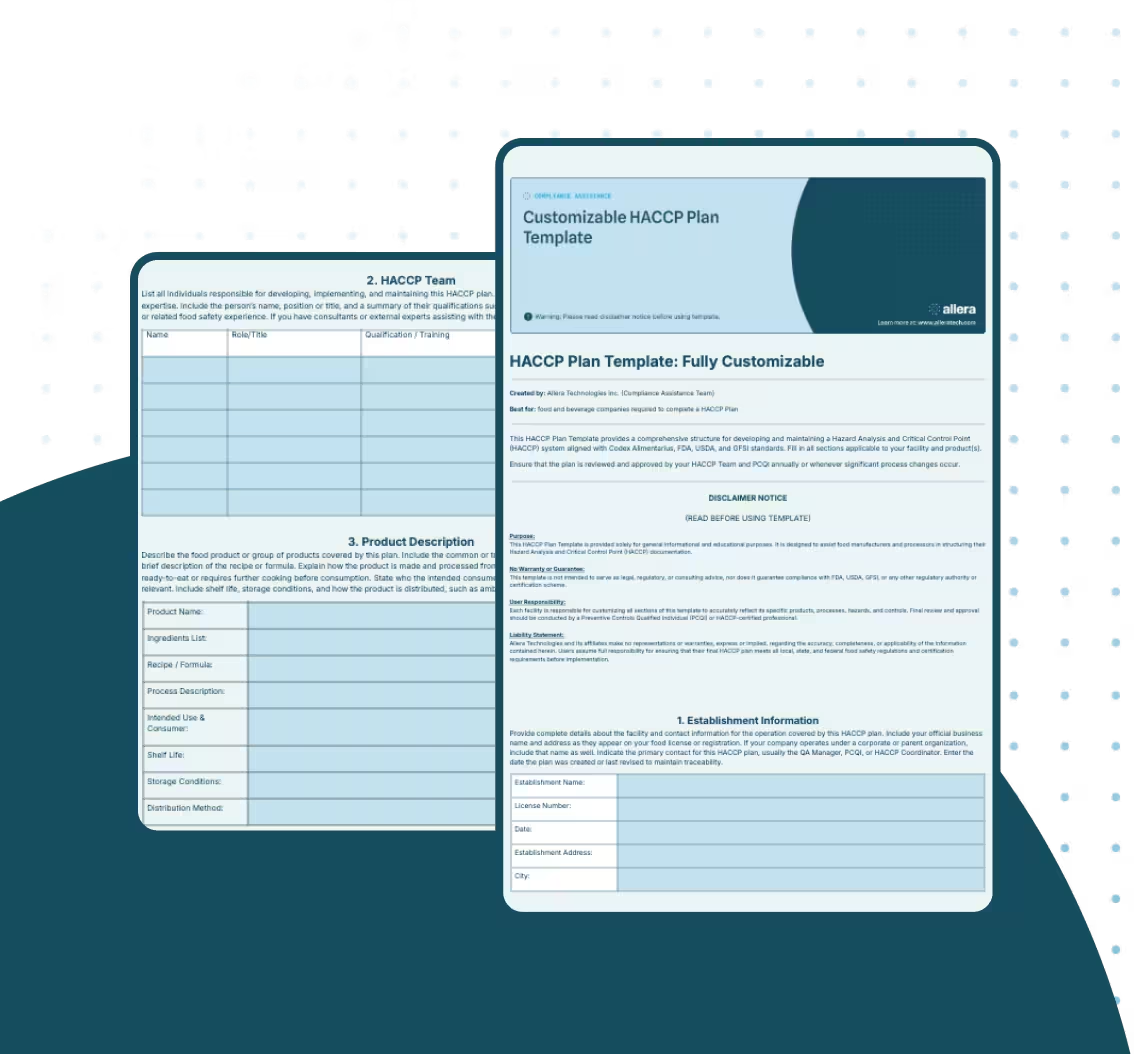
This is where your food safety plan and your HACCP plan become living documents rather than binders on a shelf. The plan defines what you will do; the records prove you did it. Keeping the two aligned, current, and accessible is the daily reality of compliance.
Which Compliance Requirements Apply to You?
"Compliance" is not one undifferentiated obligation. The specific rules you must meet depend on what kind of operation you run and where your product sits in the supply chain. Mapping your requirements to your business type prevents both overbuilding and dangerous gaps.
Manufacturers and Processors
If you manufacture, process, pack, or hold food, the Preventive Controls for Human Food rule under 21 CFR 117 is your core obligation, layered on top of current Good Manufacturing Practices. CGMPs cover the foundational conditions of your facility: personnel hygiene, building and equipment sanitation, and process controls. Our guide to GMP in the food industry covers this prerequisite layer in depth.
These requirements apply whether you are a small co-packer or a large multi-line plant, though the scale of your program will differ. The rule is risk-based, so a higher-risk product such as ready-to-eat foods carries heavier control and documentation expectations than a low-risk shelf-stable one.
Importers
If you bring food into the United States from foreign suppliers, the Foreign Supplier Verification Program adds a layer on top of your other obligations. FSVP requires you to verify that your foreign suppliers produce food under controls equivalent to U.S. standards. You become responsible for evidence about facilities you do not own or operate.
This shifts a meaningful compliance burden onto your supplier verification process. You need documented approval of each supplier, evidence of their hazard controls, and ongoing reverification. For importers, supplier records are not a side file; they are central to staying compliant.
Co-Packers and Private-Label Producers
When you manufacture under another brand's label, or when someone manufactures under yours, compliance becomes a shared responsibility that must be clearly divided. Both parties need clarity on who owns the hazard analysis, who holds which records, and who answers to the customer's auditor. Ambiguity here is a frequent source of audit findings.
Supplier approval and verification sit at the heart of these relationships. The brand owner needs documented assurance that the co-packer's program meets requirements, and the co-packer needs to maintain records that satisfy multiple customers at once. Strong documentation discipline is what makes these arrangements workable.
Where Food Safety Compliance Sits Inside FSQA
Compliance is one pillar of a broader function: food safety and quality assurance. FSQA encompasses not only regulatory compliance but also quality specifications, customer requirements, and continuous improvement. Compliance is the non-negotiable core, but it operates inside this wider system.
Seeing compliance as part of FSQA helps you avoid treating it as an isolated checklist. Our FSQA (food safety and quality assurance) guide shows how the pieces connect, and why the same data that proves compliance also drives quality decisions across the operation.
Mapping Compliance to GFSI Schemes (SQF, BRCGS, FSSC 22000, ISO 22000)
Here is the piece most compliance guides miss entirely. Regulatory compliance and certification are two different bars, and serious manufacturers have to clear both. Understanding how they relate is what separates a program that merely satisfies the FDA from one that wins and keeps major retail business.
Regulation vs. Certification: Two Different Bars
Regulatory compliance, such as meeting FSMA, is mandatory and enforced by government agencies. Certification to a recognized scheme is voluntary in legal terms but is required by most large retailers and buyers as a condition of doing business. The schemes that carry the most weight are those benchmarked by the Global Food Safety Initiative (GFSI), an industry body that recognizes standards meeting its criteria.
In practice, the distinction blurs because failing your certification audit can be as commercially fatal as a regulatory action. You can be fully FSMA-compliant and still lose a contract because your SQF certification lapsed. Most manufacturers therefore treat both as mandatory, even though only one is legally required.
How the Major Schemes Compare
Four certification standards dominate the manufacturing world. They overlap heavily in what they require but differ in ownership, scope, and which buyers prefer them.
| Scheme | Owner | Scope and focus | Who tends to ask for it |
|---|---|---|---|
| SQF | Food Industry Association (FMI) | Full supply chain, food safety and quality modules | North American retailers and brands |
| BRCGS | BRCGS (LGC) | Food safety, strong on product and process control | UK and European retailers, global brands |
| FSSC 22000 | FSSC Foundation | Built on ISO 22000 plus sector prerequisites | Global manufacturers, multinational buyers |
| ISO 22000 | ISO | Management-system standard for food safety | Organizations wanting an ISO-aligned FSMS |
Each scheme has its own depth, and choosing among them usually comes down to what your customers require. You can dig into the details through the SQF food safety certification program, the BRCGS Global Standard Food Safety, the FSSC 22000 certification scheme, and ISO 22000, the food safety management standard. For Allera's own deep dives, see our guides to the SQF certification guide, BRCGS certification, and FSSC 22000 version 6.
Do the Work Once
The encouraging reality is that FSMA records and GFSI evidence overlap enormously. Your hazard analysis, monitoring records, corrective actions, supplier approvals, and verification activities satisfy both the regulator and the certification auditor. You are not building two separate systems; you are building one and pointing it at two audiences.
This is why a single, well-organized records system is so valuable. When the same controlled document serves your FSMA file and your SQF audit, you eliminate duplicate effort and the inconsistencies that come with maintaining parallel records. Build the program once, build it well, and let it serve every audit that comes.
Running Compliance Day to Day: The Operational Reality
All the regulation and certification theory in the world means nothing if your daily operation cannot execute it. Compliance is won or lost in the thousand small acts of recording, approving, and retrieving that happen on the production floor and in the quality office. This is the layer the regulators describe but rarely help you run.
Compliance Lives or Dies on Recordkeeping
Every compliance failure that escalates has a recordkeeping problem at its root. Either the record did not exist, could not be found, lacked a required signature, or had been overwritten with no version history. Auditors and inspectors ask for specific records on specific dates, and your ability to retrieve them instantly is the whole game.
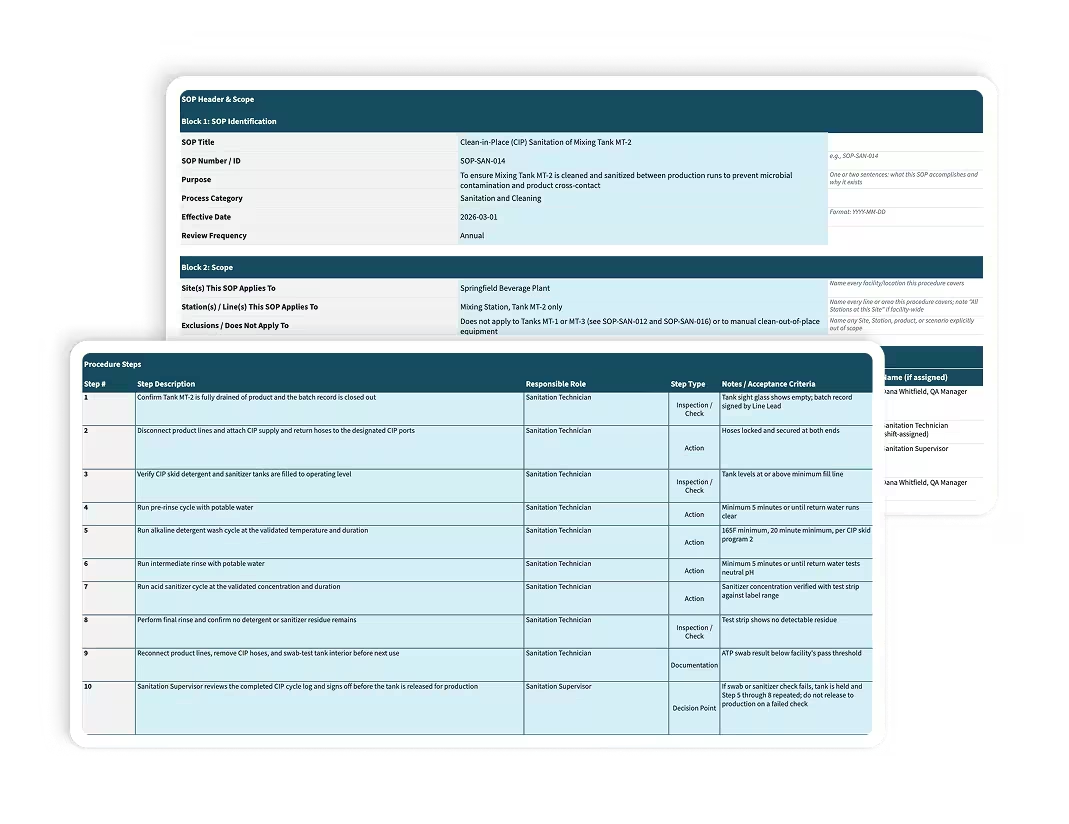
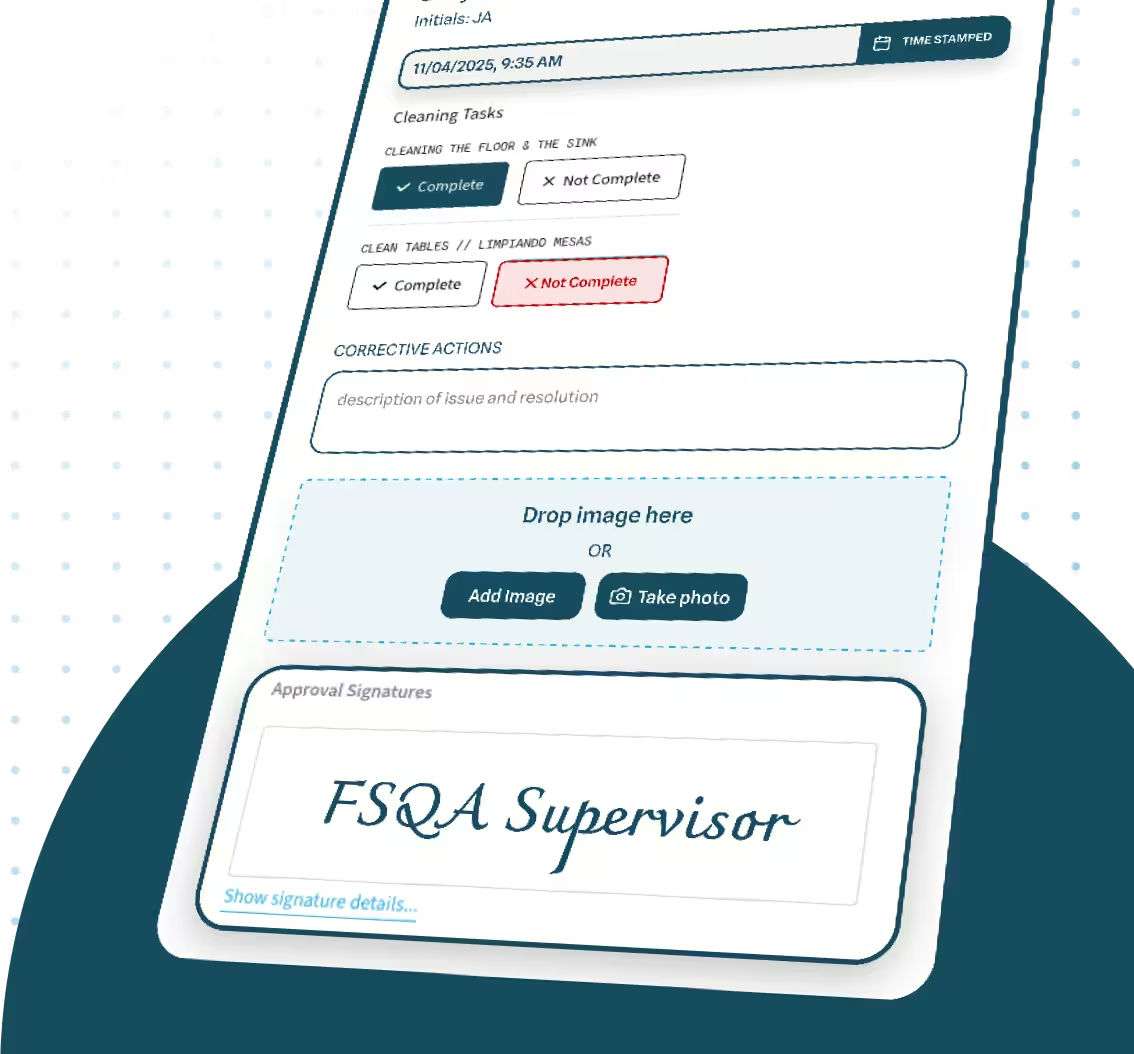
This is why controlled document control is foundational rather than administrative. You need current document versions, locked approval workflows, retained history, and fast retrieval. When an inspector asks for the sanitation record from a Tuesday three months ago, "we think it's in a binder somewhere" is not an answer that ends well.
Your Suppliers Are Part of Your Compliance
Your compliance does not stop at your own four walls. Under FSMA and every GFSI scheme, you are responsible for the hazards your suppliers control, which means supplier approval and verification are part of your own compliance record. An unapproved supplier or an expired certificate in your file is a finding waiting to happen.
Managing this well means tracking each supplier's approval status, certifications, expiration dates, and verification activities in one place. Strong supplier management turns a sprawling web of vendor documents into a controlled, alertable system, so you know before a certificate lapses rather than after an auditor points it out.
Why Spreadsheets Fail an Audit
Spreadsheets feel like control until the audit starts. They have no real version history, so you cannot prove which version was in effect when. They have no audit trail, so you cannot show who changed what and when. They cannot enforce signatures, send alerts, or prevent a well-meaning colleague from overwriting a critical cell.
The deeper problem is that spreadsheets scatter your compliance evidence across dozens of files and people. When the records that prove your compliance are fragmented, assembling them for an audit becomes a multi-day fire drill. A proper food safety management system centralizes that evidence and keeps it audit-ready by design.
Audit-Ready, Not Audit-Anxious
There are two ways to approach an audit. You can scramble in the weeks before, pulling records, chasing signatures, and hoping nothing surfaces. Or you can maintain continuous readiness, where the audit is just a snapshot of a system that is always current.
Continuous readiness is calmer, cheaper, and far more credible to auditors. When your records are captured in real time and your documents are controlled by default, food safety audit preparation shrinks from a project to a routine. The facilities that pass cleanly are almost always the ones that never stopped being ready.
Compliance is only as strong as the system that runs it. See how manufacturers manage records, suppliers, and audit readiness without the spreadsheet scramble.
See how Allera handles document control
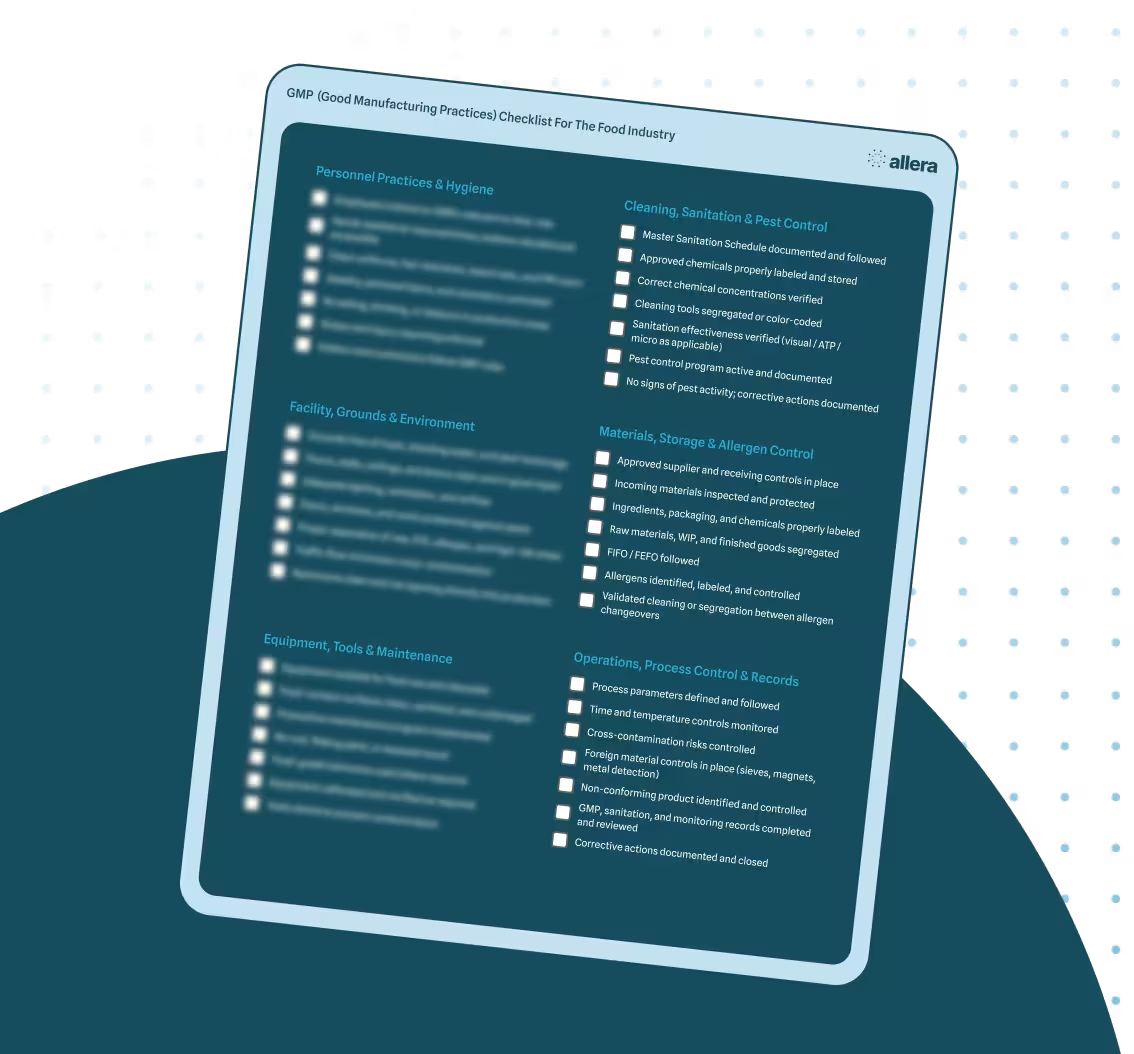
A Practical Food Safety Compliance Checklist
Use this as a working checklist to gauge where your program stands. It is organized from foundation to verification, and it reflects what an FDA inspector and a GFSI auditor will actually look for. Treat any "no" as a priority for your next quarter.
Foundational
- Your facility is registered with the FDA and registration is current.
- You have a written food safety plan that reflects your current products and processes.
- A trained Preventive Controls Qualified Individual is assigned and has prepared or overseen the plan. If you need to build this capability, see our overview of PCQI training programs.
- Current Good Manufacturing Practices are documented and in place across the facility.
Operational
- Monitoring records for every preventive control are captured at the defined frequency.
- Sanitation procedures are documented, executed, and recorded.
- Allergen controls are defined, including labeling, segregation, and changeover procedures.
- Supplier approvals and verification records are current for every active supplier.
Documentation
- Records are retained for the required period and can be retrieved on demand.
- Every deviation has a documented corrective action showing resolution.
- Training records exist for all personnel in food-safety-relevant roles.
- Documents carry version control and approval signatures.
Verification
- Internal audits are scheduled and conducted on a defined cycle.
- A mock recall has been performed and the results documented within the past year.
- Environmental monitoring trends are reviewed, not just collected.
- Management reviews the overall program at a defined cadence.
How Much Does Food Safety Compliance Cost?
Cost is the question everyone asks and few competitors answer honestly. The truthful answer is that it varies widely, but the drivers are predictable, and the cost of compliance is almost always smaller than the cost of getting it wrong.
The Cost Drivers
Several factors determine what a compliance program costs. Facility size and product risk set the baseline, since higher-risk products demand more controls and testing. Your number of suppliers drives verification workload, your certification scope determines audit fees, and your choice between in-house staff, consultants, and software shapes the ongoing labor cost.
Certification adds its own line items: the audit fee itself, plus the internal preparation time. These recur annually, so they belong in your operating budget rather than treated as a one-time project. The largest hidden cost, though, is usually labor spent assembling and chasing records by hand.
Cost of Compliance vs. Cost of Non-Compliance
Set your program budget against the alternative. A single recall can cost millions once you total product loss, logistics, legal fees, and lost sales, and that figure excludes the long tail of reputational damage. An import refusal strands a shipment; a lost retail listing erases a revenue stream you may never recover.
Against those numbers, a robust compliance program is inexpensive insurance. The math almost always favors investment, because the program cost is bounded and predictable while the cost of failure is open-ended. This is the heart of the cost-to-investment reframe: you are buying down a large, volatile risk with a small, fixed expense.
Where Software Lowers the Total Cost
The biggest controllable cost in compliance is labor, and that is where software moves the needle. Time spent manually logging records, hunting for documents, chasing approvals, and preparing for audits adds up to a substantial share of a quality team's week. Digitizing those workflows recovers that time.
Software also reduces the cost of mistakes by enforcing the discipline that prevents findings: required fields, automatic version control, expiration alerts, and complete audit trails. Our food safety software guide walks through how to evaluate tools for this. The total cost of compliance drops not because the requirements shrink, but because meeting them stops eating so much of your team's time.
FAQs
What are the 7 steps of food safety?
The seven steps of food safety are the seven principles of HACCP, the framework that underpins modern food safety planning:
- Conduct a hazard analysis.
- Determine the critical control points (CCPs).
- Establish critical limits for each CCP.
- Establish monitoring procedures.
- Establish corrective actions.
- Establish verification procedures.
- Establish recordkeeping and documentation procedures.
What are the 7 elements of compliance?
The seven elements of an effective compliance program, drawn from federal guidance, are:
- Written policies, procedures, and standards of conduct.
- A designated compliance officer or committee with authority.
- Effective training and education.
- Open lines of communication and reporting.
- Monitoring and auditing to detect problems.
- Consistent enforcement through clear disciplinary standards.
- Prompt response and corrective action when issues are found.
In food safety, these map closely onto FSMA's expectations for documented controls, qualified individuals, recordkeeping, verification, and corrective actions.
What is the 2 2 2 food rule?
The 2-2-2 rule is a simple guide for handling leftovers safely. Refrigerate food within 2 hours of cooking, store it in shallow containers no more than 2 inches deep so it cools quickly, and use or freeze it within 2 days. The principle behind it is the same one that drives commercial food safety: limit the time food spends at temperatures where bacteria multiply.
What are the 5 C's of compliance?
The five C's of compliance are often summarized as culture, conduct, compliance, communication, and controls. They describe what an effective program needs: a culture that values doing things right, conduct that matches the rules, documented compliance with requirements, clear communication and reporting channels, and controls that monitor and enforce the system. For a food facility, the controls and communication elements are what turn good intentions into audit-ready evidence.
What are the 3 C's of compliance?
The three C's of compliance are commonly described as culture, conduct, and compliance itself. Culture is the shared commitment to doing things correctly, conduct is how people actually behave day to day, and compliance is the documented adherence to rules and standards. In food manufacturing, a strong compliance culture is what keeps records accurate and controls followed when no auditor is watching.
What are the 5 key areas of compliance?
In a food safety program, compliance work tends to concentrate in five key areas:
- Regulatory requirements: knowing which FSMA, FDA, or USDA rules apply to your facility.
- Documented controls: hazard analysis and preventive controls that address your risks.
- Recordkeeping: capturing and retaining the evidence that controls are working.
- Training: ensuring staff and your PCQI are qualified for their roles.
- Monitoring and auditing: verifying the system continuously and correcting deviations.
What is the 2 hour 4 hour rule?
The 2 hour 4 hour rule guides how long ready-to-eat food can safely sit in the temperature danger zone, roughly 40 to 140 degrees Fahrenheit (5 to 60 degrees Celsius). If food has been in that zone for under 2 hours, you can use it or return it to refrigeration. Between 2 and 4 hours, you should use it immediately. Beyond 4 hours, you discard it, because pathogen growth makes it unsafe.
What are the 5 basic food safety rules?
The five basic food safety rules come from the World Health Organization's Five Keys to Safer Food:
- Keep clean: wash hands and sanitize surfaces and equipment.
- Separate raw and cooked: prevent cross-contamination between raw and ready-to-eat foods.
- Cook thoroughly: heat food to a temperature that destroys pathogens.
- Keep food at safe temperatures: hold cold food cold and hot food hot, out of the danger zone.
- Use safe water and raw materials: source clean water and approved ingredients.
In a manufacturing setting these principles are formalized into documented sanitation, process, and supplier controls.
What is the compliance of food safety?
Food safety compliance is the ongoing practice of meeting the laws, regulations, and certification-scheme requirements that govern how food is produced, handled, labeled, and documented. For a food manufacturer, it means running a documented food safety system and being able to prove it to regulators and auditors at any time. Compliance is a state you maintain every day of production, not a box you check once a year.
.avif)
.avif)
.avif)
.avif)
%20(1).avif)
.avif)
.avif)

%20(1).png)

.avif)



.avif)