.avif)



Metal Detection in Food Packaging | What You Should Know


Metal detection in food packaging is the use of electromagnetic inspection equipment integrated into food production and packaging lines to identify and reject metal contaminants before products reach consumers.
Foreign body contamination is one of the leading causes of food recalls in the United States. Metal contaminants (from equipment wear, raw material carry-over, or packaging line debris) are among the most common physical hazards FSQA teams are expected to control. And it is not just a recall risk: every major food safety certification standard, from BRCGS to SQF to FSSC 22000, mandates foreign body detection programs with documented critical limits, monitoring schedules, and corrective action procedures.
This guide covers how metal detection technology works, what each compliance standard requires, how to set up metal detection as a formal HACCP critical control point, and how to build a monitoring program your auditors will have nothing to question.
What Is Metal Detection in Food Packaging?
Metal detection in food packaging refers to electromagnetic inspection technology integrated into production lines to detect and reject ferrous, non-ferrous, and stainless steel contaminants in food products and their packaging before they reach retail shelves or end consumers.
The stakes are significant. Physical hazard recalls consistently rank among the top reasons for FDA-initiated food recalls in the US, and metal is one of the most common physical contaminants found. Beyond the direct consumer safety risk, a single foreign body incident can trigger a full product recall, regulatory scrutiny, and lasting reputational damage.
Metal detection is one of several essential food safety testing methods that FSQA teams use to control physical hazards at the production line level. Understanding how it works, what each standard requires, and how to document it correctly is core to any rigorous food safety program.
How Metal Detectors Work in Food Packaging Lines
Understanding the underlying technology helps you make better decisions about equipment setup, validation, and troubleshooting.
The Three-Coil Electromagnetic Principle
Most food-grade metal detectors use a three-coil electromagnetic system. A central transmitter coil generates a balanced electromagnetic field, flanked by two receiver coils. When no metal is present, the field between the receiver coils is balanced and no signal is generated. When a metal contaminant passes through, it disturbs this balance and the system triggers an automatic rejection event.
Sensitivity varies by metal type. Ferrous metals (iron and steel alloys) are the easiest to detect because they are both magnetic and electrically conductive. Non-ferrous metals (aluminium, copper, brass) are conductive but not magnetic, which makes them harder to detect, though still well within the range of modern equipment. Stainless steel is the most challenging: it has low electrical conductivity and is non-magnetic, which means smaller particles can slip under sensitivity thresholds on poorly configured equipment.
For more background on the mechanics, the Oklahoma State University Extension guide on metal detectors for food processing is a solid technical reference.
The Product Effect Challenge
The product effect is a well-known limitation of metal detection. Wet, salty, or high-moisture products (fresh meat, cheese, seafood, and ready meals) conduct electricity. This conductivity creates an electromagnetic signal that the detector cannot easily distinguish from a metal contaminant, leading to false rejections or, in the worst case, masking actual contamination.
Modern detectors address this with phase-correction technology, which filters the electromagnetic signal from the product itself so the system can still detect metal within it. Proper phase adjustment is set during commissioning and must be revalidated whenever the product formulation, moisture content, or packaging changes. This is particularly important for dairy, meat, seafood, and ambient-prepared categories.
Automatic Rejection Mechanisms
When a contaminant is detected, the system physically separates the affected product from the production line. Three rejection mechanisms are common: air blast systems (a burst of compressed air diverts the product into a reject bin), pusher arm systems (a mechanical arm ejects the product from the conveyor), and stop-and-alarm systems (the line halts and an operator physically removes the affected product). The right mechanism depends on product type, line speed, and packaging format.
Types of Metal Detectors Used in Food Packaging
Different production environments call for different equipment configurations. Understanding the main types helps you confirm your setup matches your product and line design.
Conveyor Belt Metal Detectors
Conveyor belt detectors are the most common configuration in packaged food production. Products pass through the detector aperture on a conveyor, and any rejected units are diverted by the rejection system downstream of the detector head. They work well for packaged goods including baked products, frozen meals, boxed items, confectionery, and snacks. Position on the line matters: final inspection is typically done just before or immediately after packaging to catch any contaminants introduced during filling or sealing.
Gravity-Feed and Pipeline Detectors
For free-flowing materials (grains, powders, nuts, spices, dried ingredients), gravity-feed and pipeline detectors are the right choice. Gravity-feed systems are installed vertically, allowing product to fall through the detection aperture under gravity before packaging. Pipeline detectors are used for liquid or semi-liquid products pumped through an enclosed pipe. Both configurations allow inspection of bulk product before it reaches the packaging stage.
Metalized and Foil Packaging
Metalized and foil packaging presents a specific problem for standard metal detection equipment. Because the packaging itself contains metallic material, it creates a significant electromagnetic signal that degrades the system's sensitivity, sometimes to the point where it cannot reliably detect contaminants at the critical limits your HACCP plan requires.
There are several practical solutions. X-ray inspection is the most common complement: X-ray systems work through metalized packaging because they detect differences in product density rather than electromagnetic disturbance. Phase-correction algorithms in modern detectors can partially compensate by filtering the packaging signal, but this comes at the cost of some sensitivity. Some facilities validate at a reduced sensitivity level for metalized packs and document this in their HACCP plan, though this approach may not meet all retailer specifications, which often set tighter thresholds than the certification standard minimum.
For snack, confectionery, and ready meal producers using foil pouches or metalized film, discuss this with your equipment supplier at commissioning and document the outcome as part of your validation study.
Your metal detection setup is only as reliable as the records behind it. Allera's food safety platform lets QA teams log every test, flag failures, and generate audit-ready CCP documentation automatically. See how it works →
Setting Up Metal Detection as a HACCP Critical Control Point
Metal detection is almost universally treated as a critical control point in food manufacturing HACCP plans, or as a preventive control under FSMA's Preventive Controls for Human Food rule. If you're unfamiliar with the broader structure, our guide to CCP examples in food manufacturing covers metal detection alongside other common control points.
The Codex Alimentarius HACCP System and Guidelines for Its Application provides the foundational framework that all major certification schemes build on. Here's how to apply it to metal detection specifically, using the seven HACCP principles as your guide.
Step 1: Conducting the Hazard Analysis
The first step is formally identifying metal contamination as a reasonably likely physical hazard in your process. Your hazard analysis should document the potential sources: equipment wear and tear (broken blades, worn seals, snapped fasteners), raw material contamination arriving from suppliers, and metal introduced during the packaging process itself.
Good manufacturing practices address physical hazard prevention upstream (equipment maintenance programs, supplier approval requirements, and facility inspections) but they do not eliminate the risk. That is why metal detection as a CCP is needed as a downstream catch. The hazard analysis output determines whether a CCP is required, and for most food manufacturing and packaging environments the answer is yes.
Step 2: Establishing Critical Limits
Your critical limit defines the maximum metal particle size that must be reliably detected and rejected. This is not a number you choose arbitrarily. It is determined by your hazard analysis, product type, line conditions, and the requirements of your certification standard and retail customers.
A commonly used starting point: 1.5mm ferrous, 2.0mm non-ferrous, and 2.5mm stainless steel for dry or low-moisture products. Wet or conductive products typically require looser limits due to the product effect. The FDA Fish and Fishery Products Hazards and Controls Guidance, Chapter 20: Metal Inclusion provides a useful model for documenting critical limits for seafood products. Your critical control point in your HACCP plan documentation should clearly state the limit, its basis, and the equipment settings used to achieve it.
Step 3: Monitoring Procedures
Monitoring confirms that your metal detector is performing at the critical limit during every production run. The standard monitoring schedule includes: a startup check before production begins, periodic checks during production (typically every 30–60 minutes), a check at each product changeover, and a final check at shift end.
Each check uses certified test pieces (ferrous, non-ferrous, and stainless steel spheres) at the critical limit size. The test piece must pass through the detector and trigger a rejection. If it does not, production stops immediately. All results must be recorded by the operator or QA technician at the time of the check, with the date, time, and their signature.
Step 4: Corrective Actions
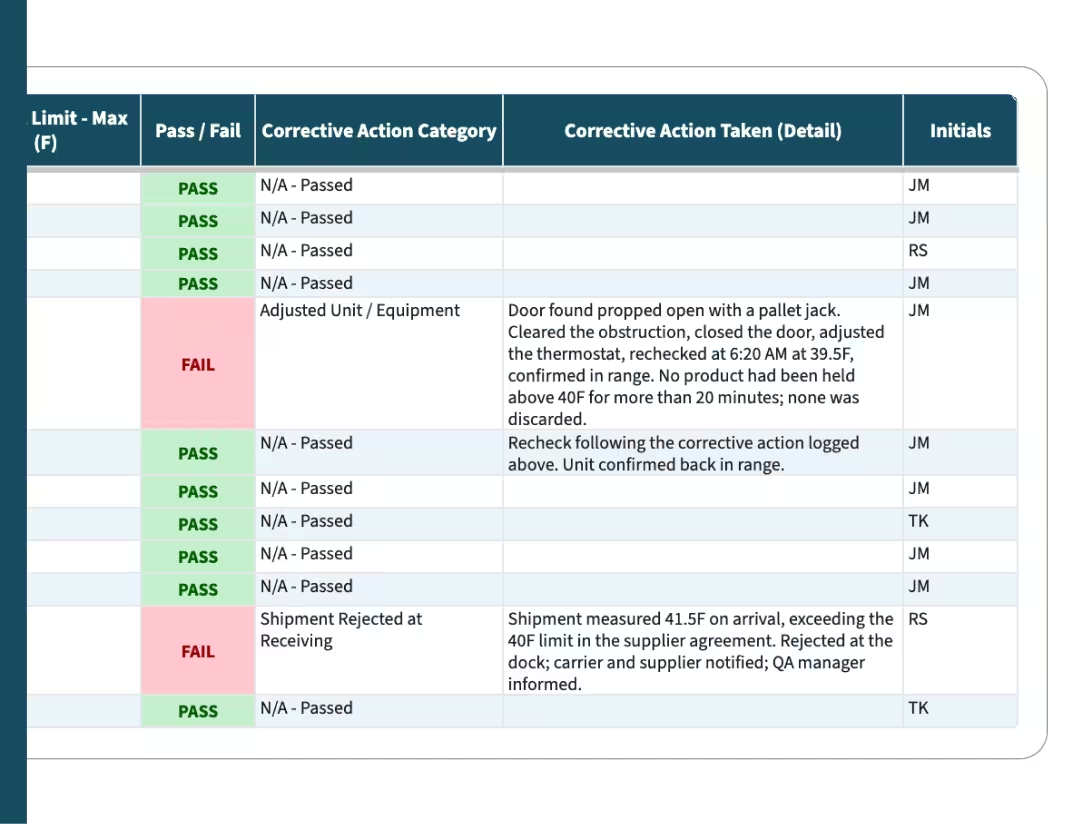
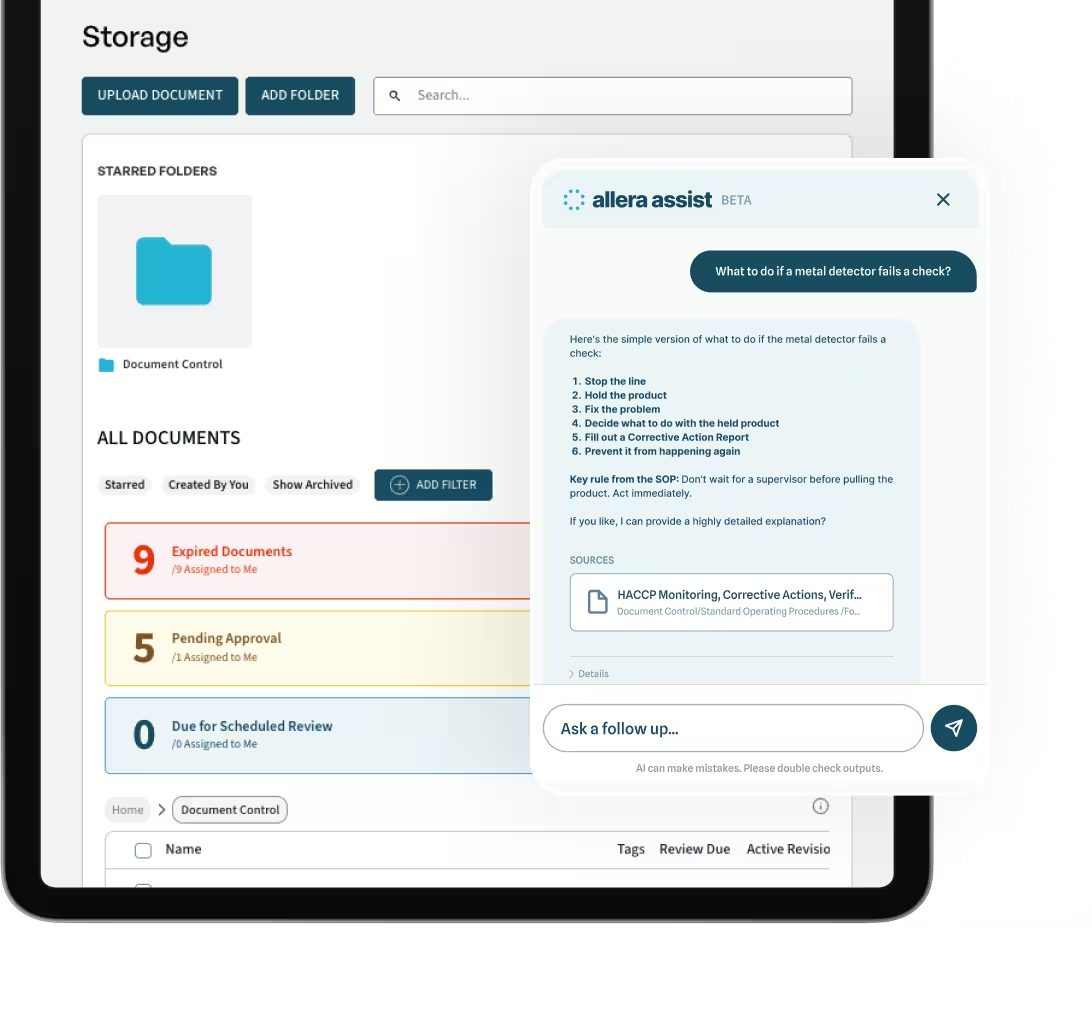
When a monitoring check fails (meaning the detector does not reject the test piece), your corrective action procedure kicks in immediately. The production line stops. All product produced since the last passing check is quarantined and held for investigation. The root cause is identified: equipment fault, settings drift, test piece condition, or a maintenance issue.
No product leaves quarantine until the detector is re-validated and confirmed to be performing at the critical limit. All corrective actions must be documented: what happened, what product was affected, what caused it, and what was done to resolve it. This documentation is reviewed during food safety audits and is a key part of your HACCP records.
Step 5: Verification and Record-Keeping
Verification is ongoing confirmation that your validated system continues to work correctly; the next section covers its distinction from validation in full. Verification activities for metal detection include reviewing monitoring records, calibration logs, and corrective action reports on a scheduled basis, typically weekly or monthly depending on your standard and production volume.
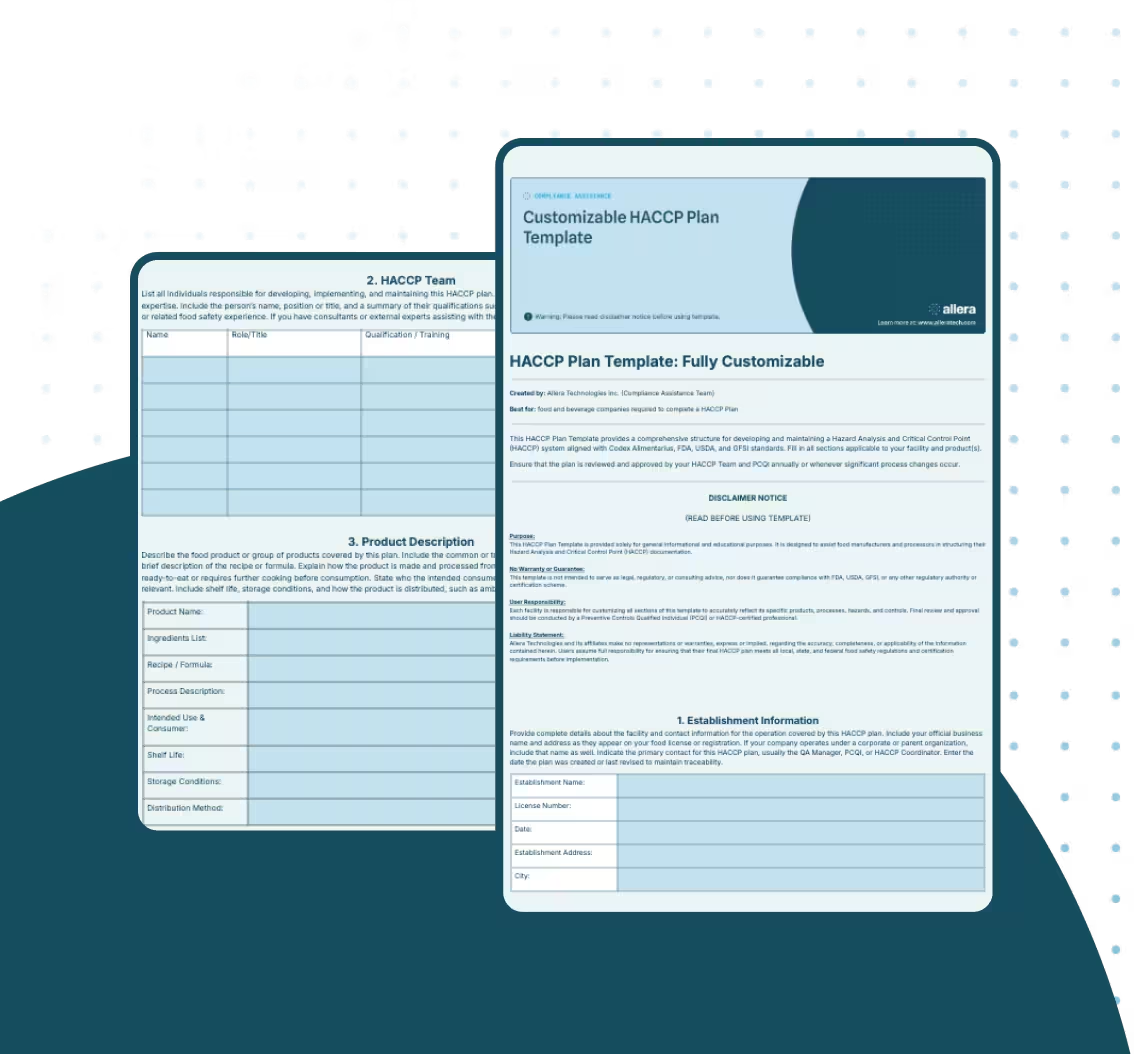
Records to retain: startup and shift-end test results, periodic monitoring logs, corrective action reports, equipment calibration and maintenance logs, and your validation study report. Under FSMA, records must be retained for a minimum of two years. If you are building your documentation structure from scratch, the free HACCP plan template can serve as a useful starting framework for your CCP record format.
What's the Difference Between Validation and Verification?
This is one of the most common points of confusion for FSQA teams, and getting it wrong is a common audit finding.
Validation proves that your metal detection system is capable of detecting the defined contaminant size under the specific production conditions. This is done at equipment commissioning, after any product or process change, and after any significant equipment repair or adjustment. A validation study typically involves running product through the line with test pieces at the critical limit size, under realistic production conditions (speed, product load, packaging), and confirming consistent detection and rejection.
Verification is the ongoing confirmation that the validated system continues to work correctly during production. Your startup checks, periodic shift checks, and review of monitoring records are all verification activities.
The distinction matters because the two activities are performed at different times, by different people, and generate different records, all of which are checked during BRCGS, SQF, FSSC 22000, and FSMA audits.
Validation
- When: Initial setup; product/process changes
- Who: QA Manager or specialist
- What it proves: System CAN detect at critical limit
- Documentation: Validation study report
- Standard requirement: BRCGS, SQF, FSSC 22000, FSMA
Verification
- When: Every shift; every startup
- Who: Line operator / QA tech
- What it proves: System IS detecting at critical limit
- Documentation: Monitoring log / CCP record
- Standard requirement: All standards
Metal Detection Compliance Requirements by Certification Scheme
No resource in the top search results maps all the relevant standards in one place. Here's what each scheme actually requires. Metal detection sits within a broader food safety management system and must be treated as a formal control, not just a piece of equipment on the line. All GFSI-recognised standards (BRCGS, SQF, FSSC 22000, and IFS) require foreign body detection controls as part of their requirements. See the GFSI-Recognised Certification Programme Owners page for the full list of benchmarked programmes.
FSMA Preventive Controls Rule (FDA)
Under the FDA's Preventive Controls for Human Food rule (21 CFR Part 117), metal detection qualifies as a preventive control for physical hazards. Facilities subject to FSMA must identify metal contamination as a hazard in their food safety plan if it is reasonably likely to occur, and implement and validate a control measure.
The FDA Compliance Policy Guide Sec. 555.425 defines the agency's enforcement threshold: hard or sharp foreign objects over 7mm in a ready-to-eat food are actionable. This does not mean your critical limit should be 7mm. It should be set to detect the smallest particle that poses a consumer safety risk under your specific product conditions.
For USDA-regulated meat and poultry facilities, USDA FSIS Directive 7310.5 governs foreign material control and documentation requirements. FSMA records must be signed, dated, and retained for a minimum of two years, and the Preventive Controls Qualified Individual (PCQI) must validate the control and review records regularly. For the broader traceability and recall context that sits alongside metal detection programs, our food traceability and recall management guide covers the FSMA 204 requirements.
BRCGS Global Standard for Food Safety Issue 9
BRCGS Clause 4.9.3 requires that metal detection and other foreign body detection equipment be validated to confirm it can detect contaminants at the defined critical limit, and verified at set frequencies during production. Documented sensitivity levels are required: your validation study report must state the specific test piece sizes used and confirmed. A corrective action procedure must be written and followed when checks fail.
BRCGS also specifies minimum testing frequency in its guidance and expects that test frequency is risk-justified. Equipment calibration records and maintenance logs are reviewed during BRCGS audits. For full certification requirements, see our BRCGS certification requirements guide and the BRCGS Global Standard for Food Safety Issue 9 directly.
SQF Code: Element 11.7 Foreign Body Prevention
The SQF Code requires a documented foreign body prevention program under Element 11.7. This program must include metal detection where the hazard analysis identifies metal contamination as a food safety risk. Monitoring records must be signed by a responsible person, and the program must include documented critical limits and corrective action procedures.
The SQF Institute Guidance and Checklists for SQF Code compliance provides additional context on what auditors look for in practice.
FSSC 22000 Version 6
FSSC 22000 addresses metal detection through its Prerequisite Programme (PRP) on product inspection and testing, which covers foreign body detection equipment. Version 6 added explicit requirements for monitoring the measurement system, meaning the detector itself must be included in your measurement and monitoring equipment program, with calibration records. See our breakdown of the FSSC 22000 Version 6 changes for how this update affects your existing program, and the FSSC 22000 standard for the full requirements.
IFS Food Standard
The IFS Food Standard requires that hazard analysis include physical contaminants, and treats metal detection as a key control measure for relevant processes. IFS auditors review your hazard analysis documentation, control measure justification, critical limits, monitoring records, and corrective action history, the same core documentation package required by the other standards.
Metal Detection Sensitivity Standards: Thresholds by Certification Scheme
Sensitivity thresholds define the minimum contaminant size your metal detector must reliably detect and reject. These thresholds vary by standard, product type, and retailer specification. The table below gives you the benchmark values used across the industry.
| Standard / Specification | Ferrous | Non-Ferrous | Stainless Steel |
|---|---|---|---|
| Industry best practice (dry products) | 1.5mm | 2.0mm | 2.5mm |
| Industry best practice (wet/high-moisture) | 2.0mm | 2.5mm | 3.5mm |
| Retail specification (typical UK/EU retailers) | 1.0mm | 1.5mm | 2.5mm |
| BRCGS Clause 4.9.3 (minimum documented level) | Per validation | Per validation | Per validation |
| FDA CPG Sec. 555.425 (hard/sharp foreign objects) | >7mm actionable (all materials) | N/A | N/A |
| SQF Code 11.7 | Per documented program | Per documented program | Per documented program |
Thresholds are expressed as the minimum sphere diameter that must be reliably detected under production conditions. BRCGS and SQF do not mandate fixed numbers. They require you to document and validate whatever limit your hazard analysis determines is appropriate. Retail customer specifications often set tighter limits than certification standards, so review your retailer code of practice before setting your critical limits.
Metal Detection vs. X-Ray Inspection: Which Is Right for Your Line?
Metal detection and X-ray inspection are both accepted foreign body detection technologies under all major certification standards. They are not always alternatives. Many facilities run both in sequence. The right choice depends on your product, packaging, hazard profile, and budget.
Metal Detection
- Contaminants detected: Ferrous, non-ferrous, stainless steel
- Metalized packaging: Degraded sensitivity (significant limitation)
- Capital cost: Lower ($5,000–$40,000 typical range)
- Operating cost: Lower
- Detection in wet/conductive products: Challenging (product effect)
- Regulatory acceptance: Accepted by all standards
- Throughput speed: Very high-speed
- Best for: Dry or non-foil packaged goods; high-volume commodity lines
X-Ray Inspection
- Contaminants detected: Metal + non-metal (glass, bone, dense plastics, stone)
- Metalized packaging: Works well through metalized packaging
- Capital cost: Higher ($30,000–$150,000+)
- Operating cost: Higher (maintenance, X-ray tube replacement)
- Detection in wet/conductive products: Less affected
- Regulatory acceptance: Accepted by all standards
- Throughput speed: High, but typically lower
- Best for: Metalized/foil packs; high-value products; multi-hazard detection
When to choose metal detection only: Your products are not in metalized packaging, your hazard profile does not include glass or bone, and your budget favors a lower capital outlay. Metal detection handles the physical hazard risk at high throughput and low operating cost.
When to add X-ray: You produce in foil or metalized film packaging, your product presents a realistic risk of bone, glass, or dense plastic contamination, or your retail customer specification requires X-ray inspection.
When to run both in sequence: High-risk product categories (baby food, allergen-sensitive products, premium ready meals), or facilities where multiple packaging formats (some metalized, some not) run through the same line.
Building Your Metal Detection Monitoring Program
A monitoring program is only as strong as its structure and its records. Here's what a defensible program looks like in practice.
Testing Frequency Schedule
The minimum testing schedule recognized across all major standards:
- Startup: Before production begins, test with all three test pieces (Fe, NFe, SS) at the critical limit size
- During production: Every 30–60 minutes, or at whatever interval is specified in your HACCP plan and risk-justified
- Product changeover: Re-test immediately after any change in product, packaging format, line speed, or detector settings
- Shift end: Final test before shutdown: if this fails, quarantine all product produced since the last passing check and work backward to identify the affected batch
- After maintenance or adjustment: Full re-validation before production restarts
Test Pieces and Equipment
Test pieces are calibrated spheres of ferrous, non-ferrous, and stainless steel at the defined critical limit size. They must be certified and traceable (with a certificate of conformity from your supplier) and replaced on the manufacturer's recommended schedule, typically annually.
Each test piece must be stored securely when not in use, with serial numbers logged in your calibration records. A damaged, worn, or demagnetized test piece may not replicate the detection challenge accurately, which means your monitoring checks are not confirming what you think they are. Treat test piece management as part of your measurement and monitoring equipment program.
Documentation and Record-Keeping
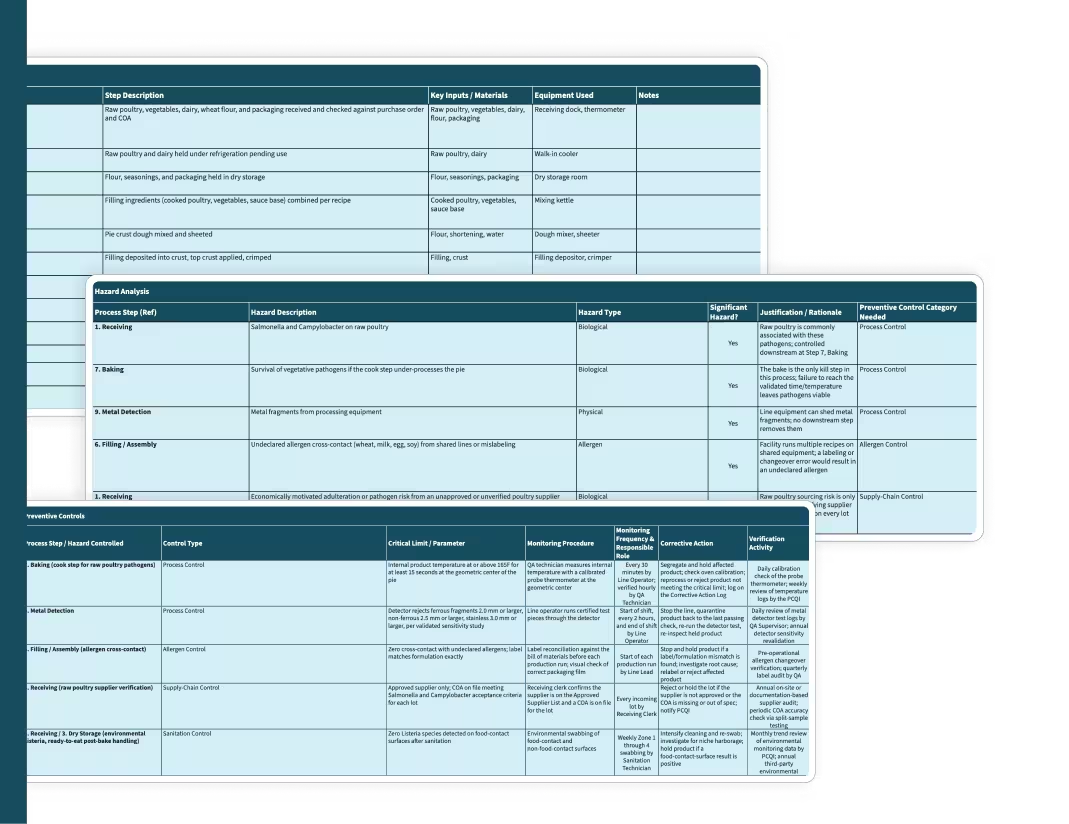
Every check generates a record. At minimum, each record must capture: the date and time of the check, the test piece sizes used, whether each test piece was detected and rejected, the name and signature of the operator performing the check, and any corrective actions taken.
Paper records are FSMA-compliant, but digital records significantly reduce audit preparation time. Searching and exporting three years of paper CCP logs during an unannounced audit is a stressful exercise that digital systems eliminate. You can also explore how a FSQA guide for food manufacturers approaches the broader documentation strategy behind programs like this.
For retention periods: two years minimum under FSMA, three or more years in practice for BRCGS and SQF. When in doubt, retain longer. Your food quality control processes documentation framework should align with whatever retention schedule your most demanding standard requires.
Managing metal detection records, corrective action logs, and CCP monitoring across multiple lines adds up fast. Allera's food safety platform centralizes everything in one place, so your team spends less time on paperwork and more time on production. Book a 30-minute demo →
FAQs
What is the product effect in metal detection?
The product effect occurs when the food itself conducts electricity and interferes with the detector's electromagnetic field. Wet, salty, or high-moisture products (fresh meat, cheese, seafood, ready meals) are most affected, causing false rejections or masking actual contaminants.
Modern detectors address this with phase-correction technology, which filters the product's electromagnetic signal so the system can still detect metal within it. Phase settings must be calibrated at commissioning and revalidated whenever product formulation, moisture content, or packaging changes.
How often should metal detectors be tested in food production?
Most certification standards require testing at these minimum intervals:
- Startup: before production begins, using all three test piece types
- During production: every 30-60 minutes (or per your HACCP plan)
- Product changeover: after any change in product, packaging, line speed, or detector settings
- Shift end: final check before shutdown
- After maintenance: full re-validation before restarting
If a check fails, all product produced since the last passing check must be quarantined and investigated before release.
How do you validate a metal detector for food safety?
Metal detector validation confirms the system can reliably detect contaminants at the defined critical limit under actual production conditions. The process involves:
- Running product through the line at production speed with certified test pieces (ferrous, non-ferrous, and stainless steel spheres at the critical limit size)
- Confirming each test piece triggers a rejection consistently
- Documenting the settings, product conditions, and results in a validation study report
Validation must be repeated after product or process changes, packaging changes, or significant equipment repairs. This is distinct from verification, which is the ongoing shift-level check that the validated system continues to perform correctly.
What is the difference between metal detection and X-ray inspection?
Metal detection uses electromagnetic fields to identify ferrous, non-ferrous, and stainless steel contaminants. X-ray inspection uses radiation to detect differences in product density, finding metal as well as non-metal contaminants like glass, bone, and dense plastics.
Key practical differences:
- Metalized packaging: metal detection struggles with foil or metalized film; X-ray works through it
- Cost: metal detection has lower capital and operating costs
- Contaminant range: X-ray detects a wider range of foreign bodies
Many facilities use both in sequence for comprehensive coverage, particularly in high-risk product categories.
What metals can food detectors detect?
Food metal detectors can detect three categories of metal:
- Ferrous metals (iron and steel alloys): the easiest to detect because they are both magnetic and electrically conductive
- Non-ferrous metals (aluminium, copper, brass): conductive but not magnetic, moderately difficult to detect
- Stainless steel: the hardest to detect due to low electrical conductivity and low magnetic permeability
Sensitivity varies by product type and equipment configuration. Stainless steel detection requires proper phase calibration and validated test piece sizes.
Is metal detection required by the FDA?
Under FSMA's Preventive Controls for Human Food rule (21 CFR Part 117), metal detection is a recognized physical hazard control measure. Facilities must identify metal contamination as a hazard in their food safety plan if it is reasonably likely to occur, and implement and validate a control measure.
The FDA's Compliance Policy Guide (CPG Sec. 555.425) defines actionable thresholds for hard or sharp foreign objects. For USDA-regulated meat and poultry facilities, FSIS Directive 7310.5 governs foreign material presence and documentation requirements.
Why is metal detection important in food manufacturing?
Metal contamination is one of the leading causes of FDA-initiated food recalls in the US. A single foreign body incident can trigger a full product recall, regulatory scrutiny, and lasting consumer safety and reputational consequences.
Beyond recall prevention, metal detection is a mandated control under every major food safety certification standard, including BRCGS, SQF, FSSC 22000, and IFS. Under FSMA it is classified as a preventive control for physical hazards that must be validated and documented in your food safety plan.
What is metal detection in food packaging?
Metal detection in food packaging uses electromagnetic technology to identify ferrous, non-ferrous, and stainless steel contaminants in food products and packaging before they reach consumers. Detectors are integrated into production lines and trigger automatic rejection of contaminated units.
It is a mandated control under every major food safety certification standard (BRCGS, SQF, FSSC 22000, IFS) and a recognized preventive control under FSMA's Preventive Controls for Human Food rule.



.avif)
.avif)

.avif)

.avif)
%20(1).avif)


.avif)
.avif)

%20(1).png)

.avif)



.avif)