.avif)



Mock Recall Guide for Food Manufacturers

Mock Recall: A Complete Guide for Food Manufacturers
Running a mock recall before an auditor asks for one is one of the most practical investments a food manufacturer can make in audit-readiness. Whether your facility operates under FDA Preventive Controls, FSMA 204, SQF, BRCGS, or FSSC 22000, a credible, documented mock recall is the single most direct test of whether your recall program actually works. This guide walks through what a mock recall is, what each regulatory and certification scheme requires, and exactly how to run one that holds up under scrutiny.
What Is a Mock Recall?
A mock recall is a simulated, documented exercise that tests whether your facility can identify, locate, and account for a specific lot of product across raw materials, work-in-process, and finished goods within the time and accuracy thresholds expected by FDA, USDA FSIS, and your certification scheme.
The word "mock" is load-bearing. No product is actually recalled. No public notice goes out. Customers are not contacted for real. Every other element of your recall procedure, however, is executed end-to-end: tracing the lot, calculating a mass balance, drafting notifications, escalating to leadership, and documenting the result.
A credible mock recall must verify five things: forward trace (lot to customer), backward trace (lot to raw materials), mass balance (accounting for every kilogram or case), internal communications and decision speed, and the completeness of your corrective-action system when gaps are found.
Mock Recall vs. Traceability Exercise vs. Recall Drill
These three terms are often used interchangeably, and that conflation is one of the most common causes of audit non-conformances. Auditors under BRCGS Issue 9, SQF Edition 9, and FSSC 22000 will ask for records of specific exercise types. If your documentation labels a traceability test as a mock recall, or vice versa, the auditor will note it.
| Exercise type | What it tests | Scope | Typical frequency |
|---|---|---|---|
| Traceability exercise | Records, lot codes, forward/backward chain only | Lot identification, no comms tested | SQF: annual; BRCGS: every 6 months |
| Mock recall | Traceability plus decision speed and internal comms | Full recall procedure, no public notice | At least annually (most schemes) |
| Recall drill (full) | Mock recall plus simulated external comms and customer notification | Mirrors a real recall end-to-end | Often biennial; site-defined |
| Real recall | All of the above plus public notification and FDA reporting | Actual product removal | When required |
Understanding the distinction matters practically. Under BRCGS Issue 9, a traceability test is required every 6 months and a full recall test is required annually. Those are two separate records. Under SQF Edition 9, the same logic applies: Clause 2.6.2 and Clause 2.6.3 are separate requirements. If you run one combined exercise and label it as both, you may satisfy neither.
For more on food traceability records and FSMA 204 requirements, see the linked guides.
Why Mock Recalls Matter (Beyond the Audit)
Regulatory expectation
FDA does not publish a specific mock recall frequency requirement. A working recall plan is required under 21 CFR Part 7 and under the Preventive Controls for Human Food rule (21 CFR 117.139), and a mock recall is the standard way to demonstrate that the plan functions. The FDA recalls background and definitions page lays out the framework regulators use when evaluating whether a company's recall program is credible.
FSIS under 9 CFR Part 418 requires meat, poultry, and egg products establishments to maintain a written recall plan with specific procedures for product identification, segregation, notification, and disposition. A written plan that has never been tested is a plan regulators cannot trust.
Under FSMA 204, with Key Data Element and Critical Tracking Event recordkeeping in force, the mock recall is the most direct way to verify that your Food Traceability List records are actually retrievable in the time and format FDA expects.
Certification expectation
SQF, BRCGS, and FSSC 22000 all require periodic mock recalls or recall tests as a condition of certification. The specifics vary by scheme and are covered in detail in the next section, but no major food safety certification scheme treats mock recalls as optional.
Operational reality
Unprepared facilities measure time-to-trace in days. Auditors and regulators expect hours, with a 2-to-4-hour forward-and-backward trace being the de facto benchmark. Mock recalls surface the gaps that make that timeline impossible: stale customer contact lists, missing lot codes on rework batches, ingredients received without supplier COAs, and WIP that left the production floor without a lot-code handoff.
The exercise also reveals systemic problems that are invisible until you try to move quickly. A customer who changed their logistics provider two years ago. An ingredient supplier who sends lot codes in a non-searchable PDF format. A QA retain sample that was logged in a separate system with a different lot code format. These gaps are easy to fix with time; they are catastrophic during an actual recall.
Insurance and liability
Product liability insurers increasingly request evidence of documented mock recall programs at policy renewal. A documented, scored, corrective-action-linked mock recall history is a concrete signal of due care. In the event of a real recall, it is also evidence that the facility operated a functioning food safety management system, which matters significantly in liability proceedings.
Mock Recall Requirements by Standard
FDA: 21 CFR Part 7 and FSMA Preventive Controls
FDA does not mandate a specific mock recall frequency, but a working recall plan is required under the Preventive Controls for Human Food rule (21 CFR 117.139). The rule requires that the plan identify the situations that would initiate a recall, the steps to be taken, the personnel responsible, and how effectiveness will be verified.
Mock recalls are the standard mechanism to demonstrate the plan works. FDA investigators reviewing a facility's recall readiness will look for evidence that the plan has been exercised and that findings were closed.
The FSMA Reportable Food Registry requires notification within 24 hours of a reportable food event. That 24-hour window is only achievable if your traceability chain is already working. FDA guidance on initiation of voluntary recalls provides additional detail on the regulatory process.
FSMA 204: Food Traceability Final Rule
FSMA 204 applies to manufacturers, processors, packers, and holders of foods on the Food Traceability List. That list includes leafy greens, fresh-cut produce, shell eggs, nut butters, certain cheeses, deli salads, and several seafood categories.
Mock recalls under FSMA 204 must verify that Key Data Elements are retrievable for each Critical Tracking Event in scope: growing, receiving, transforming, creating, and shipping. Records must be produced within 24 hours of an FDA request in an electronic, sortable spreadsheet format.
The original compliance date was January 20, 2026. FDA has since proposed extending the compliance deadline to July 20, 2028, to give industry more time to build compliant systems. Regardless of the final deadline, the expectation that KDE/CTE records are retrievable and complete does not change.
Review the FSMA Final Rule on Food Traceability and the Food Traceability List to confirm which of your products are in scope.
USDA FSIS: 9 CFR Part 418
FSIS regulations apply to federally inspected meat, poultry, and egg products establishments. Under 9 CFR Part 418, each establishment must maintain a written recall plan with documented procedures for product identification, segregation, customer and regulator notification, and disposition.
FSIS Directive 8080.1 documents the recall classification process and establishes how FSIS coordinates with establishments during an actual recall. A mock recall gives your team direct practice with those procedures before they matter. The USDA FSIS Recall Process page is the authoritative reference.
SQF Edition 9: Section 2.6
SQF Edition 9 contains two separate requirements that are frequently conflated.
Clause 2.6.2 requires a written product traceability procedure that must be tested at least annually. This is the traceability exercise. It verifies that lot records can be retrieved and traced forward and backward through the supply chain.
Clause 2.6.3 requires a written product withdrawal and recall procedure, and a mock recall to verify that procedure at least annually. This is distinct from the traceability test. Running one exercise and labeling it as both will result in a non-conformance against one or both clauses.
SQF also requires that suppliers notify SQFI within 24 hours of any public-facing food safety incident or product recall. Your recall plan should include that notification step explicitly.
For a comprehensive view of SQF requirements, see the SQF audit checklist.
BRCGS Food Safety Issue 9: Clause 3.11
BRCGS Issue 9 is explicit about the distinction between a traceability test and a recall test.
Clause 3.11.1 requires a documented procedure for product withdrawal and recall. Clause 3.11.2 requires a traceability test at minimum every 6 months, with full forward and backward trace and mass balance. Clause 3.11.3 requires a documented recall test at minimum annually, exercising the full procedure including communications.
All tests must be documented and all findings must be actioned. BRCGS auditors will ask for records of both exercises and will check that corrective actions from previous exercises were closed before the current audit.
See the BRCGS certification guide for a broader view of BRCGS Issue 9 requirements.
FSSC 22000 V6 (Built on ISO 22000:2018, Clause 8.9.5)
ISO 22000:2018 Clause 8.9.5 requires that your organization establish, implement, and maintain documented procedures for the withdrawal and recall of unsafe end products. Periodic testing of those procedures is required.
The FSSC 22000 V6 audit report requires details of any actual recall that occurred during the certification period, as well as evidence that similar products were evaluated. ISO/TS 22002-1 Clause 15 provides additional prerequisite guidance on withdrawal and recall procedures for food manufacturing.
For scheme-specific requirements, see FSSC 22000 Version 6 and the FSSC 22000 Version 6 Scheme document.
Cross-Scheme Requirements Table
| Requirement | FDA (21 CFR 7 / 117) | FSMA 204 | FSIS (9 CFR 418) | SQF Ed. 9 §2.6 | BRCGS Issue 9 §3.11 | FSSC 22000 V6 / ISO 22000 §8.9.5 |
|---|---|---|---|---|---|---|
| Written recall plan | Required (PC rule) | Implicit via KDE/CTE records | Required | Required | Required | Required |
| Mock recall / recall test | Recommended | Effectively required for FTL | Recommended | Annual | Annual (full recall test) | Periodic; minimum annual |
| Traceability test (separate) | Not specified | Required for FTL records | Implicit | Annual | Every 6 months | Periodic |
| Mass balance | Best practice | Implicit | Best practice | Required | Required | Required |
| Record retention | Per PC rule | 2 years | Per Part 418 | Per scheme | Per scheme | Per scheme |
| 24-hr notification | Reportable Food Registry | FDA on request | FSIS as applicable | SQFI within 24 hrs | CB within 3 working days | CB per scheme |
The 7 Steps of a Defensible Mock Recall
Step 1: Pick a Realistic Scenario
The scenario drives everything else. A vague or overly convenient scenario produces a mock recall that looks good on paper but fails to stress-test your actual procedures.
Specify the trigger (customer complaint, supplier notification, internal positive), the product and its lot or date code, the hazard type, and the FDA recall classification: Class I (reasonable probability of serious adverse health consequences), Class II (remote probability), or Class III (not likely to cause adverse health consequences). Rotate scenarios across exercises so that over a three-year cycle you have covered allergen, pathogen, foreign material, supplier defect, and label error scenarios.
Step 2: Set Time Targets Before You Start
Define your targets before the exercise begins. The 2-to-4-hour forward-and-backward trace is the audit benchmark for a manufacturer with functional records. Write down the target time-to-trace, the target time-to-notify for the communications step, and the mass-balance accuracy target (industry standard: 99 percent or higher).
Setting targets in advance means you score the exercise against objective criteria, not against the feeling in the room when it ends. It also gives you a baseline for tracking improvement over time.
Step 3: Trace Forward (Lot to Customer)
Pull the production record for the selected lot. Identify every shipment that contained that lot, by customer name, shipment date, and quantity. Verify that the customer contact records in your recall notification list are current: email addresses, phone numbers, and logistics contacts for each customer. This is where most facilities encounter their first significant gap.
Stop the clock and record elapsed time when the forward trace is complete. If you cannot identify all customers who received the lot, that is a finding, and it should be documented as one.
Step 4: Trace Backward (Lot to Raw Materials)
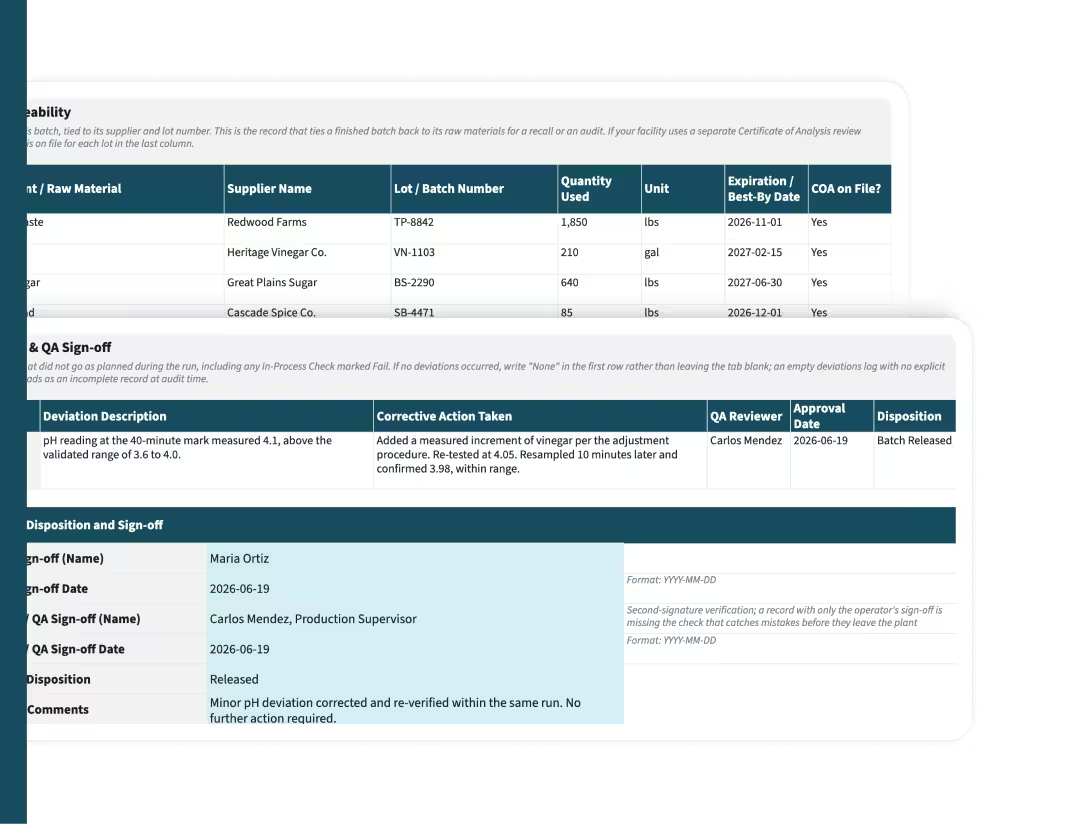
From the same production record, pull each ingredient lot used in the batch. For each ingredient lot, verify that the supplier certificate of analysis and the receiving record are on file. Cross-reference lot codes between the production record and the receiving log.
For FSMA 204 FTL foods, verify that KDE records for each CTE in scope are retrievable in the required format. If your receiving records for an ingredient do not include the required KDEs, that is a gap, and the mock recall is the right time to find it.
Stop the clock again. Time-to-backward-trace is a separate metric from time-to-forward-trace.
Step 5: Reconcile Mass Balance
The mass balance equation is: Quantity Produced = Quantity Shipped + Quantity On-Hand + Quantity Discarded/Reworked/Sampled.
Here is a worked example using round numbers. A 10,000 kg batch was produced. Shipping records show 7,800 kg shipped across 14 customers. Finished-goods inventory shows 1,950 kg on hand. QA retain and lab samples account for 180 kg. That leaves 70 kg unaccounted for, a 0.7 percent gap. Because the industry target is 99 percent or higher accountability, this result falls just below the threshold and requires a corrective action to identify the source of the gap.
Document the source record for every line in the mass balance. An unsupported number is not a mass balance; it is an estimate, and an auditor will treat it as such.
For context on how mass balance fits within broader supply-chain controls, see the food and beverage supply chain guide.
Step 6: Run the Communications Tape
Dry-run the recall notification sequence without sending any external communications. Draft the customer notification email. Log a simulated customer notification call. Escalate to the recall coordinator and to executive leadership per the recall plan. Verify that regulator notification templates are current and that the correct FDA or FSIS contact information is in the plan.
Flag every draft with the label "MOCK RECALL: DO NOT SEND" so that there is no ambiguity if a draft document is found outside the exercise file. Time-stamp every step in the sequence. The communications tape is where you discover that the recall coordinator's phone number changed six months ago, or that the executive notification template still references a VP who left the company.
Step 7: Score, Document, and Close
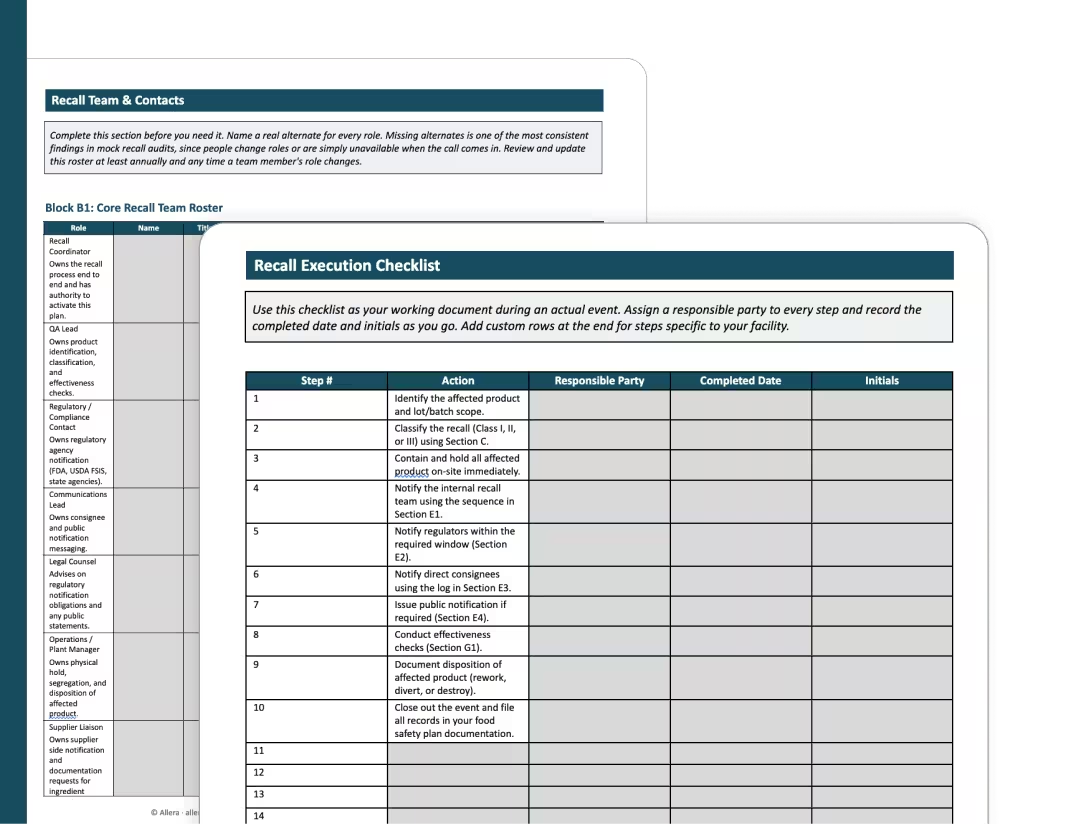
Score the exercise against the targets you set in Step 2. Record the final time-to-forward-trace, time-to-backward-trace, mass-balance percentage, and communications completeness. For every gap found, write a corrective action with a named owner and a due date.
Update the recall plan if the exercise revealed procedural defects. File the complete record: timestamps, mass-balance worksheet, communications drafts, scenario description, team roster, and corrective actions with owners and closure evidence. This file is what an auditor will review.
For guidance on structuring recall exercise records, see document control.
How to Score a Mock Recall (Pass/Fail Rubric)
Scoring matters because an undocumented exercise or a subjectively "successful" exercise provides no defensible evidence. An auditor reviewing your mock recall record wants to see criteria, measurements, and outcomes, not a narrative that says the exercise went well. Use a rubric like this one and fill in your pass/fail result for each criterion after the exercise.
| Criterion | Target | Pass | Fail | What it tests |
|---|---|---|---|---|
| Time to forward trace | 2 hours or less (audit benchmark) | Shipping records, customer DB freshness | ||
| Time to backward trace | 2 hours or less | Receiving records, COA retrieval | ||
| Mass-balance accountability | 99% or higher of produced quantity | Production records, WIP tracking | ||
| Customer contact currency | 98% or higher reachable on file | CRM and customer master data hygiene | ||
| Communications draft quality | All templates complete | Recall plan completeness | ||
| Regulator notification path | Correct contact and timing | Reporting protocol awareness | ||
| Corrective action closure | 100% within 30 days | Continuous improvement system |
For context on how mock recall scoring fits within your broader audit preparation, see the food safety audit guide.
Mock Recall Scenarios: A Library to Rotate Through
Using the same scenario every year produces a mock recall that your team can pass by memory, not by procedure. Rotate through scenarios that cover different hazard types, different entry points in the supply chain, and different regulatory classifications.
Scenario 1: Undeclared Allergen (Class I)
Trigger: a customer complaint describing an allergic reaction linked to a recent purchase. What it tests: ingredient lot trace (was the correct allergen-free ingredient used?), label control (does the label accurately reflect the formula?), and allergen swab program records. This is a Class I recall because an undeclared allergen carries a reasonable probability of serious adverse health consequence or death for allergic consumers.
For a deeper look at allergen management, see the allergen control program guide.
Scenario 2: Foreign Material (Class II)
Trigger: a customer complaint describing metal, glass, or plastic found in finished product. What it tests: metal-detection records for the lot in question, glass and brittle plastic control policy and inspection logs, and the finished-goods inspection record. Foreign material recalls are typically Class II, though the classification depends on the nature and size of the contaminant.
See metal detection in food packaging for a reference on metal detection records and validation requirements.
Scenario 3: Supplier Ingredient Defect (Class I or II)
Trigger: the supplier of a key ingredient notifies you that a specific lot of raw material is contaminated or out-of-specification. What it tests: supplier approval status, COA on file for the affected lot, backward trace from your finished goods to the affected ingredient lot, and forward trace to all customers who received finished goods containing that lot.
This scenario also tests the downstream linkage: can you identify every finished-goods lot that used the affected ingredient, and can you trace those lots to customers? For supplier corrective actions, see the supplier corrective action request guide.
Scenario 4: Pathogen Positive (Class I)
Trigger: an environmental monitoring positive or a finished-product positive for Listeria, Salmonella, or another pathogen. What it tests: your environmental monitoring program records (zone, frequency, positive history), the finished-goods hold procedure, and the regulatory notification path for a Class I hazard. This scenario is the most time-sensitive and typically the most stressful for teams that have not practiced it.
See the environmental monitoring program guide for reference on EMP documentation.
Scenario 5: Mislabeling or Wrong Best-Before Date (Class II or III)
Trigger: a customer or distributor reports that product is carrying an incorrect label or a best-before date that does not match the actual production date. What it tests: label-issue control (who approved the label run?), line-clearance records for the affected production run, and packaging COA. The recall class depends on whether the labeling error creates a safety risk (for example, an allergen omitted from the label is Class I, not Class II or III).
Scenario 6: Packaging Failure (Class II or III)
Trigger: a distributor or retailer reports swollen, leaking, or unsealed packs. What it tests: packaging supplier control (is the packaging material COA on file?), sealing-machine validation records, and finished-goods inspection records for the affected lot. This scenario often reveals gaps between packaging validation records and production batch records.
How Often Should You Run a Mock Recall?
At least annually for every food manufacturer subject to FDA Preventive Controls, USDA FSIS, SQF, BRCGS, or FSSC 22000, with a traceability test in between if you are certified to BRCGS (every 6 months).
By scheme:
- FDA Preventive Controls: not explicitly prescribed; annual is the de facto benchmark based on auditor and investigator expectations.
- FSMA 204: not prescribed as a standalone requirement; a mock recall is the practical method to verify KDE/CTE retrievability for FTL foods.
- USDA FSIS: not prescribed at a specific frequency; FSIS Directive 8080.1 expects evidence that the plan works, and annual exercises are the standard approach.
- SQF Edition 9: traceability test annually (Clause 2.6.2) plus a separate mock recall annually (Clause 2.6.3).
- BRCGS Issue 9: traceability test every 6 months (Clause 3.11.2) plus a full recall test annually (Clause 3.11.3).
- FSSC 22000 V6 / ISO 22000:2018: minimum annually; additional testing is expected after significant changes to the product range, process, or supply chain.
- Higher-risk facilities (ready-to-eat, infant food, allergen-intensive lines): many run semi-annual mock recalls regardless of scheme requirement. The regulatory and reputational stakes justify the extra exercise.
What Auditors Look For in Mock Recall Records
Documentation completeness
A credible mock recall record contains: the date, start time, and end time; the scenario description with lot code, hazard type, and recall class; the team roster with roles; the scope of the exercise; the mass-balance worksheet with source documents cited for every line; communications drafts clearly marked as MOCK; time-to-trace measurements for both forward and backward trace; and a findings log with root cause, corrective actions, named owners, due dates, and closure evidence.
If any of those elements are missing, the auditor will note it. The most common missing element is the source documentation behind the mass balance.
Procedural fidelity
An auditor will ask: was the documented recall procedure actually followed during the exercise? If your recall plan says the VP of Operations is notified within one hour and your mock recall record shows no evidence of that notification, that is a finding against the procedure. The record needs to show that the right people were engaged at the right steps.
Also check whether product identified as "recalled" in the exercise was treated as truly held during the exercise. Teams that mark product on a worksheet but do not physically verify hold status are not testing their recall procedure; they are testing their paperwork.
Continuous improvement evidence
Auditors want to see that the mock recall program drives improvement over time. Were findings from the previous mock recall closed before this year's exercise? Is time-to-trace shorter than it was last year? Has the recall plan been updated based on exercise findings?
A program that finds the same gaps every year and closes corrective actions on paper but never changes the underlying procedure is not a functioning continuous improvement system. Auditors recognize the pattern.
Common audit findings
- Customer contact list out of date. This is the single most common finding across schemes and facility types.
- Mass balance declared complete but no calculation or source documentation on file.
- No mock recall scenarios involving a supplier-side trigger, meaning the backward-trace path has never been fully stressed.
- Findings logged in the exercise record but never reaching formal corrective-action closure.
- Recall plan not updated despite the same procedural gap appearing in consecutive mock recalls.
Common Mock Recall Failures (and How to Fix Them)
Stale Customer Contact Data
Your recall plan is only as fast as your slowest contact lookup. If a customer's logistics coordinator left the company two years ago and no one updated the recall notification list, your forward trace will stall at the notification step.
Fix: integrate customer contact verification into your recall plan refresh cycle. Verify reachability for the top 20 customers quarterly as part of a standing quality task. For lower-volume customers, verify annually at minimum.
Mass Balance Not Reconciled to 99% or Higher
A mass balance that accounts for only 94 or 96 percent of a produced lot is a sign that WIP, rework, or sampling quantities are not being captured at the lot level in production records.
Fix: require lot-level reconciliation at the end of every production shift for any lot that will appear in a mock recall. Tighten rework accounting so that every kilogram diverted from a lot has a corresponding lot-code entry in production records.
Findings Logged but Never Closed
The corrective action log at the back of last year's mock recall record lists six findings. None have closure evidence. This year's mock recall surfaces the same six issues. This pattern is a near-automatic non-conformance under SQF, BRCGS, and FSSC 22000.
Fix: assign each corrective action to a named owner with a 30-day SLA. Add open mock-recall corrective actions as a standing agenda item in the management review meeting. A finding that reaches management review and is still open after 60 days is a systemic issue, not a documentation gap.
See the food safety management system guide for how corrective actions should integrate with your broader FSMS.
Same Scenario Run Every Year
Running the same allergen scenario every year with the same product and the same team means you are testing your team's memory of the last exercise, not the robustness of your procedures under unfamiliar conditions.
Fix: rotate from the scenario library above. Cover raw-material, allergen, and pathogen scenarios over a three-year cycle. Use a scenario that involves a supplier trigger at least once every three years, because supplier-initiated recalls require backward-trace skills that forward-trace-heavy exercises do not build.
Plan Updated but Team Not Retrained
The recall plan was revised after last year's exercise to add a new regulator notification step. No one briefed the recall team. The auditor asks the recall coordinator to walk through the notification sequence. The coordinator describes the old process.
Fix: trigger a brief refresher and documented re-acknowledgement by the recall team whenever the plan is updated. A 15-minute tabletop review of the changed sections, with attendance recorded, is sufficient.
See PCQI training programs for broader guidance on food safety training documentation.
KDE/CTE Records Not Tested for FTL Products
If your facility manufactures any food on the FSMA 204 Food Traceability List, your mock recall must explicitly test whether KDE records for each CTE are retrievable in the required format. A mock recall that traces lot codes through your internal systems but never pulls the FSMA 204 KDE data is not verifying your actual compliance exposure.
Fix: explicitly include FSMA 204 KDE retrieval as a required step in the mock recall procedure for any FTL food. Verify that records are exportable to an electronic, sortable spreadsheet format and that the retrieval time is within the 24-hour FDA window.
How Software Changes the Mock Recall Math
The 2-to-4-hour benchmark for forward and backward trace assumes your records are organized and accessible. For most facilities on paper or spreadsheet systems, that assumption does not hold.
Forward trace on a paper system requires walking through shipping ledgers customer by customer, matching lot codes across potentially dozens of shipment records, and manually building the customer list. Backward trace requires pulling each ingredient receiving log by hand, cross-referencing lot codes against production batch records, and verifying that COAs are filed in a location anyone on the team can find. Mass balance requires re-keying production quantities, shipping quantities, and inventory counts from three or more separate systems into a single worksheet. The 2-to-4-hour benchmark is genuinely hard to hit when data lives in five systems in three physical locations.
A connected platform changes the math materially. Lot codes link production records to ingredient lots automatically at the point of production entry. Forward and backward traces resolve in minutes because the system has already maintained the chain of custody from receiving through shipping. Mass balance is calculated against the live production record rather than re-keyed from paper. FSMA 204 KDE and CTE records sit alongside the rest of your food safety records in the same system, so the mock recall does not require a separate retrieval workflow. And mock recall findings, corrective actions, and closure evidence live in the same system as the recall plan they update, so your continuous improvement record is built automatically rather than manually assembled before each audit.
For a broader view of traceability technology options, see best food traceability software.
FAQs
.avif)
.avif)
.avif)
.avif)
%20(1).avif)
.avif)
.avif)

%20(1).png)

.avif)


.avif)