How Hof Haus Replaced 50 Binders of FSQA Paperwork with Allera

in SQF Audit Time

in Time to Search

Converted to Digital
A third-generation Chicago meat processor was ready to move beyond paper based records.
Hof Haus (John Hofmeister & Son, Inc.) is a family-owned Chicago meat processor that has made hams and turkey products since 1947, now into its third generation. Alongside its retail and foodservice lines it runs product under a USDA Agricultural Marketing Service (AMS) government program, which carries its own documentation requirements.
Tom Overpack joined as FSQA Manager about two years ago. He came from a plant that had already gone paperless, where he helped transition the facility's food safety and quality documentation to a digital system.
Getting Hof Haus off paper was his goal from the first interview, and it was the owner's goal too. What the plant had been missing was someone in place to drive it.
"My goal coming in was to get away from the antiquated paper-based system and move on to something digital, which was also kind of the goal of the owner."
Hours of manual record review each day, and 50 binders to search through for an auditor
Everything at Hof Haus ran on paper. File cabinets upon file cabinets in the office, and close to 50 binders of documentation. Each binder held a single document type in chronological order: plant temperatures in one, the next record in another, on down the line. Tom's first move was to reorganize filing by production day, which made his first audit more manageable. The underlying problem stayed.
That structure held up until an audit asked a specific question. During an SQF audit, an auditor may select specific production dates or date ranges and request the records associated with those days.
"Before Allera, when we got dates from the auditor, we had to go through every binder and hope that it was filed appropriately."
The heavier cost was the daily one. Manual entries, corrections and record review created a significant administrative burden, and reviewing documentation alone could take more than three hours.
Tom chose Allera's Digital Forms and Document Control modules to take Hof Haus off paper
Sized and priced for a plant like theirs
Tom connected with Allera at the 2025 Food Safety Summit, after vetting several vendors. One enterprise platform priced well outside what a business their size could spend. The system the plant already ran was built for occupational safety, and it buckled under the volume of food safety documentation they needed to enter. He chose Allera on how easily his team could be trained on it and how quickly the people behind it answered a plant of their size.
Operators were able to use the digital system independently within a week
Implementation was staged. Tom sent over a few forms and had a workable set built within days, then picked one department to go live first. The initial rollout deliberately started with an operator who had limited experience with digital systems. He was soon running all of his department's paperwork in Allera and taking on further forms for his areas. Only then did the rollout move to the next department. There were no issues with training.
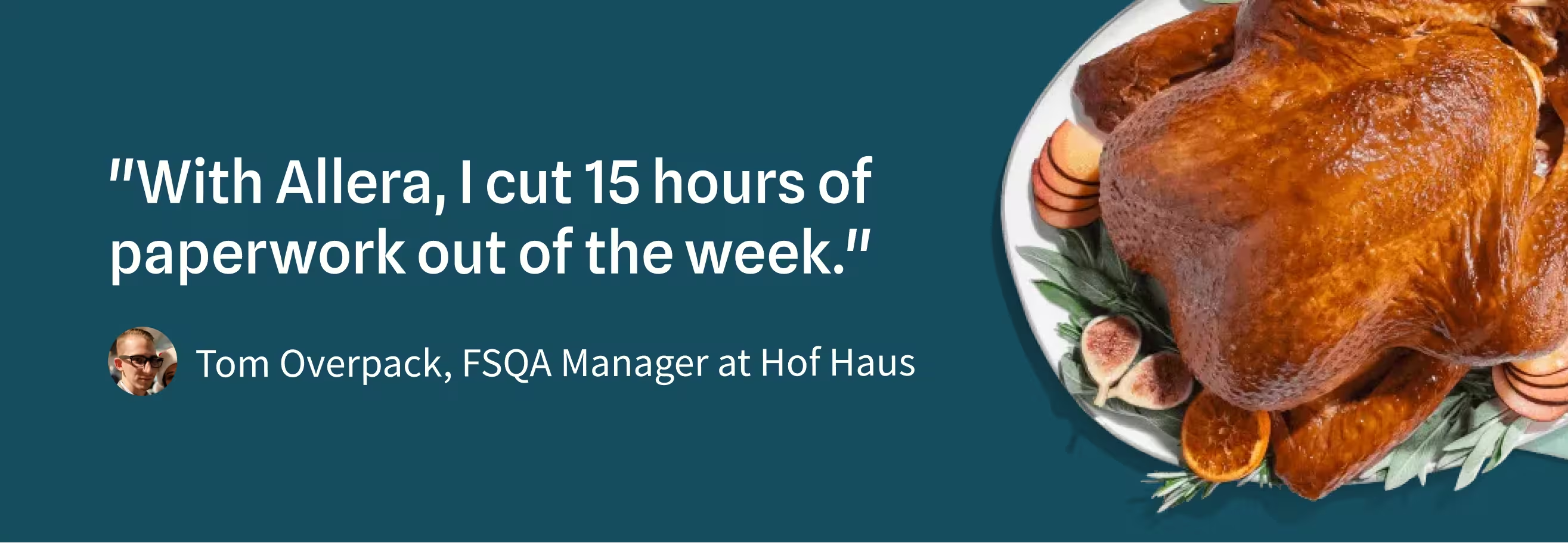
Review time fell to 30 minutes, and Tom got 15 hours of his week back.
Only failures and flagged records need a second look
Document review dropped from more than three hours to roughly 30 minutes. Submissions are automatically evaluated against predefined criteria, allowing the team to prioritize exceptions and records requiring corrective action. The forms are built to flag when something has gone wrong.
Operators stopped hand-entering code dates and went back to checking the meat
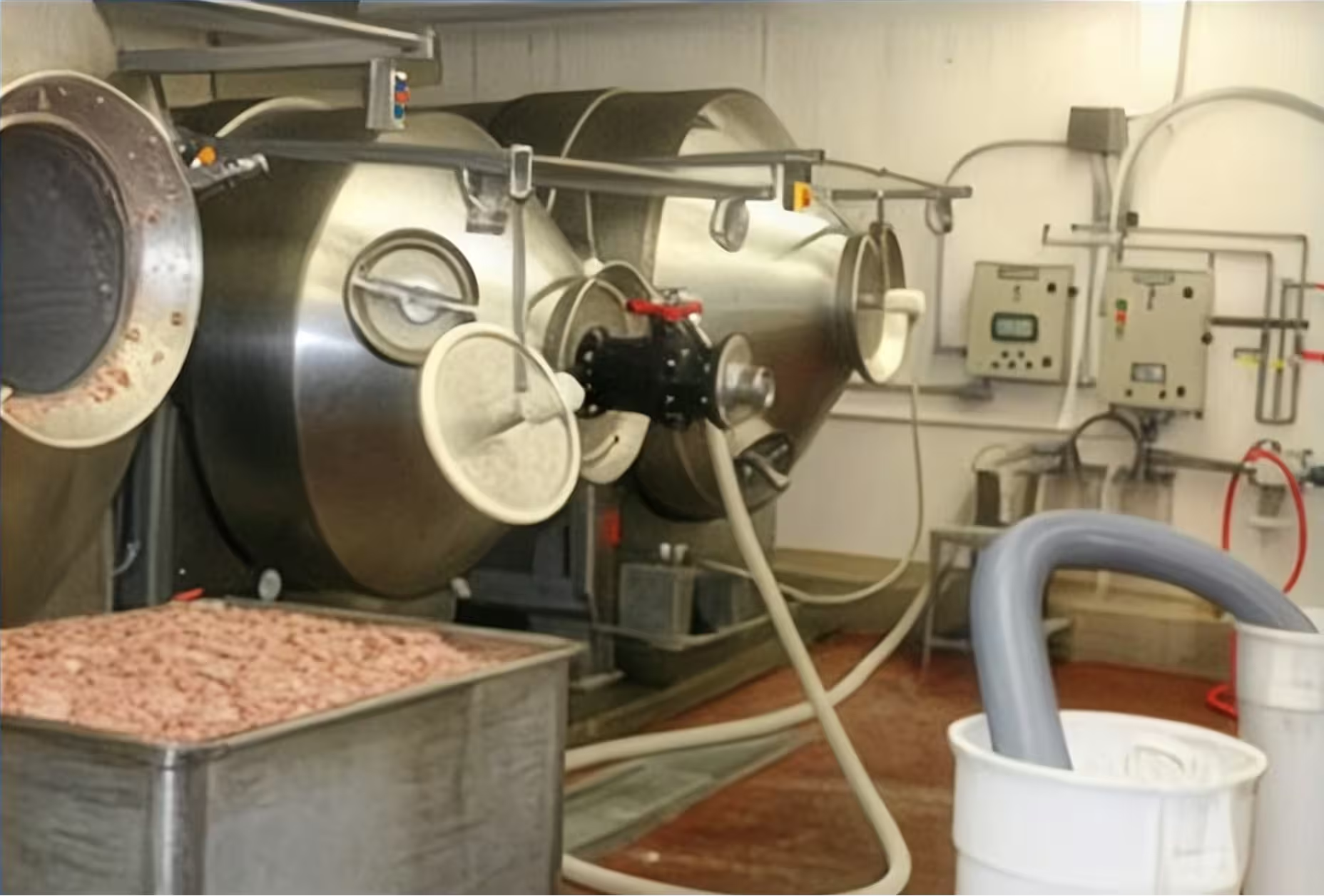
On the floor, operators got their attention back. They no longer prepare paperwork each morning or hand-enter the date and Julian code date; the forms carry it already, and lines are attached to their Stations. On the tumbler, that means focusing on the organoleptic check itself, whether the meat is the right color, whether it is pumped properly, whether it is mixing properly. As Tom put it, they are now entering actual data that means something.
USDA FSIS personnel commented on the speed of electronic record retrieval
Hof Haus is roughly 90% digital today. The forms still on paper belong to their USDA AMS program, which requires a technical proposal covering every form in use, and that update is expected to be filed before the end of the year. During a USDA FSIS Food Safety Assessment (FSA), personnel commented on how quickly records could be retrieved. Enter a date or a specific line number and everything associated appears on screen, clickable through to the next form.
The facility's first "Excellent" SQF rating
Following the digital transition, Hof Haus achieved an "Excellent" rating on their 2026 SQF audit, the facility's first "Excellent" rating to date.
"With Allera, I have much greater confidence in the accuracy and completeness of our FSQA documentation going into an audit."
Now Tom tells other manufacturers to make the same move
Asked what he would tell other food manufacturers weighing Allera, Tom pointed at both halves of it: a platform that is easy to use, easy to train people on, and that records information the way you would expect a QMS to, and the people standing behind it.
"Allera has a good group of people that are at your disposal that will work to get you the right answer!"
Digitize FSQA paperwork with Allera.