.avif)



Clean-in-Place (CIP) in the Food Industry: Cycle, Validation, and Records

CIP stands for clean-in-place, an automated method of cleaning the internal surfaces of tanks, pipework, pumps, heat exchangers and fillers without taking any of it apart. A CIP system circulates water and cleaning chemistry through the process line at controlled temperatures and flow rates, then rinses and sanitizes, all while the equipment stays assembled and in position.
That definition is easy to find. What your auditor will actually ask about is how you prove the cycle worked. This article covers both: the mechanics, and the validation, verification and records that turn a clean line into defensible evidence.
One note on the acronym: in finance CIP means capital improvement plan and in shipping it is an Incoterm. In a food plant it means clean-in-place.
CIP vs. COP: which cleaning method for which equipment
CIP and COP are complementary. The choice turns on whether the soiled surface can be reached by circulating liquid while the equipment stays assembled.
| Clean-in-place (CIP) | Clean-out-of-place (COP) | Manual cleaning | |
|---|---|---|---|
| Equipment stays assembled | Yes | No, parts are removed | Partially |
| Typical targets | Tanks, silos, pipework, plate heat exchangers, fillers, pasteurizers, homogenizers | Gaskets, fittings, valve seats, small parts, hoses, nozzles, blades | Open equipment, conveyors, floors, exteriors, complex assemblies |
| Mechanical action from | Flow velocity and spray devices | Agitation in a wash tank, often with ultrasonics | Brushing and scrubbing |
| Repeatability | High, parameters are set and controlled | Moderate, depends on loading and time | Low, operator dependent |
| Main failure mode | Dead legs and poor coverage | Under-loading or overcrowding the tank | Inconsistency between shifts and people |
Most plants run both. A dairy filler is CIP'd through its product path, then its change parts go into a COP tank overnight. Your cleaning and sanitation program should say which method applies to which asset, and your master sanitation schedule should carry both.
Where SIP fits, and why it is a different thing
Sterilize-in-place (SIP) is a separate step that follows cleaning rather than replacing it. It uses saturated steam or chemical sterilant to achieve commercial sterility on an already-clean surface, and appears mainly in aseptic and extended-shelf-life operations. You cannot sterilize a dirty line, because organic soil shields microorganisms from the sterilant.
The CIP cycle, stage by stage
A conventional CIP cycle runs five stages. Times and temperatures vary by product, soil and equipment, so treat the figures below as starting points rather than specifications for your plant.
Stage 1: Pre-rinse
Ambient or warm water, usually 2 to 10 minutes. The pre-rinse wets the surface and removes gross soil and soluble solids before any chemistry is introduced. Done properly it carries away 90 percent or more of the soil load, so the caustic wash that follows is doing fine cleaning rather than bulk removal.
Water temperature matters. Too hot on a protein soil and you bake it onto the surface. For dairy and egg soils, keep the pre-rinse below the protein denaturation range.
Stage 2: Caustic wash
Sodium hydroxide, typically 1 to 2 percent at 140 to 180°F for 10 to 30 minutes. The caustic wash saponifies fats and hydrolyses proteins, which is the heavy lifting of the cycle. Concentration, temperature and time are all traded against each other, so a lower concentration needs longer contact or higher heat to reach the same result.
Most recirculating systems recover and reuse this solution, so a recovered caustic tank needs concentration monitoring: carryover water dilutes it and soil load consumes it.
Stage 3: Intermediate rinse
Two to five minutes of water to displace the caustic and its suspended soil before the next chemistry goes in. Shortening this stage makes the acid neutralise residual caustic instead of doing its job, quietly wasting chemistry and leaving mineral scale behind.
Stage 4: Acid wash and sanitize
Nitric or phosphoric acid, typically 0.5 to 1 percent at 120 to 150°F. Caustic does not remove mineral deposits, so the acid stage handles calcium and magnesium scale, milkstone, beerstone and hardness films. It also neutralises remaining alkalinity and passivates stainless steel.
Sanitizing follows, either chemically using peracetic acid, chlorine dioxide or sodium hypochlorite, or thermally with hot water. Sanitizer efficacy depends on contact with a clean surface, which is why it comes last and never substitutes for cleaning.
Stage 5: Final rinse
Potable water, run until conductivity and pH return to baseline. This is the stage where residue testing belongs. Rinse water quality is part of the cycle: if your final rinse water carries microbial load, you have just recontaminated a clean line.
Optional stages: push-out and air blow
A product push-out before the pre-rinse, run with water or compressed air, recovers saleable product and reduces the soil load reaching the drain. An air blow at the end removes standing water, which matters because residual moisture in a closed system feeds the organisms your environmental monitoring program is looking for.
Five steps or seven? Reconciling the two versions
You will see CIP described as a five-step cycle and as a seven-step process, which causes real confusion in training material. Both describe the same sequence. The seven-step version breaks out the optional stages and splits the combined acid and sanitize stage.
| Five-stage model | Seven-step model |
|---|---|
| (not counted) | 1. Product push-out or recovery |
| 1. Pre-rinse | 2. Pre-rinse |
| 2. Caustic wash | 3. Caustic wash |
| 3. Intermediate rinse | 4. Intermediate rinse |
| 4. Acid wash and sanitize | 5. Acid wash |
| 6. Sanitize | |
| 5. Final rinse | 7. Final rinse and air blow |
Neither count is more correct. What matters is that your procedure names every stage your system actually performs, in order, with its parameters, and that the record proves each one ran. An auditor comparing a five-stage SOP against a controller running seven steps will ask which document is telling the truth.
The four control parameters, and how each one fails
A CIP cycle is four variables. Every cleaning failure traces back to at least one of them drifting out of range, which is why they are the things worth monitoring rather than the cycle as a whole.
Time. Contact duration at each stage. Fails when someone shortens a cycle to recover production time, or a controller timer is edited without a change record. Short-cycling is the most common deliberate deviation and the hardest to detect afterwards, because a shortened cycle still produces a visually clean line.
Temperature. Fails through fouled heat exchangers, undersized steam supply, uninsulated runs losing heat before the far end of the circuit, and out-of-calibration sensors. A cycle reading 165°F at the supply and 130°F at the return has not run to specification past the midpoint.
Chemical concentration. Fails through dilution by carryover water, depletion by soil load, dosing pump wear, and recovered tanks that are topped up on a schedule rather than on a titration result. Concentration is the parameter most often assumed rather than measured.
Flow and turbulence. Mechanical action comes from liquid velocity, conventionally around 5 feet per second in pipework to maintain turbulent flow. Fails through undersized pumps, partly closed valves, air entrainment and pipework changes made for other reasons. Spray balls fail by blocking or by being the wrong pattern for the vessel, leaving shadowed areas that never see solution. Dead legs, where a branch exceeds roughly three pipe diameters, hold stagnant soil indefinitely.
These four parameters are what a monitoring record should capture at each cycle, and what a deviation procedure should be written against. A CIP record showing only a start time and an operator initial cannot tell you which of the four failed.
Soil types by sector, and what they demand
Cleaning chemistry is chosen against soil, and soil is a function of what you make. A cycle designed for a beverage line will underperform on a cheese vat.
| Sector | Dominant soil | What it demands |
|---|---|---|
| Dairy | Whey protein, butterfat, milkstone | The hardest profile in food. Strong caustic, plus a reliable acid stage for milkstone. Pre-rinse temperature control is critical. |
| Meat and poultry | High-fat, high-protein soils, blood | Elevated caustic temperatures for emulsification. Fat redeposition on cooling makes final rinse temperature matter. |
| Beverage and brewing | Sugars, yeast, beerstone, hop resins | Lighter soil, shorter cycles. Beerstone drives the acid stage. |
| Prepared foods, snacks, bakery | Starch, sugar, oils | Starch gelatinises and becomes adhesive, so mechanical action and contact time outweigh chemistry strength. |
| Sauces, dressings, emulsions | Emulsified oil, egg, acidic residues | Emulsion breaking is the challenge. Surfactant selection matters more than caustic concentration. |
Dairy operations under the Grade "A" program have the additional layer of the Pasteurized Milk Ordinance, whose current revision and supporting model documents are published on FDA's NCIMS model documents page.
Validating a CIP cycle vs. verifying it ran
Here is the distinction that most CIP content skips, and the one that generates audit findings. Validation and verification answer different questions, happen at different frequencies, and produce different records.
What validation means
Validation is the up-front evidence that your cycle works at all. You run it against a known soil, then demonstrate by measurement that the surface is clean to a defined standard. It is a study, not a daily check, and it produces a protocol and report that stay in your document set.
A CIP validation typically includes riboflavin or fluorescent dye coverage testing to prove spray devices reach every internal surface, swab and rinse-water microbiology against acceptance criteria, residue testing, and borescope inspection where surfaces cannot be reached directly. EHEDG covers this ground in Doc 45 on cleaning validation, monitoring and verification and Doc 50 on hygienic design requirements for CIP installations, available through the EHEDG guidelines library.
Revalidation is triggered by change, not the calendar. New product or formulation, a changed soil profile, modified pipework, a different chemistry or supplier, altered cycle parameters, or a pattern of verification failures all mean the original study no longer describes what you are doing.
What verification means
Verification is the routine confirmation that the validated cycle actually ran as designed, every time. Validation proves the cycle can work. Verification proves it did work on Tuesday night.
This is where the four control parameters come back. A verification record for a single cycle should show the time, temperature, concentration and flow achieved at each stage, measured rather than assumed, plus the result of whatever post-cycle checks your program specifies.
The verification toolkit
Different tools answer different questions, and a mature program uses several:
- Conductivity and pH on the final rinse, confirming chemical residue has cleared.
- Titration of caustic and acid, confirming concentration rather than trusting the dosing pump.
- ATP swabs for rapid organic-residue indication, remembering ATP is not a microbiological result.
- Rinse-water microbiology and surface swabs against defined limits, for the question ATP does not answer.
- Allergen-specific residue tests where the changeover demands it.
- Visual and borescope inspection, still the most informative check and the one auditors weight heavily.
- Controller or datalogger output showing the achieved parameter trace.
Setting frequencies, and who signs off
Frequency should be risk-based and written down. Concentration titration and final-rinse conductivity are usually per cycle. ATP and visual checks run per cycle on high-risk lines and per shift elsewhere. Rinse-water microbiology and swab sets run weekly or monthly.
The sign-off question matters as much as the frequency. Whoever performs a check needs documented training for it, and the reviewer should not normally be the person who produced the record. Reviewer competence and independence are among the first things a food safety internal audit examines, because a record signed by someone unqualified to interpret it is not evidence.
CIP sits in your prerequisite programs rather than being a critical control point in most plants, though the hazard analysis behind your HACCP plan should say why. Under FSMA, sanitation is a named preventive control, explained on FDA's preventive controls rule page with the full text at 21 CFR Part 117.
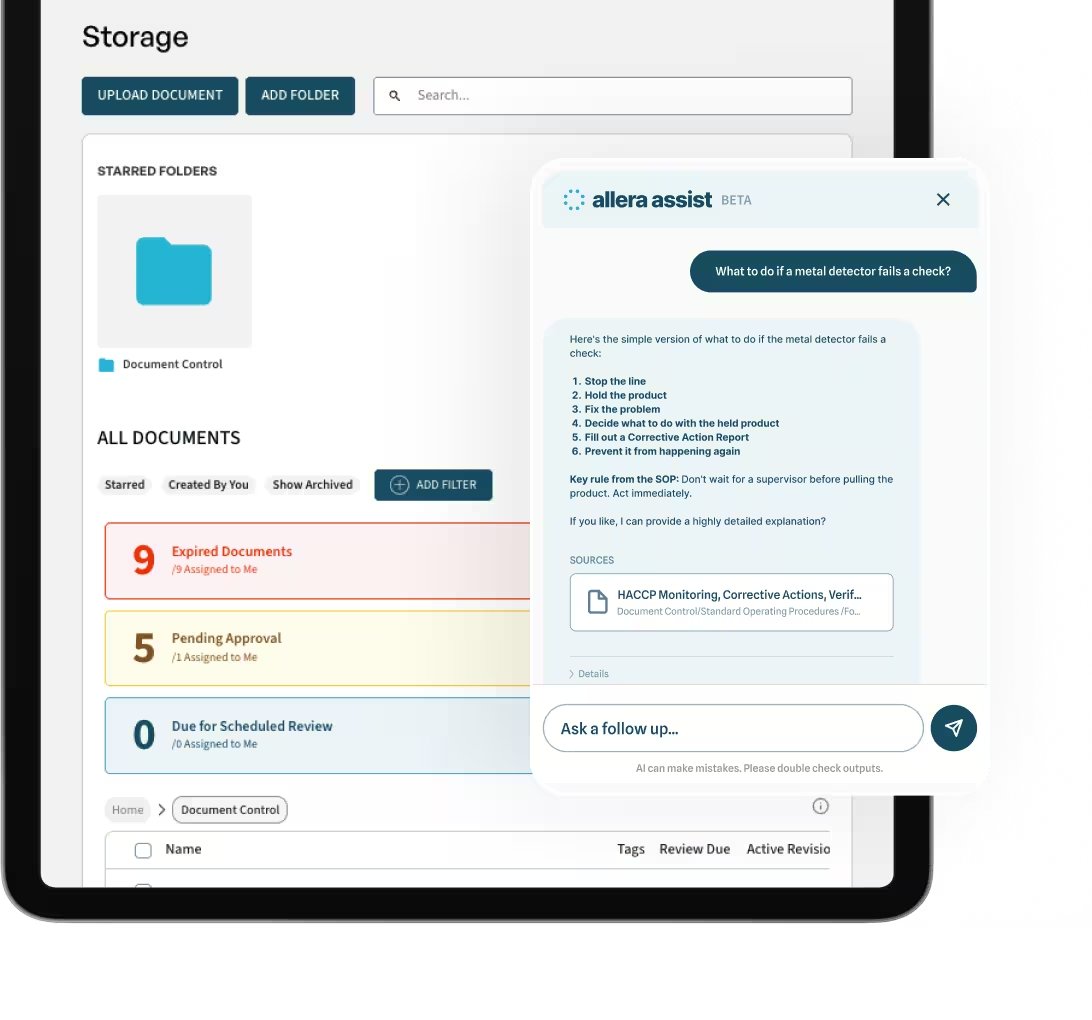
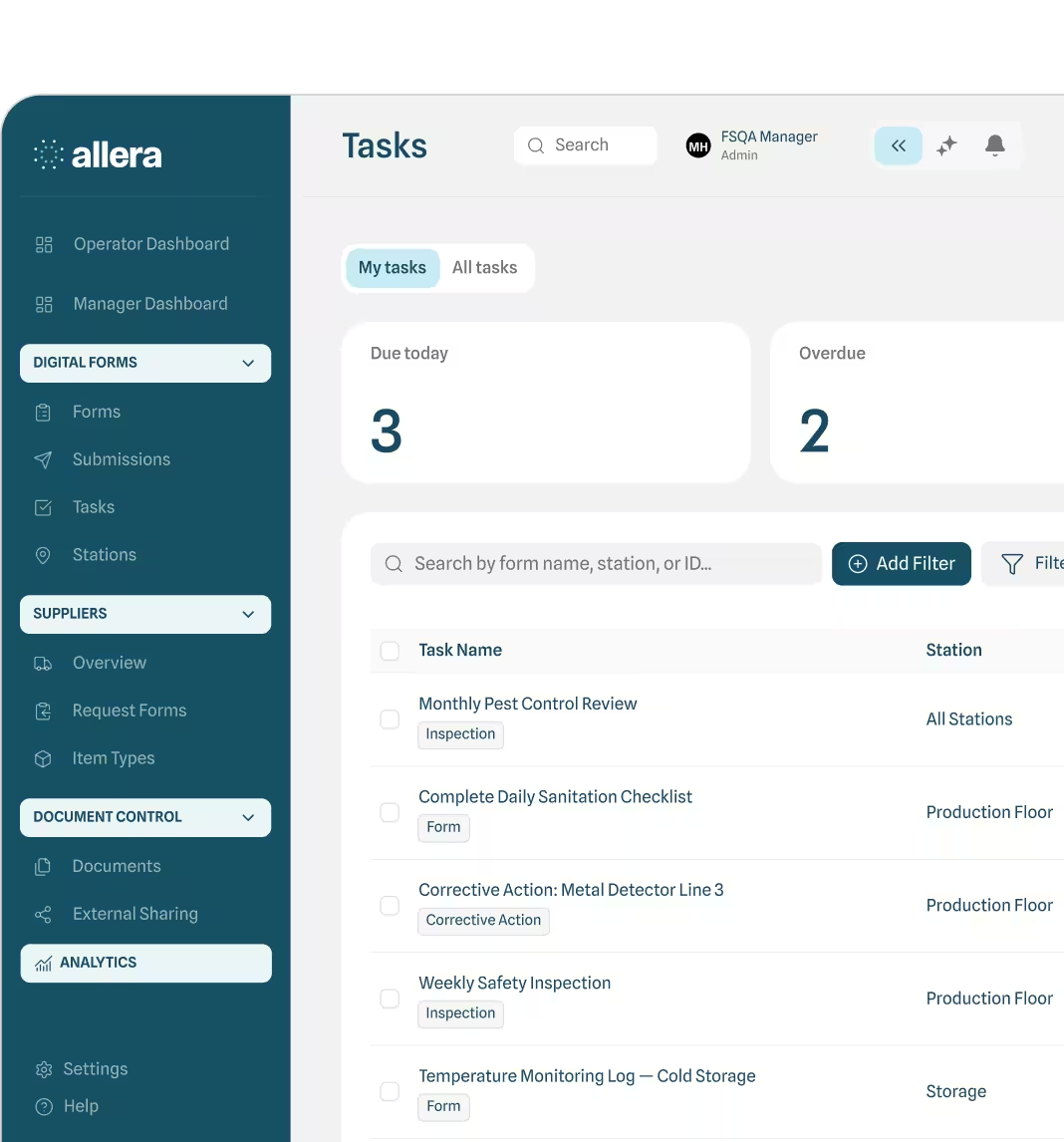
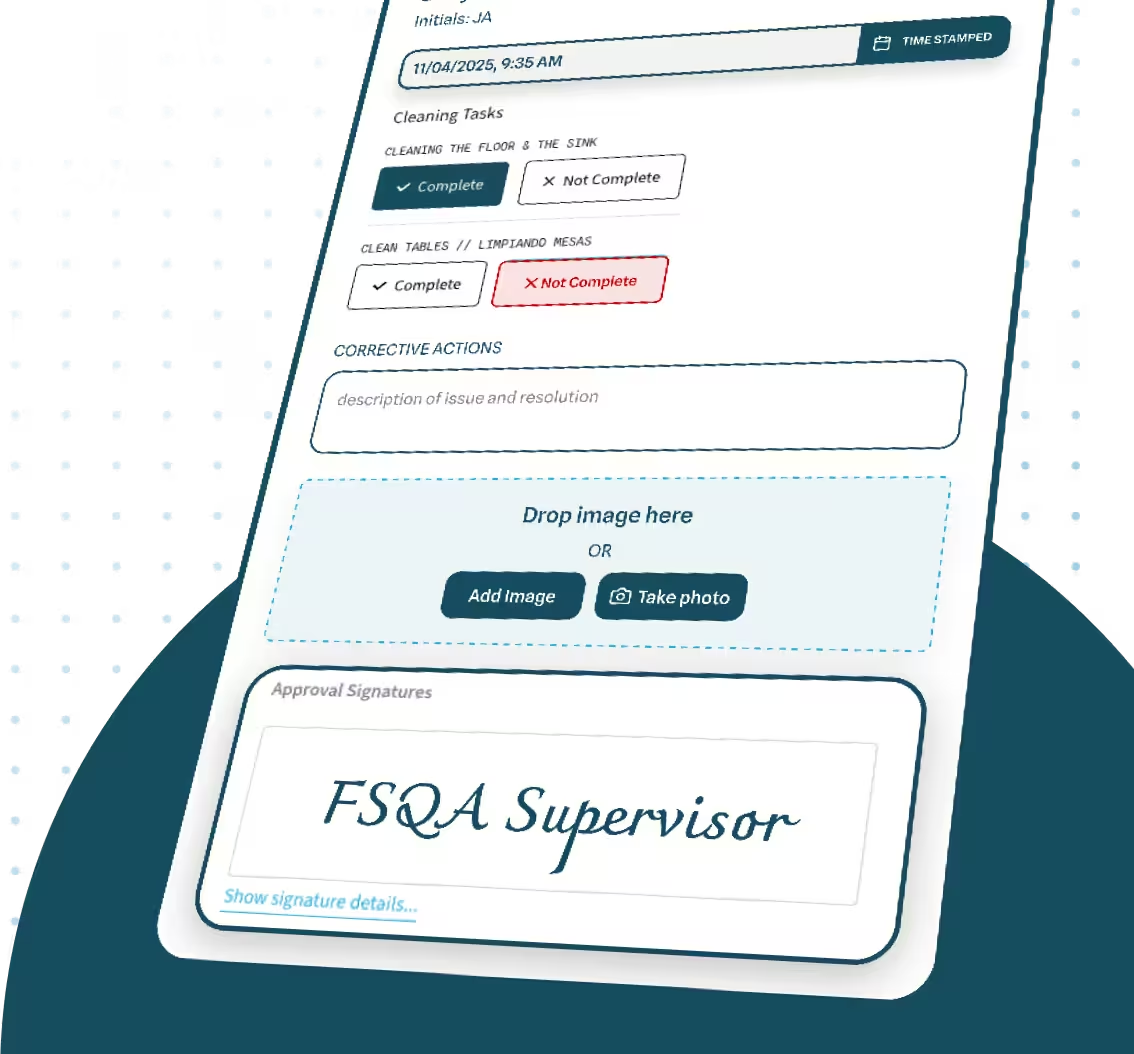
If you are digitising CIP records, the useful test is whether an out-of-range reading creates work for a named person automatically or just gets stored. Allera's Digital Forms handle the CIP checksheet with offline capture on the floor, and a failed check trips a rule that creates a Corrective Action task with an owner. See how Allera handles operational records.
CIP for allergen changeover
Allergen changeover deserves its own treatment, because a cycle validated for microbiological cleanliness has not been validated for allergen removal. They are different acceptance criteria measured with different tools.
Visual cleanliness is not an allergen result. Changeover validation needs allergen-specific testing, usually a quantitative ELISA or validated lateral flow against a defined action limit, run on surface swabs and final rinse water. The limit should come from a reasoned assessment of what carryover would mean in the next product, not from the test kit's detection floor.
Sequencing helps as much as cleaning. Running allergen-containing products last in a block, or dedicating change parts where risk justifies it, reduces how often you depend on a changeover clean being perfect. Your allergen control program should name the validated procedure for each allergen and product pair.
When a cycle fails: deviation handling and product disposition
Most CIP procedures describe the cycle well and say nothing about what happens when it does not complete. That gap is where product risk lives.
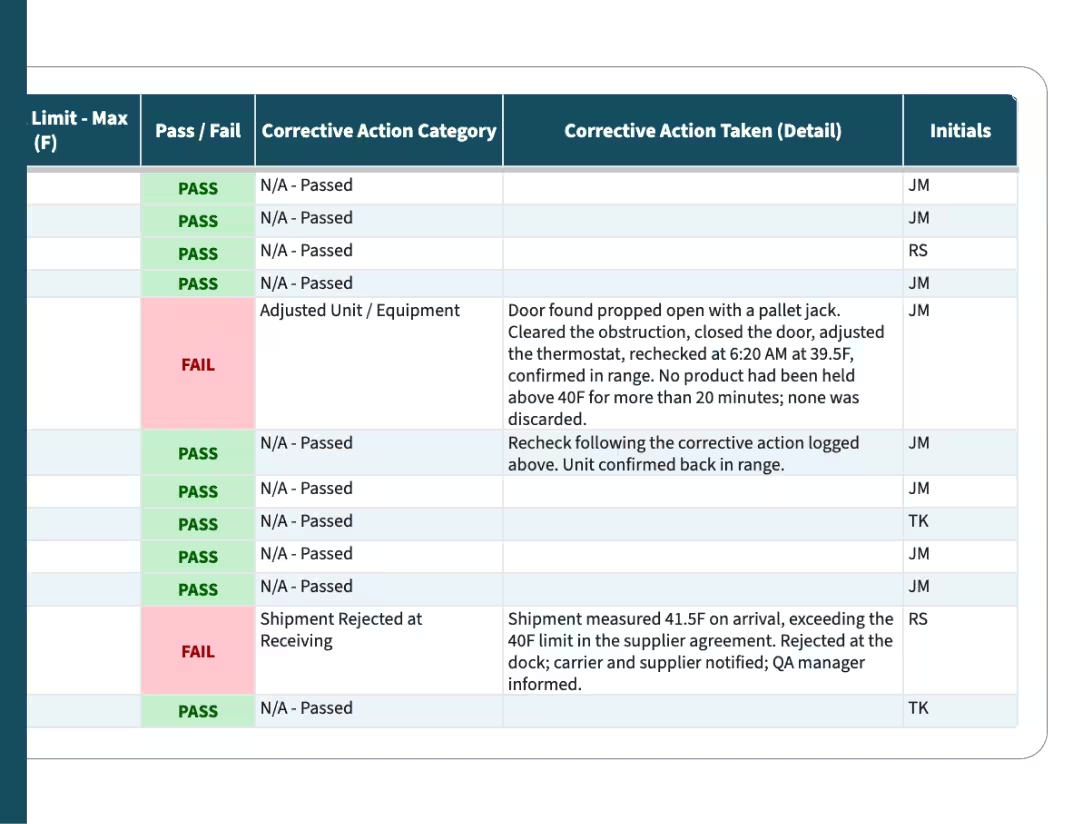
A workable deviation path answers five questions in order. What failed, and at which stage? Is the line clean, unknown, or definitely not clean? Does it need re-cleaning from the start, or can the cycle resume? Was product made since the last verified-good clean, and what is its status? What is the cause, and what stops it recurring?
The product question is the one people skip under time pressure. If a cycle failed and product ran afterwards, that product's status is unresolved until someone with authority assesses it. Hold it, document the assessment, and record the disposition with a named decision-maker. A corrective action that fixes the pump and never addresses the product downstream is incomplete.
Recurring failures are a design signal rather than an operator problem. A spray ball that blocks monthly, a circuit that never reaches temperature at the far end, or a dead leg that keeps failing swabs point to hygienic design issues that re-cleaning will not fix. 3-A and EHEDG both publish equipment design criteria worth citing when you make the case for capital spend.
The records an auditor will ask for
Bring these to the audit and most CIP questions answer themselves:
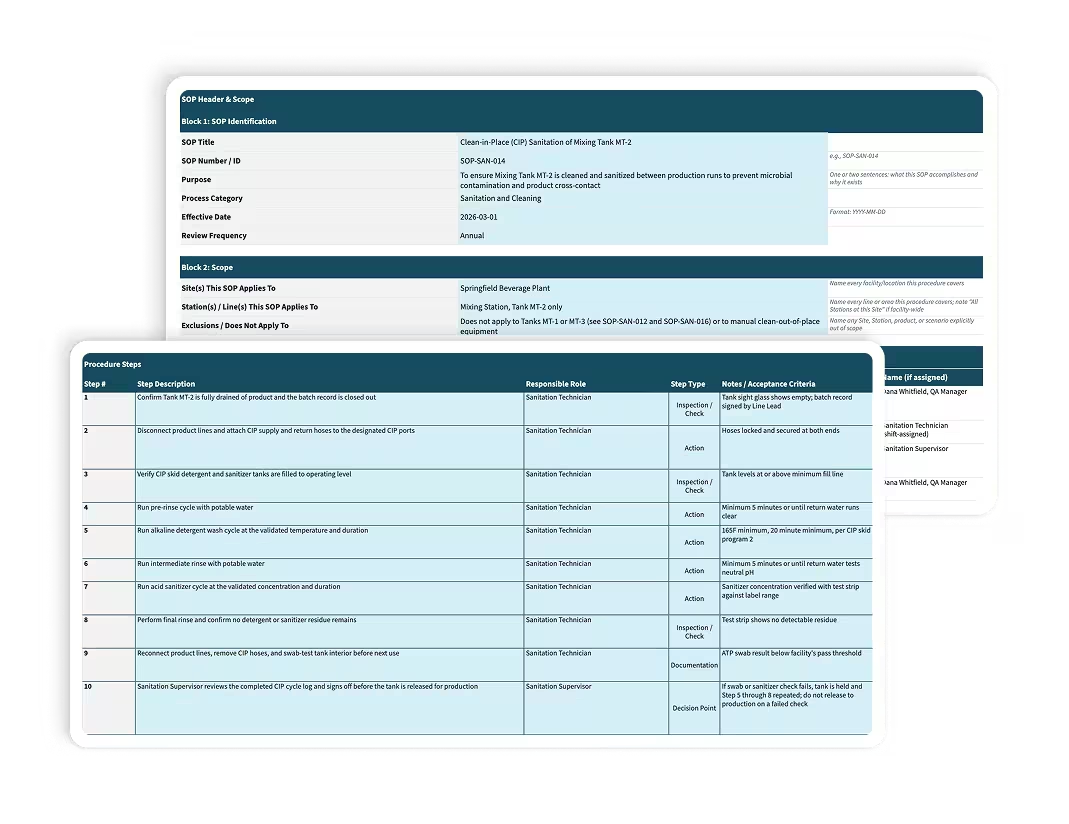
- The CIP procedure, current version, naming every stage with its parameter ranges and acceptance criteria.
- The validation study and report, with the coverage testing, residue results and microbiology behind the parameters.
- Cycle records showing achieved time, temperature, concentration and flow, not target values only.
- Concentration verification, with titration results and instrument calibration status.
- Calibration records for every sensor the cycle depends on.
- Post-cycle verification results: ATP, swabs, rinse-water micro or visual inspection.
- The deviation log, with investigations and product dispositions closed out.
- Training records for everyone performing and reviewing checks.
- Evidence of record review, dated and signed by someone other than the person who completed it.
That last one is the finding auditors write most often. Records get completed diligently, filed, and never reviewed, so an out-of-range result sits in a binder for months with nobody having looked at it. The failure is the absence of any mechanism that would have surfaced it.
This is a scheduling and escalation problem more than a documentation one. Allera's recurring Task Instances track each scheduled verification with its own status, so an instance that is Overdue, Late or Skipped shows as an exception rather than an absence, and Document Control keeps the CIP SOP and validation report on scheduled review with version history. Worth being clear on the boundary: Allera does not connect to CIP skids, PLCs or SCADA and does not read cycle data automatically. It is the verification and record layer around the system, not the control system.
What each certification scheme requires
Every major scheme addresses CIP, though none has a clause with that title. Cleaning sits within prerequisite programs, and validation of cleaning is explicit in the GFSI-benchmarked schemes.
| Framework | Where CIP lands | What it expects |
|---|---|---|
| FSMA / 21 CFR 117 | Sanitation preventive controls, cGMPs in Subpart B | Written procedures, monitoring, corrective actions, verification and records. Sanitation controls require verification that they are consistently performed. |
| SQF | Prerequisite programs, cleaning and sanitation | A documented procedure per item of equipment, defined methods and chemicals, validated effectiveness, verification, and trained personnel. Pre-operational inspection is explicit. |
| BRCGS | Housekeeping and hygiene | Documented procedures with limits, cleaning validation, verification by defined methods, and changeover cleaning where allergens are handled. |
| ISO 22000 / FSSC 22000 | Operational prerequisite programmes | Cleaning is managed as an OPRP with defined action criteria, monitoring and evidence of effectiveness, with validation of the control measure required. |
The practical implication is the same across all four: a written procedure, evidence it works, evidence it was followed, and evidence someone competent reviewed that evidence. Preparing for an SQF audit or BRC audit means assembling those four, and the second is where most programs are thinnest.
Oklahoma State University Extension's Clean in Place fact sheet is a useful plain-language reference for a team new to the topic. Our guides to SSOPs, GMPs in the food industry and preventing biological hazards cover the adjacent ground.
A CIP system that runs reliably and proves it did shortens audits and removes an entire category of argument about product status. If your records live in binders and nobody finds out about an out-of-range reading until someone goes looking, that is the part worth fixing first. See how Allera turns operational checks into records you can defend.
FAQs
.avif)
.avif)
.avif)
.avif)
%20(1).avif)
.avif)
.avif)

%20(1).png)

.avif)



.avif)