.avif)



Food Safety Culture Questionnaire for Food Manufacturers (Free Template)

.avif)

.avif)
Food safety culture is now an auditable requirement under three of the most widely used GFSI-benchmarked standards: BRCGS Issue 9, FSSC 22000 Version 6, and SQF Edition 10. When auditors arrive, they're not just checking your documentation. They're looking for evidence that food safety is embedded in how your team actually thinks and behaves.
The problem most manufacturers face is not understanding what food safety culture means. It's knowing how to measure it. A food safety culture questionnaire gives you a structured, repeatable way to assess where your site stands, identify gaps before an auditor does, and track improvement over time.
In November 2025, GFSI released an updated food safety culture framework with more auditable criteria, a signal that expectations are tightening across all major schemes. A well-designed questionnaire is no longer optional.
This article walks you through the full Allera food safety culture questionnaire, built specifically for SQF Edition 10 (Element 2.1.2.1), and explains how to administer it, score it, and act on the results. Download the free template below and read on for the guidance that no other resource on this topic provides.
Download the Free Food Safety Culture Questionnaire Template
The Allera food safety culture questionnaire is a 10-page assessment tool built for SQF Edition 10. It covers 8 operational areas with 6 scored statements each, rated on a 1–5 Likert scale (1 = Strongly Disagree, 5 = Strongly Agree), with an N/A option for statements that don't apply to a respondent's role or area.
Each section also includes three open-response prompts:
- What is working well in this area?
- Where does this area break down under pressure, during change, or on off-shifts?
- What one improvement would most reduce risk in this area?
The template includes a Section Scoring Summary sheet and an Action Planning Worksheet, making it a complete assessment tool, not just a list of questions.
The template is built for SQF Edition 10 (Element 2.1.2.1), but the 8 assessment sections align with the culture dimensions required by BRCGS Issue 9 (Clause 1.1.2) and FSSC 22000 Version 6 (Section 2.5.8). The compliance map for each standard is covered later in this article.
Disclaimer: This template is provided for informational purposes only. Allera makes no representations or warranties regarding its accuracy, completeness, or suitability for any particular purpose. This questionnaire is intended as a starting point and does not constitute professional compliance advice. Use of this template does not guarantee compliance with SQF Edition 10, BRCGS Issue 9, FSSC 22000, or any other food safety scheme or regulatory requirement. You should consult a qualified food safety professional or certification body before relying on any assessment tool for compliance purposes. Allera assumes no liability for audit outcomes, certification results, or any other consequences arising from the use of this template.
What Is a Food Safety Culture Questionnaire?
GFSI defines food safety culture as "the shared values, beliefs and norms that affect mindset and behaviour toward food safety in, across and throughout an organization." A questionnaire measures whether those values are actually present and consistently applied, not just written in your food safety policy.
A checklist confirms whether procedures exist. A questionnaire measures whether people understand those procedures, follow them under pressure, feel safe raising concerns, and trust that leadership will respond. That's a different level of assessment.
It helps to understand how a questionnaire differs from other assessment types:
- Survey: An anonymous questionnaire distributed to all employees or a representative sample to gauge perceptions
- Assessment: A broader structured evaluation that includes the survey plus management interviews, KPI review, and floor observation
- Audit: Third-party evaluation against a specific standard (e.g., BRCGS, SQF)
Standards like BRCGS and FSSC 22000 expect a full assessment. The questionnaire is a critical input, not the complete requirement. In November 2025, GFSI published an updated food safety culture framework that makes culture assessment more auditable across all benchmarked schemes.
Questionnaires are the foundation because they generate quantitative data you can trend over time. Observations and interviews add depth, but a scored questionnaire is what gives you a baseline and a way to demonstrate improvement to an auditor.
Learn more about food safety culture and what drives it at the organizational level.
What the Questionnaire Covers: 8 Assessment Sections
Most free questionnaires on this topic just list questions. The Allera template organizes 48 scored statements across 8 operational areas, each targeting a distinct dimension of culture risk. Below is what each section measures and what low scores reveal.
Per the GFSI Food Safety Culture Position Paper, a sound culture assessment covers leadership commitment, communication, employee engagement, risk awareness, and resource adequacy. The 8 sections below map to these dimensions with operational specificity.
1. Leadership Commitment and Resource Support
This section measures whether leaders visibly prioritize food safety, respond to issues, provide resources, and reinforce sound decisions when food safety and operational pressure collide.
Sample statement from the template: "Senior leaders consistently communicate that food safety comes before output, speed, or convenience."
SQF auditors look for evidence that culture starts at the top. A low score in this section, particularly on statements about management follow-through or resource availability, tells you that frontline teams don't believe leadership backs up its words. That disconnect is one of the most common root causes of food safety incidents.
2. Communication, Speak-Up Culture, and Engagement
This section measures whether employees know how to report concerns and feel psychologically safe doing so.
Sample statement from the template: "People feel comfortable reporting mistakes, deviations, and near misses."
Anonymous responses matter especially in this section. If respondents believe their answers can be traced back to them, you'll get inflated scores that mask real reporting barriers. A low score here, or a high N/A rate, often signals that employees don't trust the reporting system or have seen concerns go unaddressed.
3. Training, Competency, and Applied Knowledge
This section measures whether training is role-specific, practical, and verified, not just signatures collected.
Sample statement from the template: "Supervisors verify understanding and competence rather than only collecting signatures."
There's a meaningful difference between training completion and training competency. A site can have 100% training records and still have frontline workers who can't explain the hazards in their area. A low score here is often the first sign that your training program is documenting attendance rather than building capability.
4. Hazard Control Discipline, Verification, and Response
This section measures whether critical controls are followed consistently under pressure and deviations are handled correctly.
Sample statement from the template: "Critical food safety controls are consistently followed even during busy periods or staffing challenges."
This section exposes the gap between written procedures and actual floor behavior. Production pressure is the primary driver of control failures. If employees feel they have to choose between speed and food safety, the answer is almost always speed. Low scores here often trace back to Section 1 (leadership) or Section 2 (speak-up culture) as root causes.
5. Sanitation, Environmental Monitoring, and Hygienic Conditions
This section measures whether sanitation expectations are understood, verified, and acted on, not just scheduled.
Sample statement from the template: "Swabbing, inspection, and sanitation findings are trended and used to improve hygienic control."
Your EMP findings are a culture signal, not just a technical result. A site with strong sanitation discipline uses swab trends to drive improvement. A site with weak culture treats positive results as isolated incidents and resets without root cause analysis. Low scores in this section often appear alongside low scores in Section 4.
6. Supplier, Material, and Change Risk Awareness
This section measures whether teams treat supplier issues and process changes as food safety risks, not just purchasing or scheduling problems.
Sample statement from the template: "People understand that undocumented or poorly controlled change can create food safety risk."
Undocumented change is one of the most common audit findings. When operational pressure creates workarounds (a different supplier, a substituted ingredient, a modified line setup) and no one flags it for food safety review, you have a culture problem, not just a process gap.
7. Accountability, Learning, and Continuous Improvement
This section measures whether the organization learns from deviations and complaints, or just closes them.
Sample statement from the template: "Improvement actions are tracked until effectiveness is verified."
This section maps directly to SQF's management review requirement. A site that closes CAPAs without verifying effectiveness is creating the conditions for repeat failures. Low scores here are often accompanied by recurring audit findings on the same issue types.
8. Food Defense, Food Fraud, and Overall System Vigilance
This section measures whether employees understand intentional threat risks and know how to report suspicious activity.
Sample statement from the template: "Food fraud vulnerabilities are treated as part of the broader food safety conversation when relevant to the site."
This section goes beyond what any other free questionnaire covers. Food defense and food fraud awareness are expected by BRCGS and FSSC 22000, and SQF auditors are increasingly asking frontline workers to demonstrate awareness of intentional threats. A low score here doesn't necessarily mean your site is at elevated risk. It often means the topic hasn't been communicated effectively to the floor.
Note: The template also includes a Red-Flag Statements section scored separately. The scoring section below explains how to interpret those results.
Read more about building a strong food safety culture with practical steps for FSQA teams.
Who Should Complete the Questionnaire?
The template is designed as a cross-functional assessment, meaning one document used across QA, operations, sanitation, maintenance, warehousing, and site leadership. A questionnaire administered only to QA staff gives you QA's perception of culture, which is usually the most favorable view in the building.
SQF Edition 10 expects evidence of cross-functional input. The template includes demographic fields (Department, Shift, Role level, Time at site, Employment type, and Language used) so you can filter results without breaking anonymity. A recommended minimum is 10 or more respondents across at least 3 departments for the results to be meaningful.
The template explicitly includes temporary labor and contractors as respondent groups. Most competing questionnaires don't. Temporary workers often have less training, less familiarity with your procedures, and less psychological safety to report concerns, which makes their responses particularly revealing.
For large multi-shift sites, you may want to administer the questionnaire by role group separately rather than all at once. For smaller sites with 20–30 employees, a single administration works well as long as anonymity can be protected.
Analyzing Results by Role Level
After collecting responses, filter your results by role level to surface disconnects. A gap greater than 1.0 between leadership scores and frontline scores in the same section almost always signals a communication or trust breakdown.
The most common and most dangerous pattern is leadership rating culture highly while frontline scores are low. Leaders believe the culture is strong because they see compliance in formal settings. Frontline workers experience the actual day-to-day pressure and know what really happens when a line is running behind.
The FDA's food safety culture systematic literature review confirms that perception gaps between management and frontline employees are among the strongest predictors of food safety failures. Use the role-level filter in your demographic data to identify these gaps before an auditor does.
Explore how food safety and quality assurance functions can work together to build and measure culture effectively.
Why Your Questionnaire Results Are Required: Compliance Standards Map
Food safety culture is now an auditable, documented requirement under the three most common GFSI schemes. A questionnaire is the primary mechanism for meeting the assessment mandate. Following the GFSI November 2025 framework update, expectations are tightening across every major scheme.
BRCGS Food Safety Issue 9
- Requirement: Annual food safety culture assessment
- Clause/Section: Clause 1.1.2
- Questionnaire Role: Primary assessment tool; must show trends over time
FSSC 22000 Version 6
- Requirement: Food Safety and Quality Culture requirement
- Clause/Section: Part 2, Section 2.5.8
- Questionnaire Role: Formal assessment of shared values at all levels
SQF Edition 10
- Requirement: Food safety culture assessment plan
- Clause/Section: Element 2.1.2.1
- Questionnaire Role: Documented plan with survey component; reviewed annually
FDA New Era of Smarter Food Safety
- Requirement: Core Element 4: Food Safety Culture
- Clause/Section: Blueprint 2020
- Questionnaire Role: Recommended tool for influencing behavioral change
BRCGS Issue 9: Clause 1.1.2
BRCGS Issue 9 requires sites to define, maintain, and monitor a food safety culture plan. Auditors look for documented evidence of how you measure culture, what tools you use, and how results trend year over year. A single questionnaire result tells them you completed the assessment. Year-over-year trend data tells them you're managing culture as a system.
BRCGS also offers the Food Safety Culture Excellence (FSCE) digital assessment tool, a paid platform that benchmarks your site against BRCGS peers. The Allera template gives you a comparable assessment structure without the subscription cost, and your documented results feed directly into your BRCGS culture plan.
See the full BRCGS certification requirements and how culture documentation fits into the broader certification process.
FSSC 22000 Version 6: Section 2.5.8
FSSC 22000 Version 6, published in 2023, introduced a formal Food Safety and Quality Culture requirement as part of its Additional Requirements. Section 2.5.8 requires organizations to define, implement, and monitor a culture program covering communication, training, and employee feedback mechanisms.
The FSSC 22000 Additional Requirements page outlines what's expected, and the FSSC Food Safety and Quality Culture Guidance Document provides detailed implementation guidance. Auditors assess whether your culture program is active and evidence-based, not just a policy statement.
See what changed in FSSC 22000 Version 6 and how to update your food safety management system accordingly.
SQF Edition 10: Culture Assessment Plan
SQF Edition 10 made food safety culture assessment a mandatory, documented element (it was optional in Edition 9). Element 2.1.2.1 requires a documented culture plan that includes survey results, training content, corrective actions from assessment findings, and evidence of management follow-through. The plan is reviewed annually during management review.
The SQF food safety culture assessment guidance document explains what auditors are looking for, and the SQF Edition 10 Food Safety Code defines the element requirements directly. The Allera template is built specifically for this requirement. The questionnaire, Section Scoring Summary, and Action Planning Worksheet together provide the documented evidence SQF auditors expect.
Read the complete SQF certification guide for food safety leaders preparing for Edition 10 audits.
How to Score Your Food Safety Culture Questionnaire Results
A questionnaire without scoring guidance is just a list of questions. The template includes a Section Scoring Summary sheet with built-in score bands and an interpretation guide. Here's how to use it.
Choosing a Scoring Scale
The template uses a 1–5 Likert scale: 1 = Strongly Disagree, 2 = Disagree, 3 = Neutral, 4 = Agree, 5 = Strongly Agree, with an N/A option for non-applicable statements.
A 5-point scale is preferred over binary agree/disagree because it generates continuous data you can track over time. A site that moves from a 3.2 to a 3.8 in Section 2 over 12 months has a documented improvement trend, something a binary response can't capture. Anonymous responses are strongly recommended for Sections 2 (Communication) and 4 (Hazard Control) in particular, where fear of blame most commonly suppresses honest answers.
Calculating Section Scores
For each of the 8 sections, add up all numeric responses and divide by the number of answered statements. Skip N/A responses; they don't count toward the denominator. Record the section average in the Section Scoring Summary sheet, then calculate the overall site average as the sum of all 8 section averages divided by 8.
The template uses four score bands:
4.5 – 5.0 | Strong / Mature
- Suggested Response: Maintain discipline. Verify consistency across shifts. Capture best practices.
3.5 – 4.4 | Functional but Uneven
- Suggested Response: Target weak areas. Improve supervisor follow-through. Close training gaps.
2.5 – 3.4 | Vulnerable / Reactive
- Suggested Response: Prioritize structured actions. Direct leadership engagement. Stronger verification.
Below 2.5 | High Risk
- Suggested Response: Escalate immediately. Reassess resource constraints, behaviors, and accountability.
The Red-Flag Statements: Scored Separately
The template includes 6 red-flag statements that use inverted logic: high agreement (scores 4–5) is the bad outcome. These statements probe the risks that average scores can mask.
The 6 red-flag statements in the template are:
- Production pressure sometimes leads people to take shortcuts that could affect food safety.
- People avoid raising issues because they believe nothing will change.
- Some employees complete records based on what should have happened rather than what actually happened.
- Temporary staff or new hires are sometimes expected to work before they fully understand food safety expectations.
- Corrective actions are sometimes closed before the problem is truly solved.
- The site becomes much more focused on food safety right before audits than during normal operations.
Red-flag scores are not averaged into the overall score. Any single response of 4 or 5 on a red-flag statement triggers mandatory leadership review, regardless of how strong your overall score looks. A site can score 4.2 overall and still have systematic record falsification happening. The red-flag statements are designed to surface exactly that.
Identifying Section Gaps
Sections 4 (Hazard Control) and 5 (Sanitation) consistently score lowest at most sites. That's where real operational pressure shows up in the data. Section 2 (Communication) requires the most careful interpretation: a high score may reflect strong communication, or it may mean employees didn't feel safe giving honest answers.
When comparing results across shifts or departments, pay attention to variance as much as averages. Two departments with a section average of 3.5 might have very different underlying patterns. Review open-response comments alongside the numbers before drawing conclusions.
For presenting results to senior management, build a simple visual summary: 8 section scores mapped to color bands, red-flag responses listed separately, and top 3 open-response themes by section. That's enough for a meaningful management review discussion.
See how a food safety audit uses culture data alongside documentation and floor observation to build a complete picture.
Learn how a mature food safety management system integrates culture assessment into ongoing improvement cycles.
What to Do With Your Results: Culture Action Planning
A questionnaire without action creates survey fatigue. If employees complete the assessment and see no changes, response rates and honest answers will both drop on your next cycle. The template includes an Action Planning Worksheet to bridge the gap between results and response.
Prioritizing Corrective Actions by Section
Use the Action Planning Worksheet to assign ownership, due dates, and effectiveness check dates to each finding. The right response depends on which section scored low:
- Section 1 gaps (Leadership): Executive workshops, visible commitment actions, resource allocation review
- Section 2 gaps (Communication): Cascading briefings, visual management boards, anonymous reporting channels
- Section 3 gaps (Training): Competency verification overhaul, not just retraining. If employees can't explain the hazards in their area, more training hours won't fix a curriculum problem.
- Section 4 gaps (Hazard Control): Floor observation program, deviation trend review, management presence on the line
- Section 5 gaps (Sanitation): EMP trend review, hygienic zoning reinforcement, sanitation effectiveness audits
- Red-flag triggers: Root cause analysis is required before any other corrective action. Closing a CAPA without understanding why people felt unsafe reporting, or why records were being falsified, will produce another red-flag result next cycle.
Setting Measurable Culture KPIs
Culture is difficult to manage if you're only looking at lagging indicators like recall rates, audit findings, and customer complaints. Those tell you something went wrong. Leading indicators tell you where something might go wrong.
Useful culture leading indicators include near-miss report rates (are people actually reporting?), training competency verification rates (are supervisors checking for understanding?), and section scores from the culture questionnaire itself. SQF Edition 10 expects evidence of improvement over time. A single annual questionnaire is the floor, not the ceiling of what you should be doing.
Track your 8 section scores as a trend line across assessment cycles. A consistent improvement in Section 2 after implementing anonymous reporting channels is exactly the kind of evidence auditors want to see, and exactly the kind of program story you want to tell at management review.
How Often to Conduct the Questionnaire
The minimum frequency is annual, as required by BRCGS Issue 9 and SQF Edition 10. Best practice is twice per year, with an additional pulse check after any major corrective action, significant operational change, or leadership transition.
Timing matters. Avoid administering the questionnaire during peak production, immediately before a scheduled audit, or right after a major incident. Results collected under those conditions won't reflect your normal operational culture, and your baseline will be skewed.
Watch our interview with food safety culture expert, Sharon K.K. Beals, discussing the human side of food safety culture, which covers the behavioral factors that questionnaire data reflects but doesn't fully explain.
Common Mistakes When Running a Food Safety Culture Questionnaire
Most FSQA teams run into the same problems the first time they administer a culture questionnaire. Here are the six that most commonly undermine results.
1. Using a one-size-fits-all questionnaire without audience segmentation. A production supervisor and a QA manager experience culture very differently. The Allera template addresses this through demographic filtering, but you should also brief each group on why the questionnaire matters for their role specifically before distributing it.
2. Low response rates. If employees don't understand the purpose or don't believe their responses are truly anonymous, participation drops and honest answers go with it. Brief team leads before distribution, explain that results will be reviewed at the department level rather than the individual level, and publicly commit to sharing what you find.
3. Treating it as a one-time compliance event. A single questionnaire tells you where you are. A second questionnaire 12 months later tells you whether you improved. Culture requires longitudinal tracking. A snapshot is useful, but a trend line is what demonstrates program effectiveness to an auditor.
4. Scoring but not acting. Survey fatigue is real. If employees complete the assessment and notice nothing changed in the areas they flagged, next year's response rates will be lower and the scores will be less honest. Share a summary of findings and commit to at least two or three visible actions taken in response.
5. Confusing the questionnaire with the full assessment. A questionnaire is one input. Floor observation, management interviews, CAPA trend analysis, and KPI review are equally important. BRCGS and FSSC 22000 expect a full assessment. The questionnaire feeds into it, not replaces it.
6. No baseline before corrective actions. If you administer the questionnaire after already rolling out a new communication initiative, you don't have a pre-intervention baseline. Run your first questionnaire before implementing changes so you can measure the actual impact.
See how PCQI training programs build the foundational competence that culture questionnaire Section 3 is designed to measure.
Food Safety Culture Assessment Tools and Software
Running a paper-based culture questionnaire works for a first assessment. Over time, the administrative burden of distributing forms, collecting responses, calculating section scores, tracking corrective actions, and storing results for audit review becomes significant.
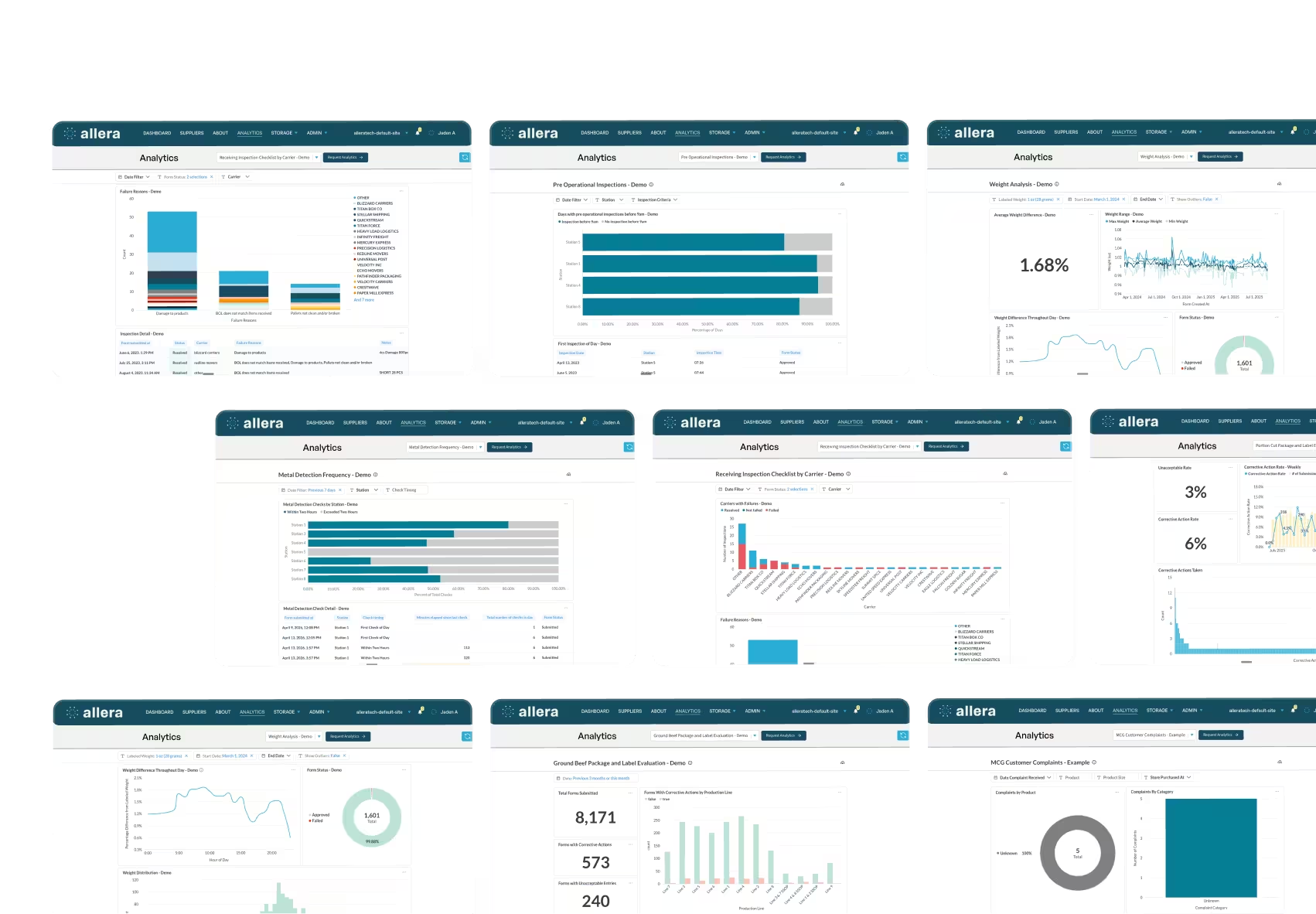
Modern food safety management platforms centralize this process. When evaluating tools, look for: digital questionnaire deployment with anonymous response collection, automatic section score calculation, trend dashboards that compare results across assessment cycles, corrective action tracking tied to assessment findings, and audit-ready reporting that links questionnaire results to your management review record.
For BRCGS, FSSC 22000, and SQF requirements specifically, you need a system that generates documented evidence of your entire culture program, not just scores, but the full chain from questionnaire administration to corrective action closure to management review. Allera's platform supports culture assessment requirements across all three standards, helping you manage questionnaire deployment, response collection, results analysis, and corrective action tracking in one place.
Ready to Turn Your Culture Assessment Into a Continuous Improvement System?
A food safety culture questionnaire is the starting point. Acting on results, tracking improvement over time, and demonstrating compliance to BRCGS, FSSC 22000, and SQF auditors requires a structured system. Allera helps food manufacturers manage their entire culture program in one place: from questionnaire deployment to corrective action close-out. Schedule a Free Demo
FAQs
.avif)
.avif)
.avif)
%20(1).avif)
.avif)
.avif)


.avif)

%20(1).png)

.avif)



.avif)