.avif)



Supplier Corrective Action Request (SCAR) for Food Manufacturers

A supplier corrective action request (SCAR) is a formal document a food manufacturer issues to a supplier after a nonconformance, requiring the supplier to identify the root cause, contain affected product, and implement actions that prevent the problem from recurring.
In food manufacturing, SCARs matter more than in most other industries. A pathogen-positive ingredient, an undeclared allergen, or a foreign material finding are not just quality defects - they can trigger a Class I recall, a Reportable Food Registry obligation, or a critical finding on your next SQF, BRCGS, or FSSC 22000 audit. The Codex Alimentarius General Principles of Food Hygiene (CXC 1-1969) establishes the international baseline for supplier control expectations that GFSI schemes build on. The supplier corrective action request is how you document that your supply chain is under control.
This guide covers the full SCAR process for food manufacturers: when to issue one, how to structure it, what FSMA and GFSI schemes require, and how to close one in a way that satisfies auditors. You will also find a free food-specific SCAR template, a worked 8D example using a Listeria-positive raw ingredient, and sample email language to send to suppliers.
What Is a Supplier Corrective Action Request (SCAR)?
A supplier corrective action request (SCAR) is a formal request a food manufacturer issues to a supplier after a nonconformance, requiring the supplier to investigate the root cause, contain the affected product, and implement actions that prevent recurrence.
Every effective SCAR contains six components:
- Nonconformance description: Lot or batch number, detection date, COA or test result reference
- Affected product disposition: Where the product is (in-transit, in your stock, at a customer) and what should happen to it
- Required containment actions and timeline: Typically within 24 hours of receiving the SCAR
- Required root cause analysis and method: 8D, 5 Whys, Fishbone, or DMAIC - specify which you expect
- Required corrective action with verification evidence: Not just a plan, but proof it worked
- Closure criteria: What the supplier must demonstrate before you close the record
In most food plants, the QA or food safety team owns SCAR issuance. Procurement and operations may be involved depending on the severity of the finding. In facilities with a dedicated supplier quality function, that team typically coordinates the full SCAR lifecycle.
SCAR vs. CAR vs. CAPA vs. Nonconformance Report - Stop the Confusion
These four terms get used interchangeably in quality systems, which creates confusion in your documentation and during audits. They describe related but distinct things.
SCAR (Supplier Corrective Action Request): External. You issue a SCAR to a supplier when a nonconformance originates outside your facility.
CAR (Corrective Action Request): Can be internal or external. A SCAR is a specific type of CAR directed at a supplier. Internal CARs address issues that originate within your own facility.
CAPA (Corrective and Preventive Action): The umbrella quality system process that both CARs and SCARs feed into. CAPA covers both fixing the immediate issue (corrective) and preventing recurrence (preventive). SCARs are one input to your CAPA system, which should be structured according to ISO 9001:2015 - Quality Management Systems principles.
NCR (Nonconformance Report): The upstream record. When receiving inspection catches a problem - a failed COA, a contaminated batch, a wrong spec - the NCR documents it. A formal SCAR is often triggered from an NCR, but not every NCR escalates to a SCAR.
| Term | Direction | Scope | Triggers |
|---|---|---|---|
| NCR | Internal | Documents the defect | Receiving inspection, in-process finding, audit |
| CAR | Internal or external | Requests corrective action | NCR, audit finding, customer complaint |
| SCAR | External (to supplier) | Supplier corrective action | Supplier NCR, failed verification, recall |
| CAPA | Internal system | Both corrective and preventive | Any nonconformance, including SCARs |
When a Food Manufacturer Must Issue a Supplier Corrective Action Request
Not every supplier issue needs to become a SCAR. The challenge for most QA teams is knowing where the line is and applying it consistently across all staff.
The "Issue a SCAR" Decision Framework
Use severity to decide how to respond.
High-severity triggers - always issue a SCAR:
- Pathogen-positive raw material (Listeria, Salmonella, E. coli O157:H7)
- Undeclared allergen on an ingredient or in a finished product
- Foreign material with injury potential (metal, glass, hard plastic, bone fragments)
- Mislabeling with a food safety implication (wrong allergen statement, incorrect cooking instructions)
- A recall or hold initiated by the supplier on product you received
- Falsified or fraudulent COA or food safety certification
Medium-severity triggers - usually issue a SCAR:
- Out-of-spec COA result on a critical control parameter (water activity, pH, microbial count)
An out-of-spec certificate of analysis is one of the most common SCAR triggers, which is why it pays to verify every one at receiving.
- Expired raw material delivered and accepted in receiving
- Repeated lot-level quality failures (second or third occurrence of the same issue)
- Missing, expired, or suspended food safety certifications (SQF, BRCGS, FSSC 22000)
- A food-safety-plan-relevant process change without prior notification to you
Low-severity - handle informally first:
- One-off cosmetic defects with no food safety impact
- Minor packaging or labeling discrepancies with no allergen or nutrition implications
- Minor delivery discrepancies or administrative paperwork errors
If your team disagrees about which tier a finding falls into, that is a signal that your written SCAR trigger criteria are not specific enough. Every GFSI-benchmarked scheme expects documented, consistent trigger criteria - not individual judgment calls applied inconsistently by different team members.
FSMA Supply-Chain Program - The Legal Trigger for SCARs
For US food facilities subject to the FSMA Final Rule for Preventive Controls for Human Food, SCAR issuance is not only a quality best practice. It is a legal obligation.
21 CFR Part 117 Subpart G - Supply-Chain Program requires receiving facilities to identify hazards that require a supply-chain-applied control and verify that their suppliers are controlling those hazards. When a supplier verification activity - an audit, a product test, a COA review - reveals that a control has failed, corrective action under 21 CFR 117.150 is legally required.
21 CFR 117.420 - Using Approved Suppliers further requires that you use only approved suppliers for raw materials and ingredients that require a supply-chain-applied control. A supplier corrective action is directly tied to whether that supplier retains approved status under your food safety plan.
Records of supplier corrective action must be maintained under 21 CFR 117.475 and made available to FDA on inspection. An unresolved or undocumented SCAR is not just an audit finding - it is a regulatory gap that can result in warning letters, import alerts, or facility shutdowns. If your team is developing or updating your Preventive Controls food safety plan, a PCQI training program covers Subpart G obligations in depth. For context on how FSMA traceability requirements interact with your supplier verification program, see the guide to the FSMA 204 traceability rule.
SCAR for Foreign Suppliers Under FSVP
If you import food from outside the United States, the FSMA Final Rule on Foreign Supplier Verification Programs (FSVP) adds a parallel obligation. FSVP importers must conduct corrective action when verification activities reveal an unsafe condition or a supplier failure. The FSVP corrective action requirement exists alongside - but is not identical to - your domestic supply-chain program SCAR process. Both must be documented separately, and both are subject to FDA inspection.
USDA FSIS Requirements for Meat, Poultry, and Egg Processors
If your facility falls under USDA FSIS regulation, supplier-related deviations trigger corrective action obligations under 9 CFR Part 417. A failed supplier-applied control is treated as a HACCP deviation. Corrective action records are required and must be available for review by FSIS inspectors. The USDA FSIS HACCP Compliance Guidance covers these obligations in detail.
How GFSI-Benchmarked Schemes Define SCAR Obligations
GFSI Recognition and Benchmarking sets the framework for what all major food safety schemes require. GFSI-benchmarked standards do not always use the term "SCAR," but every major scheme requires a documented process for handling supplier nonconformances, linked to your approved supplier program.
SQF Corrective Action and Approved Supplier Clauses
The SQF Food Safety Code - Food Manufacturing requires documented corrective and preventive action procedures for all nonconformances, including those originating from suppliers. The code also requires facilities to maintain an approved supplier program with defined criteria for monitoring, verifying, and - when necessary - removing suppliers.
SQF auditors look for SCAR records that document systemic root cause analysis, not just "supplier will retrain operators." They look for evidence that corrective actions were verified effective across subsequent lots, and for a documented process showing how SCAR outcomes feed into approved supplier status updates. The SQF audit checklist provides a detailed view of what SQF auditors expect during a supplier program review. For the full picture on achieving and maintaining certification, see the SQF certification complete guide.
BRCGS Issue 9 Clauses 3.5 and 3.7
The BRCGS Global Standard for Food Safety addresses supplier nonconformances through two key clauses. Clause 3.5 (supplier approval and performance monitoring) requires a defined procedure for handling supplier nonconformity, including escalation criteria and status changes on your approved supplier list. Clause 3.7 (corrective and preventive action) requires documented root cause analysis and preventive action for all nonconformances, and is explicit that corrective action must address the systemic cause, not just the symptom.
Auditors expect to see SCAR closure with verification evidence. A completed corrective action plan without a verified effectiveness check will not satisfy Clause 3.7. For a full breakdown of BRCGS requirements, see the guide to BRCGS certification requirements.
FSSC 22000 v6 and ISO 22000:2018 Clause 8.9
FSSC 22000 v6 is built on ISO 22000:2018 - Food Safety Management Systems. The standard defines supplier-related corrective action requirements across several clauses. Clause 8.9.2 (corrections) requires documented corrections for any detected nonconformity, including supplier-originated ones. Clause 8.9.3 (corrective actions) requires documented corrective actions addressing root causes to prevent recurrence. Clause 7.1.6 (externally provided processes, products, and services) covers the supplier verification obligations that feed directly into SCAR triggers. For more on FSSC requirements, see the guide to FSSC 22000 version 6 requirements.
Cross-standard SCAR requirements at a glance:
| Requirement | SQF | BRCGS Issue 9 | FSSC 22000 v6 | ISO 22000:2018 | FSMA 21 CFR 117 Subpart G |
|---|---|---|---|---|---|
| Trigger | Nonconformance, supplier audit finding | Clause 3.5 supplier non-conformity | Clause 7.1.6 verification failure | Clause 7.1.6 | Supplier control failure §117.150 |
| Required RCA depth | Documented, systemic cause | Systemic cause required | Documented root cause | Documented root cause | Not prescriptive, but must be documented |
| Documentation | SCAR record + CA evidence | Root cause + preventive action | Corrections + corrective action | Corrections + corrective action | Records under §117.475 |
| Closure criteria | Verification of effectiveness | Verified effectiveness | Effectiveness review | Effectiveness review | Documented resolution |
| Audit evidence | SCAR file, approved supplier list update | SCAR file, ASL update | SCAR file, effectiveness data | SCAR file, effectiveness data | Available to FDA on inspection |
The 8-Step Supplier Corrective Action Request Process (Food-Industry Walkthrough)
Step 1 - Detect and Document the Nonconformance
Every SCAR starts with a detection event. Common sources include receiving inspection, COA review, in-process testing, environmental monitoring results, customer complaints, and external audit findings. As soon as you detect the issue, document it completely: lot or batch number, supplier name, material name and code, PO reference, date of detection, the specific test result or specification failure, affected quantity, and current physical location of the product. This record becomes your NCR, and the NCR feeds your SCAR.
Step 2 - Decide Whether to Escalate to a SCAR
Apply the decision framework above. If the finding meets your high-severity or medium-severity criteria, escalate to a formal SCAR. At the same time, initiate containment within your own facility: place affected lots on hold, segregate them physically, and communicate to operations and procurement so no additional product from the affected lot moves through your process.
Step 3 - Issue the SCAR to the Supplier
The SCAR notice must contain everything the supplier needs to respond: a clear description of the nonconformance, lot and batch information, affected quantity, your disposition decision, the required containment action and deadline (typically 24 hours), the required root cause analysis method and deadline (typically 5 to 10 business days), and the corrective and preventive action deadline (typically 30 days). Write clearly and directly. The goal is supplier improvement, not punishment. See the sample language section below for ready-to-use phrasing.
Step 4 -Supplier Containment Action
Your supplier must stop shipment of suspect lots, identify and segregate suspect product in their stock, in transit, and at any other customers who received product from the same production run. They must document these actions and report back to you within your stated deadline. If the supplier cannot confirm containment within 24 hours, escalate internally and consider placing the supplier on immediate probationary status while the investigation continues.
Step 5 - Supplier Root Cause Analysis
The RCA is where most SCAR responses fall short. Suppliers often submit "human error" or "operator oversight" as root cause - but those are symptoms, not causes. Push for the process or system gap that made the human error possible. Common RCA methods include:
- 5 Whys: Best for straightforward, single-factor problems. Ask "why" five times until you reach a process or system failure.
- Fishbone (Ishikawa): Best for multi-factor problems. Maps potential causes across categories: materials, methods, machines, people, measurement, and environment.
- 8D (Eight Disciplines): Best for complex or recurring problems. A structured, team-based approach with formal containment, root cause, corrective action, and preventive action steps. See the worked example below.
- DMAIC: Used in Six Sigma environments for data-heavy process problems.
The ASQ Root Cause Analysis Resources provide additional guidance on selecting and applying each method.
Step 6 - Corrective Action and Preventive Action Plan
The supplier's corrective action addresses the specific nonconformance. The preventive action addresses the systemic cause so the problem does not recur. Every CAPA plan must include a responsible owner, specific action steps, a completion date, and a verification method. A plan without verification criteria is not a CAPA - it is a statement of intention. For more on CAPA requirements, see ASQ Corrective and Preventive Action (CAPA) Training.
Step 7 - Verify Effectiveness
Do not accept the supplier's CAPA plan as closure. Verification means confirming the action actually worked. Acceptable evidence includes re-test results on subsequent lots, a revised SOP or control procedure with an implementation date, results from the supplier's internal audit showing the new control in place, or for high-severity SCARs, an on-site verification visit by your team. A single clean lot is not sufficient. Verify across three to five subsequent lots before considering closure.
Step 8 - Close the SCAR and Update Approved Supplier Status
Close the SCAR only when containment is confirmed, root cause has been identified, and the CAPA has been verified as effective. At closure, update the supplier's status on your supplier approval program: continued approval, probationary status, suspension, or removal. File the complete SCAR record with your food safety plan documentation so it is accessible for your next audit. Update the supplier scorecard with SCAR count, severity, and time-to-close data.
A Worked 8D Example - Listeria-Positive Raw RTE Ingredient
This walkthrough shows how the 8D process applies to one of the most serious SCAR triggers in food manufacturing: a pathogen-positive raw material destined for a ready-to-eat product.
D1 - Team Assembly
Assemble the cross-functional team: QA Manager, Procurement Lead, Operations Director, and the supplier's QA contact. Assign a team leader on your side and confirm a single point of contact at the supplier for all communications during this SCAR.
D2 - Problem Description (5W2H)
Listeria monocytogenes positive detected on Lot #L240518 of ready-to-eat diced cooked chicken from Supplier X. Discovered via environmental swabbing of finished blend Lot #B240522 on 2024-05-22. Affected quantity: 1,200 lbs, currently on hold in your quarantine area. No product has left your facility. Supplier produced Lot #L240518 on 2024-05-15 at their Springfield facility.
D3 - Containment
Your facility places all of Lot #B240522 and any downstream blends using that lot on hold. Operations halts further processing using material from Supplier X pending investigation. The SCAR issued to the supplier requires them to: (1) hold all product from production date 2024-05-15 and adjacent dates, (2) identify any Lot #L240518 material shipped to other customers, and (3) confirm containment actions in writing within 24 hours.
D4 - Root Cause Analysis
The supplier's post-lethality environmental monitoring program (PEMP) swabbed cooler floor drains on a monthly schedule. A positive result on a drain adjacent to the post-lethality processing area occurred in the week before Lot #L240518 production but was not detected until your finished-product environmental program identified the contamination downstream. The root cause: insufficient PEMP frequency on high-risk zones allowed a contamination source to persist undetected through an entire production cycle.
D5 - Corrective Action
Supplier performs a deep-clean and full sanitation re-validation of the cooler, including all drain zones. PEMP frequency for drain zones revised from monthly to weekly. Supplier submits sanitation records, revised PEMP schedule, and re-validation results within 10 business days of SCAR issuance.
D6 - Implementation and Verification
New PEMP results reviewed across four subsequent weeks - all results negative. Revised SOP submitted and reviewed by your QA team. Supplier's food safety plan updated to reflect the new monitoring frequency. Your QA team verifies that the next three shipments of RTE diced chicken from Supplier X clear your incoming environmental program before the SCAR moves to closure.
D7 - Preventive Action
Your approved supplier agreement is updated to require monthly environmental monitoring data sharing for all high-risk RTE ingredient suppliers. Your supplier qualification checklist is updated to include PEMP frequency and zone coverage as a verification criterion for RTE ingredient suppliers during the annual approval review.
D8 - Team Recognition and Closure
SCAR closed. Supplier remains approved with enhanced monitoring requirements documented in the supplier file. Lessons learned shared with the full QA team at the next food safety meeting, including the updated incoming verification protocol for RTE ingredients.
What to Include in a Food-Industry SCAR Template (Free Download)
Generic SCAR templates - the kind you find from aerospace and medical device manufacturers - do not have the fields food manufacturers need. Here is what a food-specific SCAR template must contain.
Header section:
- SCAR number (sequential or based on your document control system)
- Date issued and response deadline breakdown: 24-hour containment, 10-day RCA, 30-day CAPA verification
Supplier and material identification:
- Supplier name and contact information
- Material name and material code
- Lot or batch number and production date
- Purchase order reference
- COA reference number
Nonconformance details:
- Detection date and source of finding (receiving inspection, in-process, environmental monitoring, audit, customer complaint)
- Clear description of the nonconformance
- Affected quantity and unit of measure
- Current location of affected product
Food-safety classification fields - these are what every generic template is missing:
- Pathogen detected: organism name, detection method, count or qualitative result
- Allergen involved: which of the 9 major allergens (peanuts, tree nuts, milk, eggs, fish, shellfish, wheat, soybeans, sesame)
- Foreign material: type, probable source, injury risk assessment
- COA parameter out of spec: parameter name, required value, actual result
- Recall risk classification: Class I, Class II, or Class III potential
- Regulatory notification trigger: FDA Reportable Food Registry filing required? USDA notification required?
Required supplier response sections:
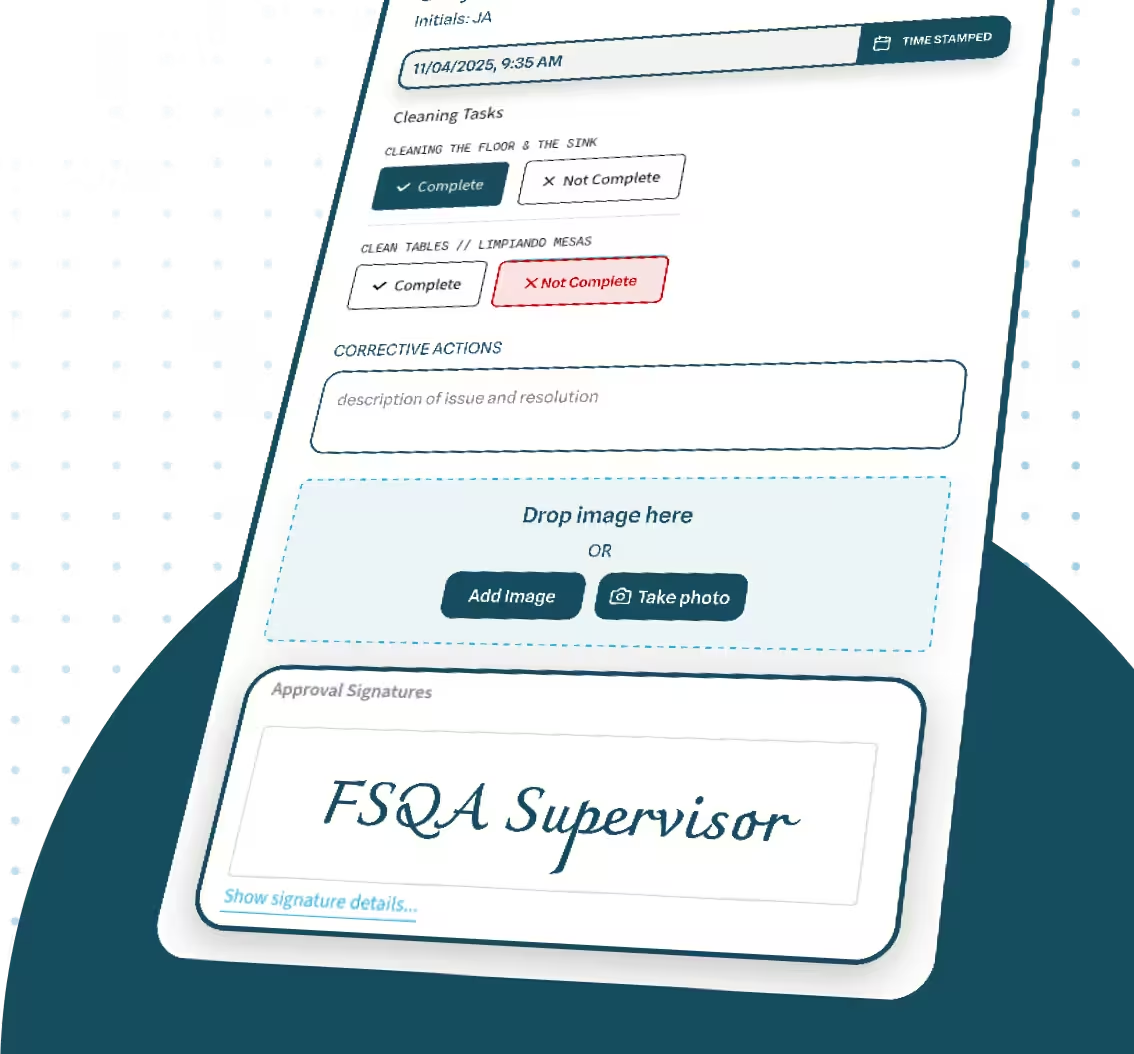
- 24-hour containment confirmation: what was done, by whom, and quantities segregated or placed on hold
- Root cause analysis: method selected, findings, and systemic cause identified
- Corrective action: specific steps, responsible owner, completion date
- Preventive action: systemic change, verification method, and completion date
Closure section:
- Verification activities completed and supporting evidence attached
- Approved supplier status decision: continued, probationary, suspended, or removed
- Reviewer name and sign-off date
The food-industry SCAR template is available for download at no cost - no form or email required.
Sample SCAR Letter / Email Language for Food Manufacturers
Writing the SCAR notice is where many QA managers get stuck. The following examples are ready to adapt for different severity levels.
Subject line examples:
- High severity:
URGENT - Supplier Corrective Action Request #SCAR-2024-047: Listeria-Positive Lot #L240518 [Supplier Name] - Medium severity:
Corrective Action Required - SCAR #SCAR-2024-031: Out-of-Spec COA, Lot #F240410 [Supplier Name] - Informational/low:
Quality Notice - SCAR #SCAR-2024-019: Repeated Packaging Discrepancy, [Supplier Name]
Opening paragraph:
[Supplier Name], we are issuing this Supplier Corrective Action Request in response to a nonconformance identified with your material [Material Name], Lot #[XXXXX], received [date] under PO #[XXXXX]. A full description of the nonconformance and our required actions are detailed below. We request your written response within the timeframes indicated.
Nonconformance description language:
During [receiving inspection / in-process testing / environmental monitoring], our quality team identified [specific description of finding - for example: "a Listeria monocytogenes positive result on an environmental swab adjacent to the handling area for Lot #XXXXX," not "a quality issue"]. The affected quantity is [X lbs/kg/units], currently [location and hold status].
Containment expectation language:
We require your written confirmation within 24 hours that: (1) all product from Lot #[XXXXX] and adjacent production runs has been identified and placed on hold at your facility; (2) any affected product already shipped to other customers has been identified and those customers have been notified; and (3) no additional product from this production run will be shipped until this SCAR is resolved.
Root cause and corrective action request language:
Within [10] business days, please submit a written root cause analysis using [5 Whys / 8D / Fishbone - specify your requirement]. We require identification of the systemic root cause, not a description of the symptom. Within [30] calendar days, please submit a corrective and preventive action plan that includes a responsible owner, specific steps, completion dates, and your proposed verification method.
Response deadline and escalation language:
If we do not receive your containment confirmation within 24 hours or your root cause analysis within 10 business days, we will initiate a supplier status review, which may result in suspension from our approved supplier list pending resolution.
Closing language:
We value our partnership with [Supplier Name] and our goal is to resolve this collaboratively and permanently. Please direct all responses to [QA contact name, email, phone]. Thank you for your prompt attention.
SCARs are corrective, not punitive. Suppliers who feel blamed rather than supported are more likely to submit defensive responses than genuine root cause analyses. Clear, professional language protects the relationship while still setting firm expectations.
Common SCAR Process Failures (And How to Avoid Them)
These patterns appear repeatedly in food safety audit findings and supplier quality reviews. Each one is preventable.
1. Accepting "Human Error" as Root Cause
Human error is a symptom. The root cause is always a process, system, or training gap that made the human error possible - or that failed to catch it before the product left the supplier's facility. When a supplier submits "operator forgot to check temperature" as root cause, push back: why was there no automated monitoring or second-check step? Why was the monitoring frequency insufficient to catch a deviation within the same production shift? "Human error" root cause answers will not satisfy SQF, BRCGS Issue 9, or ISO 22000:2018 auditors - and they should not satisfy you.
2. Closing SCARs Without Verification
An accepted corrective action plan is not a closed SCAR. Closure requires evidence that the action worked, demonstrated across multiple subsequent lots. Food safety auditors routinely find SCARs closed on the same day the supplier submitted their response, with no verification record attached. That is a major audit finding under BRCGS Clause 3.7 and ISO 22000:2018 Clause 8.9.3 - and it means the underlying problem may still be active.
3. No Linkage to the Approved Supplier List
A SCAR that does not result in a documented supplier status decision is incomplete. Every GFSI-benchmarked standard expects your approved supplier list to reflect the outcome of corrective action. If a supplier accumulated three high-severity SCARs within 12 months and still shows "Approved" with no annotation or review, that inconsistency will be flagged during an audit immediately.
4. Generic Templates with Missing Food Fields
If your SCAR form does not have fields for pathogen organism, allergen type, foreign material category, and recall risk classification, you are not capturing the information FDA or a GFSI auditor will look for when they review your supplier records. A parts-and-components template designed for aerospace procurement is not adequate for a food safety management system.
5. SCARs Held in Email Instead of a System
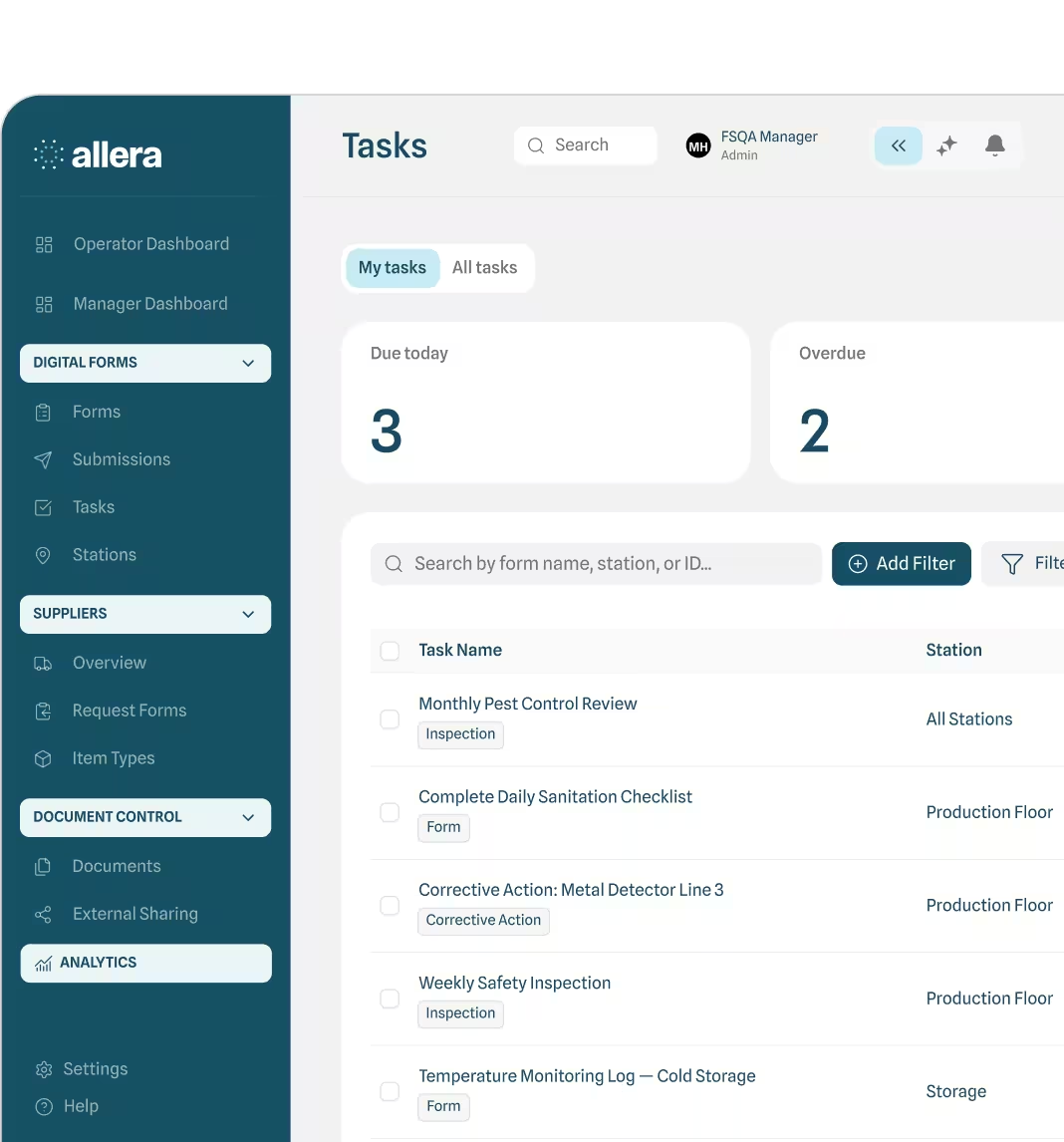
An email thread is not an audit-ready SCAR record. Supplier responses get buried in inboxes, attachments get lost, and there is no way to demonstrate the sequence of events or prove that response deadlines were monitored. At three or more active SCARs, managing the process by email becomes a significant risk. Centralizing SCARs in your supplier management software creates a documented, traceable record from issuance through closure.
6. Inconsistent SCAR Triggers Across the QA Team
If two QA team members would respond differently to the same supplier finding, your trigger criteria are not documented specifically enough. SQF, BRCGS, and FSSC 22000 all require a consistent, documented procedure - not individual judgment. Define your high, medium, and low criteria in writing, review them as a team, and include them in your food safety management system and food quality management system documentation.
7. No Effectiveness Review Across Multiple Lots
One clean lot after a supplier CAPA is not verification. Effectiveness requires a sustained trend - typically three to five subsequent lots, each verified against the same parameter that triggered the original SCAR. Build this standard into your SCAR closure criteria so it is not optional.
Need to get your SCAR records audit-ready before your next SQF or BRCGS audit? Allera centralizes supplier nonconformance records, root cause documentation, and verification evidence in one platform. Book a call with the team to see how it works.
Integrating SCAR with Your Approved Supplier List and Supplier Scorecards
Your SCAR process and your supplier approval program should form a single connected system - not two separate workflows that require manual coordination.
When a SCAR closes, the outcome must feed directly into the supplier's status on your approved supplier list. The decision should be documented: continued approval (CAPA verified, no pattern of recurrence), probationary status (CAPA pending verification or a second SCAR of the same type), suspension (high-severity SCAR with incomplete containment or a delayed response), or removal (repeated high-severity SCARs, refusal to engage, or an unresolvable food safety risk).
Supplier scorecards should pull data from your SCAR records. Useful metrics include SCAR count by severity level over the trailing 12 months, average time-to-close by severity, repeat nonconformance rate for the same issue type, and verification failure rate (SCARs where the first corrective action did not hold across subsequent lots).
When a supplier accumulates repeated SCARs, your food safety plan needs documented criteria for when removal is triggered - not just a threshold number, but a defined process. Auditors expect to see that approved supplier list decisions are criteria-based and traceable, not reactive or relationship-driven. For more on building a connected approved supplier framework, see the guide to supplier quality management tools. For context on how supplier management fits your overall supply chain operations, see the food and beverage supply chain overview.
Managing SCARs at Scale - Spreadsheets vs. Software
Where Email and Spreadsheet SCAR Management Breaks Down
A shared spreadsheet and email inbox can handle a handful of SCARs per year. Once your supplier base grows - or your SCAR frequency increases after a BRCGS or SQF certification audit - that system creates more compliance risk than it mitigates.
Common failure points:
- No audit trail of supplier responses. An email thread does not prove when the supplier received the SCAR, which version they responded to, or when you formally accepted or rejected their CAPA.
- Manual deadline tracking. When your 10-day RCA deadline passes with no response, who catches it first - and how many days later?
- No supplier portal for evidence upload. Suppliers email attachments to individual inboxes. Files arrive in the wrong thread, or not at all.
- Manual scorecard recalculation. Pulling SCAR data for a quarterly supplier review means rebuilding the analysis from scratch each time.
- Audit prep is labor-intensive. Pulling every SCAR record, response, and closure verification for an auditor reviewing your supplier program requires significant manual effort.
What to Look for in SCAR-Capable Supplier Software
When evaluating supply chain software for food manufacturers, look for these SCAR-specific capabilities:
- SCAR workflow with status tracking and automated deadline reminders at 24-hour, 10-day, and 30-day intervals
- A supplier-facing portal where suppliers upload containment evidence, root cause analysis, and CAPA documentation directly into the record
- Linkage to the approved supplier list, so SCAR outcomes trigger an automatic status review
- Scorecarding that pulls SCAR count, severity, and resolution data for each supplier
- Audit-ready export of the full SCAR history with timestamps, approval records, and attached evidence
- Integration with your food safety plan, document control system, and CAPA workflow
Tired of chasing supplier responses by email?
FAQs
What happens to a supplier's approved status after a SCAR?
SCAR closure should always include a documented decision on approved supplier status.
Options are:
Continued approval: CAPA verified effective, with no pattern of recurrence.
Probationary status: CAPA pending verification or a second SCAR of the same type.
Suspension: high-severity SCAR with incomplete containment or a delayed response.
Removal: repeated high-severity SCARs, refusal to respond, or an unresolvable food safety risk.
The decision and its rationale must be documented in the supplier file and reflected on your approved supplier list.
GFSI auditors expect supplier status decisions to be criteria-based and fully traceable -- not relationship-driven or undocumented.
How does a SCAR connect to FSMA 21 CFR 117?
Under 21 CFR Part 117 Subpart G, US food facilities that identify a supplier control failure during a verification activity are legally required to take corrective action under 21 CFR 117.150.
Records of that corrective action must be maintained under 21 CFR 117.475 and are subject to FDA inspection.
A documented SCAR process -- with records showing root cause analysis, containment, corrective action, and verification -- is how you demonstrate compliance with Subpart G.
For more on managing Subpart G documentation, see the guide to FSMA compliance software.
Is a SCAR process required for SQF, BRCGS, or FSSC 22000 certification?
Yes. All three schemes require a documented corrective and preventive action process that covers supplier nonconformances.
SQF requires documented corrective action procedures linked to your approved supplier program.
BRCGS Issue 9 Clauses 3.5 and 3.7 require defined procedures for supplier nonconformity handling and documented root cause analysis.
FSSC 22000 v6, built on ISO 22000:2018, requires corrections and corrective actions under Clauses 8.9.2 and 8.9.3.
None of the three schemes mandate the term "SCAR," but all require the equivalent documented process with a full paper trail.
When should a food manufacturer issue a SCAR vs. handle a supplier issue informally?
Always issue a SCAR for pathogen-positive results, undeclared allergens, foreign material with injury risk, mislabeled product, or any supplier-initiated recall.
Escalate to a SCAR for out-of-spec COA results on critical control parameters, expired materials, repeated quality failures, or missing certifications.
For one-off cosmetic defects or minor administrative discrepancies with no food safety implication, an informal supplier notification may be sufficient -- but document that decision.
Inconsistent escalation decisions create audit findings because SQF, BRCGS, and FSSC 22000 all expect documented, consistently applied trigger criteria.
How do you write a SCAR letter?
A SCAR letter should include:
A clear subject line with the SCAR number and lot reference.
An opening paragraph identifying the nonconformance and requesting a formal written response.
A precise description of the finding, including lot number, date, specific test result, or specification failure.
Your containment requirements and 24-hour confirmation deadline.
Your root cause analysis requirement and 10-day deadline.
Your CAPA requirements and 30-day deadline.
Escalation language describing what happens if deadlines are missed.
See the sample language section above for ready-to-adapt phrasing for each section.
What are the 5 parts of corrective action?
In a food safety context, the five parts are:
1. Nonconformance documentation: what happened, when, and which lot or batch was affected.
2. Containment: stopping the spread of the problem across your facility and the supply chain.
3. Root cause analysis: the systemic cause, not the symptom.
4. Corrective and preventive action plan: specific steps, owners, and deadlines.
5. Effectiveness verification: evidence across multiple subsequent lots that the fix held.
All five parts must appear in the SCAR record for it to satisfy GFSI auditors and FDA inspection.
What are the 4 steps required to complete a corrective action request?
The four essential steps are:
1. Identify and contain the nonconformance.
2. Determine the root cause.
3. Implement corrective action.
4. Verify effectiveness.
Some frameworks combine or relabel these steps, but any SCAR process that treats CAPA plan submission as closure -- without an effectiveness verification step -- will generate audit findings under BRCGS Clause 3.7 and ISO 22000:2018 Clause 8.9.3.
What are the 5 steps of a corrective action?
The five core steps are:
1. Describe the nonconformance in specific detail.
2. Contain the affected product or process immediately.
3. Identify the systemic root cause using a structured method such as 5 Whys, 8D, or Fishbone.
4. Implement corrective and preventive actions to address that root cause.
5. Verify those actions were effective before closing the record.
SQF, BRCGS, and ISO 22000:2018 each require all five steps to be documented in your corrective action records.
What is a corrective action request?
A corrective action request (CAR) is a formal request for documented action addressing the root cause of a nonconformance.
It can be issued internally -- to your own team -- or externally, to a supplier. A SCAR is a specific type of CAR directed at an external supplier.
Both types feed into your CAPA system under ISO 9001:2015 and GFSI-benchmarked food safety standards.
What is a supplier corrective action request?
A supplier corrective action request (SCAR) is a formal document a food manufacturer issues to a supplier after identifying a nonconformance with a supplied ingredient, material, or service.
It requires the supplier to document the root cause, take containment action on affected product, and implement corrective and preventive actions to prevent recurrence.
A SCAR creates a documented, audit-ready record of the issue and the supplier's response -- unlike an informal phone call or email, which leaves no trail.

.avif)
.avif)
.avif)
.avif)
%20(1).avif)
.avif)
.avif)

%20(1).png)

.avif)



.avif)