

FDA Food Facility Registration: Who Must Register, How to Renew, and What It Commits You To

FDA food facility registration is the mandatory registration, under section 415 of the FD&C Act, of every facility that manufactures, processes, packs or holds food for consumption in the United States, unless an exemption applies. It's free, it's done online, and every registered facility must renew between October 1 and December 31 of each even-numbered year. If you miss the window, FDA treats the registration as expired and cancels it.
Renewal periods run from October 1 to 11:59 PM on December 31 of each even-numbered year. That means the 2026 renewal period (Oct 1–Dec 31, 2026), then October 1 to December 31, 2028. FDA's 2026 renewal reminder and its renewal user guide cover the system steps.
Most guides to FDA food facility registration requirements are written for foreign exporters looking for a US Agent. This one is for the US plant that has to renew on time, keep the registration up to date, and live with what it switches on under food regulatory compliance rules.
The Biennial Renewal: What to Check Before December 31
Renewal is a short job when the account, the DUNS record and the plant details are in order. It's a scramble when the person who holds the login left two years ago. Work through this list first.
| Step | What to check | Rule or source |
|---|---|---|
| 1. Account access | Confirm who holds the FDA Industry Systems (FIS) account and that they can still log in. If the holder has left, recover access through FDA. Don't create a second registration. | FDA fees and registrars page, item 3 |
| 2. DUNS number | Confirm your DUNS number and that Dun & Bradstreet's address for it matches your registration address exactly. FDA won't confirm the renewal until it verifies both. | 21 CFR 1.231 |
| 3. Every section | Facility, mailing address, parent company, trade names, owner/operator/agent in charge, emergency contact, product categories and activity types | 21 CFR 1.232 |
| 4. Changes or none | If nothing has changed since your last submission, you can use the abbreviated renewal | 21 CFR 1.230(c) |
| 5. Statements | Re-make the inspection assurance and certify the information is true. If someone else submits for you, include who authorised it, with their email address. | 21 CFR 1.230(b), 1.232(a)(9)–(10) |
| 6. Qualified facility? | Submit your qualified facility attestation in the same window | 21 CFR 117.201(c)(2)(ii) |
| 7. Confirmation | Save FDA's confirmation. Your registration number doesn't change when you renew. | FDA Q&A guidance, D.2.4 |
| 8. Next reminder | Put October 1 of the next even-numbered year on someone's schedule | 21 CFR 1.230(b) |
Abbreviated Renewal: When You Can Use It
If none of the information required by 1.232 has changed since your last registration, renewal or update, you can use the abbreviated renewal. You confirm that nothing has changed and certify that the information is accurate. A new emergency contact, trade name or product category since your last submission means you need the full renewal instead.
"Renew" and "Update" Are Different Buttons
FDA's renewal user guide is blunt about this: updating your registration is a different function from renewing it. During the renewal period, the "Update" button disappears from the main menu until the registration is renewed. An update you made in March doesn't count as your renewal.
Qualified Facilities: The Attestation Is Due in the Same Window
A qualified facility gets modified requirements under the preventive controls rule because of its size. Under 21 CFR 117.3, that usually means a very small business averaging less than $1,000,000 a year, adjusted for inflation, over the previous three years. A second route applies when most sales go directly to qualified end-users and total food sales average under $500,000, adjusted for inflation.
You determine that status by July 1 each year (117.201(c)(1)). The qualified facility attestation, Form FDA 3942a for human food, is due every two years between October 1 and December 31, the same window as your renewal. Our HARPC vs HACCP comparison explains the modified requirements.
New Facility? Register Before You Operate
New facilities don't wait for October. You must register before the facility starts to manufacture, process, pack or hold food for US consumption (21 CFR 1.230(a)).
If you register before October 1 of a renewal year, you still have to renew in that year's October to December window (FDA Q&A guidance, D.2.2).
What Is FDA Food Facility Registration?
FDA food facility registration is a facility-level registration required by section 415 of the FD&C Act (21 U.S.C. 350d) and 21 CFR Part 1, Subpart H. It tells FDA where food for the US market is made, packed and held, and who to call in an emergency.
The requirement came from the Bioterrorism Act of 2002. FSMA (2011) and FDA's 2016 final rule then added biennial renewal, the inspection assurance, email addresses, product categories with activity types, the abbreviated renewal and, from October 1, 2020, a unique facility identifier.
Three facts correct a lot of what you'll read elsewhere:
- There's no fee. "No registration fee is required" (21 CFR 1.231(c)). Private firms and US Agents may charge for their services, but FDA doesn't.
- FDA issues no certificate. FDA doesn't issue a certificate of registration and doesn't recognise one issued by a private business.
- A registration number isn't approval. Under 21 CFR 1.242, a registration number "does not in any way convey FDA's approval or endorsement of a facility or its products."
Who Must Register, and Who Is Exempt
Under 21 CFR 1.225, the owner, operator or agent in charge of a domestic or foreign facility that manufactures/processes, packs or holds food for US consumption must register it. A domestic facility registers whether or not its food crosses state lines. You can authorise someone else to submit the registration for you.
Each facility registers on its own, and only sites handling food for consumption in the United States have to register (FDA Q&A guidance, C.4.1). Holding counts, so a warehouse that stores food is a facility in its own right.
The exemptions in 21 CFR 1.226 are narrower than most summaries suggest:
| Exemption | What it covers | The catch |
|---|---|---|
| Farms | Primary and secondary production farms | An operation doing activities outside the farm definition becomes a "farm mixed-type facility" and must register |
| Retail food establishments | Businesses whose primary function is selling food directly to consumers | Sales test: direct-to-consumer sales must exceed sales to all other buyers combined, and businesses don't count as consumers (21 CFR 1.227). Retail sits under state and local oversight based on the Food Code. |
| Restaurants | Facilities that prepare and sell food directly to consumers for immediate consumption | Central kitchens and caterers to interstate conveyances that don't serve consumers directly aren't restaurants (21 CFR 1.227) |
| Nonprofit food establishments | Charitable entities that prepare or serve food directly to the consumer, such as food banks and soup kitchens | The entity has to meet the charitable-entity definition in 21 CFR 1.227 |
| Fishing vessels | Harvesting and transporting fish, plus heading, eviscerating or freezing solely to prepare fish for holding on board | A vessel that otherwise processes fish must register |
| USDA-only facilities | Facilities regulated exclusively, throughout the entire facility, by USDA under the meat, poultry or egg products inspection acts | Dual-jurisdiction plants must register. That includes plants that also make finished pet food (Q&A B.6.3), process non-amenable species such as rabbit, deer, elk or bison (B.6.1), or process other fish alongside catfish-type Siluriformes (B.6.2) |
| Foreign facilities whose food is further processed abroad | Food that another foreign facility manufactures or packages before export | Not exempt if the next facility only adds labeling or does something similarly minor |
Private residences aren't facilities at all (21 CFR 1.227), so a home business doesn't register.
FDA's July 2026 advisory adds a warning in the other direction: don't register if you're exempt. FDA says it has seen "an uptick" in unnecessary registrations, which "may subject your facility to unnecessary inspections or create confusion about your compliance obligations."
What Your Registration Contains (21 CFR 1.232)
Here is what 1.232 requires of a domestic facility:
| Field | Notes |
|---|---|
| Facility name, full address and phone | The address must match your DUNS record |
| Unique facility identifier (UFI) | Required since October 1, 2020 |
| Preferred mailing address | If different from the facility address |
| Parent company | Name, address and phone, if the facility is a subsidiary |
| Trade names | All of them |
| Owner, operator or agent in charge | Name, address, phone and email |
| Food product categories | From Form FDA 3537 |
| Activity type per category | 14 options, such as manufacturer/processor, low-acid food processor, packer/repacker and ambient, refrigerated or frozen warehouse |
| Inspection assurance | See below |
| Certification statement | That the information is true and accurate |
| Contact and emergency contact | A contact email, plus an emergency phone and email if different |
Foreign facilities also list a US Agent and an emergency contact.
The Unique Facility Identifier (UFI) and Your DUNS Number
Every registration must include a unique facility identifier recognised as acceptable by FDA. Today that means your Data Universal Numbering System (DUNS) number from Dun & Bradstreet, which FDA's guidance says is "available free of charge." FDA's UFI guidance explains the policy, and you can look up or request a DUNS number through D&B's FDA registrant support site.
The part that trips people up is the address. FDA verifies that the facility-specific address on your DUNS record matches your registration, and won't confirm a registration or renewal until it does. If D&B holds an old or head-office address, fix that first.
Two things "UFI" isn't. It isn't the EU's Unique Formula Identifier on chemical labels. And an importer's DUNS under the Foreign Supplier Verification Program (FSVP) is a separate requirement.
The Inspection Assurance: What You're Agreeing To
Since FSMA, every registration contains "an assurance that FDA will be permitted to inspect the facility at the times and in the manner permitted by the Federal Food, Drug, and Cosmetic Act" (1.232(a)(9)). You re-make that assurance each time you renew. Separately, 21 U.S.C. 331(f) makes "the refusal to permit entry or inspection" as authorised by the Act a prohibited act.
In practice, that means being inspection-ready on any working day. A regular internal audit and GMP audit program is how most plants stay audit ready.
Product Categories and Activity Types
Product categories and activity types describe what each site actually does, and they change more often than people expect. A new product line, a frozen storage room or a contract packing job can each add one, and each change starts the 60-day update clock below.
Keeping It Current: Updates, Ownership Changes and Cancellation
Renewal happens every two years. Updates happen whenever something changes, and the clock is short.
| Trigger | Deadline | Action | Rule |
|---|---|---|---|
| New facility | Before you start operating | Register | 1.230(a) |
| Any change to 1.232 information, except a change of owner (new operator, agent in charge, emergency contact, product category) | Within 60 calendar days | Update | 1.234(a) |
| Information was wrong when you submitted it | Immediately | Update | 1.231 |
| New owner | Within 60 calendar days | Former owner cancels; new owner registers | 1.234(b) |
| Facility closes or stops providing food for US consumption | Within 60 calendar days | Cancel | 1.235(a) |
| Even-numbered year | October 1 to December 31 | Renew, abbreviated if nothing changed | 1.230(b)–(c) |
If someone else submits an update for you, it must identify who authorised it. Wiring these triggers into change management is the simplest way to keep track of them. If you want every renewal and update deadline on someone's task list, see how Allera schedules recurring compliance tasks.
What Happens If Your Registration Lapses
The consequences are spelled out in 21 CFR 1.241:
| Situation | Consequence | Rule |
|---|---|---|
| Not renewed by December 31 of an even-numbered year | The registration is expired, and FDA treats the facility as having failed to register under section 415 | 1.241(b) |
| Expired registration, or an address not updated in time | FDA cancels the registration | 1.241(c) |
| Failure to register, renew, update or cancel | A prohibited act under FD&C Act section 301(dd). The United States can seek an injunction (section 302) or prosecute (section 303). | 1.241(a) |
| A foreign facility that hasn't registered | Its food offered for import is handled under the prior notice procedures in Subpart I | 1.241(d) |
FDA's renewal guide adds that a registration not renewed by 11:59 PM on December 31 "is considered expired and will be removed from your account." FDA's Q&A guidance (D.2.6) says a complete renewal submitted by the deadline won't be treated as expired even if FDA processes it later. Don't count on any grace period beyond that.
Suspension Is Different
Under section 415(b), FDA can suspend a registration by order when food from the facility has a reasonable probability of causing serious adverse health consequences or death to humans or animals, the SAHCODHA standard. The registrant gets an informal hearing within 2 business days and may have to submit a corrective action plan. While suspended, the facility's food can't be imported, exported or introduced into interstate or intrastate commerce.
What Being Registered Commits You To
Registration status decides which FSMA rules reach your site. Under 21 CFR 117.3, a "facility" means one "required to register under section 415." That is what brings a plant under the hazard analysis and risk-based preventive controls requirements, unless an exemption applies.
| Rule | What registration status triggers | Read more |
|---|---|---|
| 21 CFR Part 117, Subparts C and G | Hazard analysis, preventive controls, a written food safety plan and a PCQI to oversee it | HARPC vs HACCP |
| 21 CFR 117.201 | Modified requirements and the biennial attestation, if you're a qualified facility | Renewal section above |
| 21 CFR Part 121 (intentional adulteration) | A food defense plan, unless you're a very small business averaging less than $10,000,000 a year, adjusted for inflation (121.3, 121.5) | Food defense plan |
| Reportable Food Registry (FD&C Act section 417) | A report to FDA within 24 hours of determining a food is reportable | SAHCODHA; Class I recall |
Part 117's current good manufacturing practice requirements (Subpart B) don't depend on registration. Registration is what layers the preventive controls rule and the intentional adulteration rule on top. Importers have their own FSVP obligations, which sit on the importer and not on the foreign facility's registration.
Protecting Your Registration: FDA's July 2026 Warning
On July 20, 2026, FDA published an advisory on protecting food facility registration information. It flagged three problems:
- an uptick in businesses registering when they don't have to
- third-party "registrars" asking for your registration number, PIN, or FIS username and password "to verify registration status"
- TikTok Shop and other seller platforms asking food companies for a copy of their registration, or a certificate, as part of product listing
FDA explains the risk: with your number and PIN, or your username and password, other parties can link your registration to their own FIS accounts. "Once linked, they can view, change, or even cancel your FFR."
FDA's advice:
- Never share your FIS username and password. Create subaccounts for colleagues instead.
- FDA doesn't require you to share your registration number with third parties, and registration information isn't public (21 CFR 1.243). The exception is imports, where whoever submits prior notice may need it.
- The FEI (FDA Establishment Identifier) is a separate, public number.
- If you've shared your number or PIN in error, consider cancelling and re-registering, and report suspected misuse to FDA.
The same logic applies when you qualify your own suppliers. Ask them to confirm that their registration is up to date and record the answer in your supplier approval program. Don't ask for PINs or credentials.
Who Should Own Registration in Your Plant
Most missed renewals trace back to one gap: nobody owns registration between renewals.
- A named owner and a named backup, each with their own FIS subaccount. The account holder leaving is the classic reason a renewal gets missed.
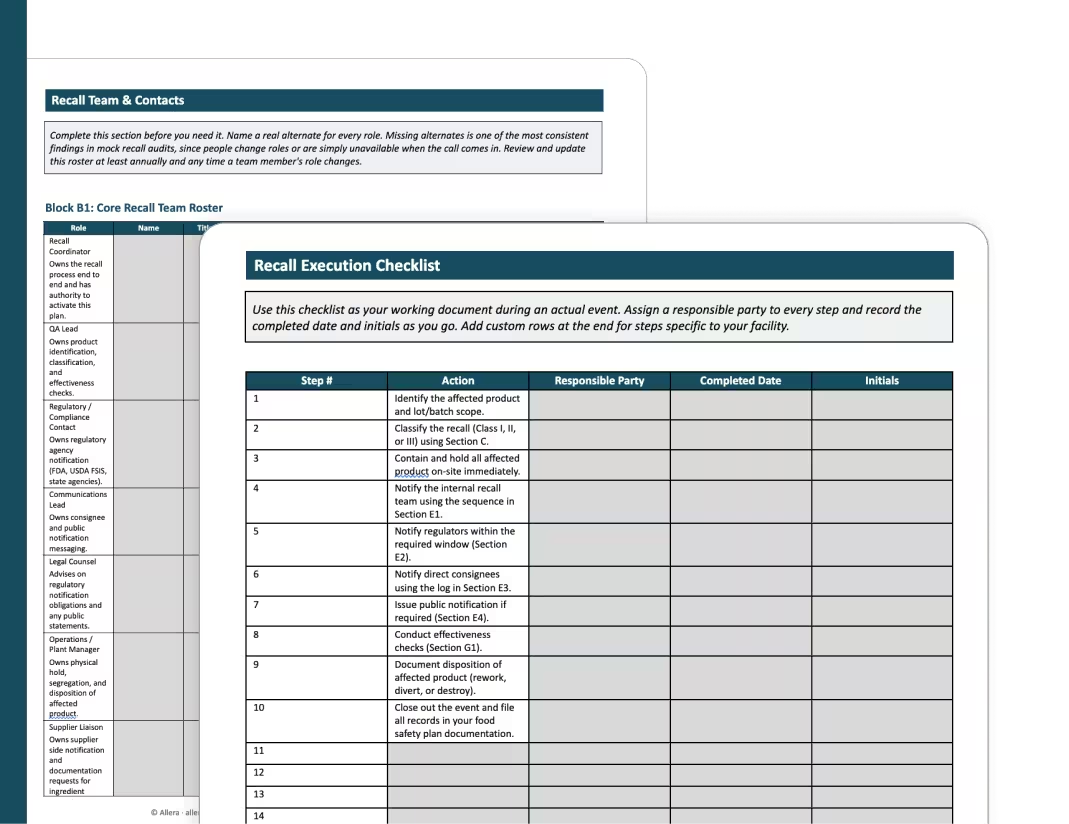
- An emergency contact who answers out of hours, matching the contact in your recall plan. Test both during your next mock recall.
- Records you can pull up: each submission and FDA confirmation, your DUNS record, any qualified facility attestation, and who authorised each submission.
- Triggers in change management. A new product category, operator, line or site should prompt the question "does this change our registration?"
Keeping Registration Tasks and Records in One Place
Registration itself happens in FDA's own system, and Allera doesn't submit, renew or check registrations. What Allera can do is keep track of the work around it.
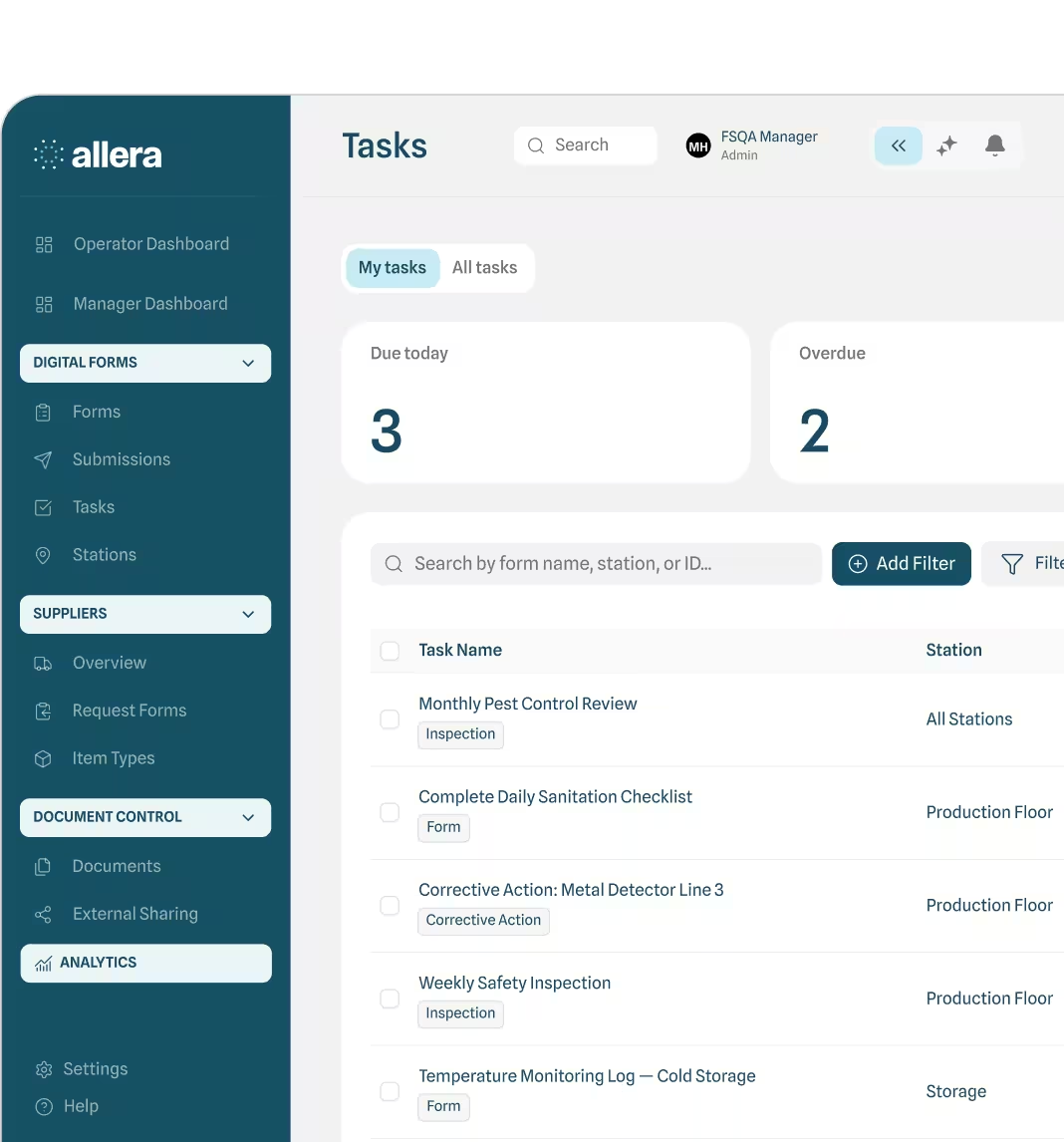
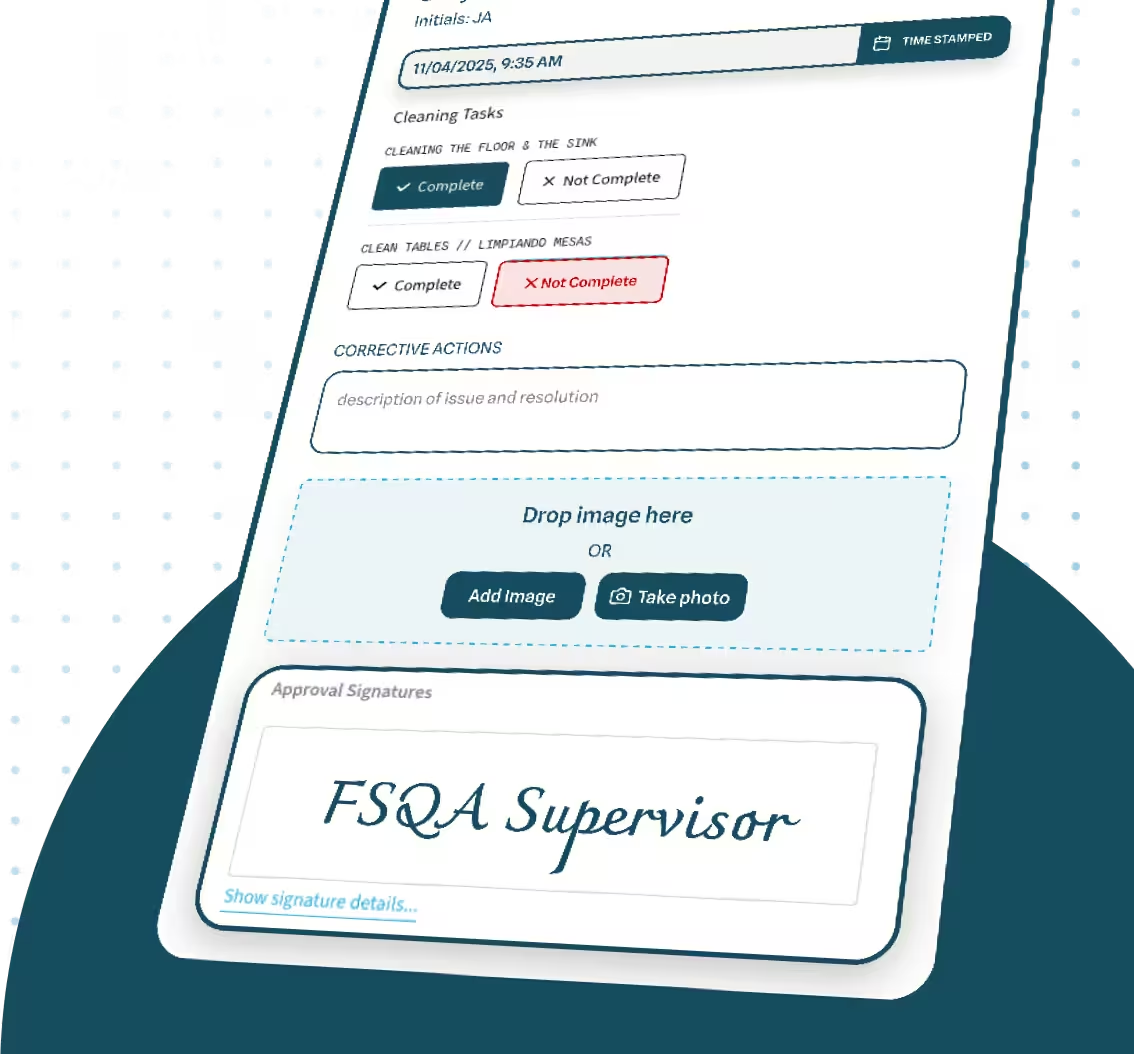
In Allera's Task Management, a Recurring task covers the even-year renewal on October 1 and another the qualified facility status check before July 1. A One-Off task covers each 60-day update. Each Task Instance is tracked as completed on time, completed late or overdue, so a slipping renewal shows up well before December 31.
In Document Control, you can store each FDA confirmation and your DUNS record, and use Access Control to limit who sees the registration number. The Audit Trail export shows who changed what and when, and Document Vault shares a single confirmation with an outside auditor without giving them an account. See how Allera keeps compliance tasks and records audit ready.
FAQs
What is a UFI, and do I need a DUNS number?
A UFI is the unique facility identifier every registration has had to include since October 1, 2020 (21 CFR 1.232(a)(2)). FDA currently recognises the DUNS number from Dun & Bradstreet as the acceptable UFI, and FDA's guidance says it's free. FDA checks that the address on your DUNS record matches your registration before it confirms a registration or renewal.
Does a USDA-inspected plant need to register with FDA?
Only if it isn't regulated exclusively by USDA throughout the entire facility (21 CFR 1.226(g)). FDA's guidance says a USDA-inspected plant must also register if it:
- makes finished pet food
- processes non-amenable species such as rabbit, deer, elk or bison
- processes other fish alongside Siluriformes, such as catfish
Can a new facility register before October 1?
Yes. A new facility must register before it starts to manufacture, process, pack or hold food for US consumption, whatever the month (21 CFR 1.230(a)). If you register before October 1 of an even-numbered year, you still have to renew between October 1 and December 31 of that same year.
Do I get a new registration number when I renew?
No. FDA doesn't issue a new registration number when you renew a current registration. You keep the same number and get a confirmation of the renewal. A new number comes with a new registration, for example when a new owner registers the facility (21 CFR 1.234(b)).
How do I look up an FDA food facility registration number?
You can't look up another company's. The list of registered facilities and registration documents isn't public (21 CFR 1.243). To find your own number, check your FDA Industry Systems account or contact FDA. The FEI (FDA Establishment Identifier) is a separate number that is public and can be searched.
Does FDA issue a food facility registration certificate?
No. FDA doesn't issue a certificate of registration and doesn't recognise one issued by a private business. If a customer or seller platform asks for a certificate, there isn't one to give. FDA's July 2026 advisory also reminds you that you don't have to share your registration number with third parties.
How much does FDA food facility registration cost?
Nothing. There is no FDA fee to register, renew, update or cancel a food facility registration (21 CFR 1.231(c)). Private registration services and US Agents may charge for their own services, but you don't need a third party to register, and FDA isn't affiliated with them.