

Types of Food Contamination: The 4 Types, How They Get In, and How Plants Control Them


The types of food contamination are usually grouped into four: biological, chemical, physical and allergen cross-contact. US regulation counts three, and it files allergens and radiological hazards under chemical. In a food plant, the label matters less than two practical questions: where each type gets into your product, and which program stops it. This guide gives you all four types in one table, a straight answer to "3 or 4 types?", the routes into a plant, and the records that prove each control is working.
What is food contamination?
Food contamination is the presence of an unwanted biological, chemical or physical agent in food that can make it unsafe to eat. An allergen that ends up in a food that shouldn't contain it counts too, even though most people could eat it safely.
The regulatory wording is close to that. 21 CFR 117.3 defines a hazard as "any biological, chemical (including radiological), or physical agent that has the potential to cause illness or injury." That definition drives the written hazard analysis required of every facility subject to FDA's preventive controls rule.
Contamination and spoilage overlap but answer different questions. Spoilage is about quality: off odors, mold growth or texture changes that make food unacceptable to eat. Contamination is about safety, and a contaminated product can look, smell and taste normal. Listeria in a deli salad or a sliver of metal in a cereal bar won't show up at a sensory check, which is why contamination is controlled through programs and records rather than inspection alone.
The word also matters legally. Contaminated food can be adulterated under the Federal Food, Drug, and Cosmetic Act, and adulterated food in commerce is what leads to warning letters, import refusals and recalls.
The 4 types of food contamination at a glance
Most food safety training works from four types of contamination. Here is how each one looks inside a food plant rather than a kitchen.
| Type | What it is | Plant examples | Where it usually gets in | Program that controls it | How it's usually found | Deep dive |
|---|---|---|---|---|---|---|
| Biological | Bacteria, viruses, parasites, molds and their toxins | Listeria monocytogenes in a floor drain, Salmonella in a dry ingredient, norovirus from a sick worker | Raw materials, people, the plant environment | Sanitation, environmental monitoring, cook or kill step, temperature control | Micro testing, environmental swabs | Biological hazards |
| Chemical | Residues, toxins and substances that shouldn't be in the food | Sanitizer left after CIP, pesticide residue in an ingredient, non-food-grade lubricant | Cleaning, maintenance, raw materials | Chemical control, supplier approval | Supplier CoAs, lab testing, concentration checks | Chemical hazards |
| Physical | Hard, sharp or foreign objects | A metal fragment from a worn screen, glass from a light fitting, hard plastic from a broken scoop | Equipment, the facility, packaging | Foreign material program, maintenance hygiene | Metal detection or X-ray, inspection, complaints | Physical contamination |
| Allergen cross-contact | An allergen getting into a food that isn't meant to contain it | Peanut residue on a shared line, rework containing milk | Shared equipment, rework, scheduling, wrong labels | Allergen program, validated changeover, label control | Allergen-specific swabs, label checks | Allergen cross-contact |
Two notes on the table. Radiological contamination is real but rare in day-to-day production, and US rules count it as a chemical hazard. Cross-contamination is missing on purpose, because it describes how any of the four types moves (more on that below).
3 types or 4? How FDA classifies food contamination hazards
If you've seen both answers, both are in use. The regulation behind your hazard analysis names three. 21 CFR 117.130(b)(1) tells you to consider:
- Biological hazards, "including microbiological hazards such as parasites, environmental pathogens, and other pathogens"
- Chemical hazards, "including radiological hazards, substances such as pesticide and drug residues, natural toxins, decomposition, unapproved food or color additives, and food allergens"
- Physical hazards, "such as stones, glass, and metal fragments"
USDA-inspected meat and poultry plants get the same three. 9 CFR 417.1 defines a food safety hazard as "any biological, chemical, or physical property that may cause a food to be unsafe for human consumption." The international view matches: the FAO GHP and HACCP toolbox says food hazards "can be categorized as chemical (e.g. pesticides), biological (e.g. pathogens) or physical (e.g. extraneous materials)."
Certification schemes such as SQF, BRCGS and FSSC 22000 expect the same categories in your HACCP plan, and several also ask you to consider fraud and malicious contamination.
Training courses split allergens out as a fourth type because the controls are so different. Cooking kills Salmonella, but it doesn't make a peanut protein safe for someone with a peanut allergy. Some industry lists go to five by adding "environmental" contamination. Under US rules that's a route, since environmental pathogens such as Listeria are biological hazards.
Economically motivated adulteration (EMA) causes the most confusion. The rule treats it as a reason a hazard is present. Section 117.130(b)(2) asks whether each hazard occurs naturally, may be introduced unintentionally, or "may be intentionally introduced for purposes of economic gain." Melamine added to a protein ingredient is still a chemical hazard; fraud is how it got there. Your food fraud vulnerability assessment is where you work out which ingredients carry that risk, and FDA's page on economically motivated adulteration has its own examples.
| Framework | Types | What it lists | Use it for |
|---|---|---|---|
| US regulation (21 CFR 117.130, 9 CFR 417.1) | 3 | Biological, chemical (including radiological and allergens), physical | Your written hazard analysis |
| Food safety training | 4 | Biological, chemical, physical, allergen | Teaching the floor |
| Some industry lists | 5 | Adds "environmental" | Read it as a route into the plant |
| Economic adulteration | Not a type | Why a hazard is present, under 117.130(b)(2)(iii) | Your food fraud vulnerability assessment |
The practical answer: use the regulatory three when you write your hazard analysis, and teach four on the floor. FDA's draft guidance on hazard analysis and risk-based preventive controls for human food works through each category in detail.
Biological contamination
Biological contamination is living organisms, or the toxins they make, getting into food. Our guide to biological hazards in food manufacturing covers the controls in depth. The groups you'll see in a hazard analysis:
- Bacteria: Salmonella in low-moisture ingredients, Listeria monocytogenes in wet RTE environments, E. coli O157:H7 in raw beef.
- Viruses: norovirus and hepatitis A, usually carried in by people.
- Parasites: mainly a raw-material issue in fish, meat and fresh produce.
- Molds and their toxins: spoilage on one side, mycotoxins such as aflatoxin on the other.
Environmental pathogens deserve their own line. 21 CFR 117.3 defines them as pathogens able to survive and persist in the plant environment, and names Listeria monocytogenes and Salmonella as examples. If a ready-to-eat food is exposed to the environment before packaging and gets no lethal step afterwards, 117.130(c)(1)(ii) says your hazard evaluation must include them. That rule is the regulatory backbone of an environmental monitoring program.
For the organisms behind most outbreaks, see the Big 6 foodborne pathogens and FDA's Bad Bug Book.
Chemical contamination
Chemical contamination is any substance in food that shouldn't be there, or is there at an unsafe level. Our guide to chemical hazards in food breaks down ten of them with controls. The 117.130 list, in plant terms:
- Cleaning and sanitizing residues, and lubricants that aren't food grade
- Pesticide and veterinary drug residues in raw materials
- Natural toxins such as mycotoxins, plus decomposition products such as histamine in fish
- Unapproved food or color additives
- Food allergens
- Radiological hazards, which FDA manages through guidance levels for radionuclides in domestic and imported food
Environmental contaminants are the active area right now. FDA's Closer to Zero program targets lead, arsenic, cadmium and mercury in foods eaten by babies and young children, and PFAS sit on FDA's list of environmental contaminants in food. For most plants, these come in through raw materials, so they're managed through supplier approval and CoA review.
Physical contamination
Physical contamination is a foreign object in food. The hazardous ones are hard or sharp: metal, glass, hard plastic, stone, wood and bone. Our physical contamination guide covers sources, the program and incident response.
FDA's line comes from CPG Sec. 555.425. A hard or sharp object between 7 mm and 25 mm long is treated as a hazard. Smaller objects can still matter for products made for infants or other high-risk groups. Hair, insects and soft packaging fragments are usually quality defects rather than injury hazards, though they still drive complaints.
Detection is your last line of defense. Metal detection and X-ray catch what got in. The foreign material program, glass and brittle plastic register and maintenance hygiene keep it from getting in in the first place.
Allergen cross-contact
21 CFR 117.3 defines allergen cross-contact as "the unintentional incorporation of a food allergen into a food." Our allergen cross-contact guide covers where it happens on a line and how to validate changeovers.
US law lists nine major food allergens in 21 U.S.C. 321(qq): milk, egg, fish, crustacean shellfish, tree nuts, wheat, peanuts, soybeans and sesame. Sesame joined the list on January 1, 2023. UK and EU lists are longer and differ, so check which list your customer specification uses. FDA's food allergies page summarizes the US rules.
Under 117.130, allergens are a chemical hazard. They still get their own program because heat, pressure and time don't remove them. The only controls are keeping them out (segregation, scheduling, validated cleaning) and declaring them correctly on the label. Your allergen control program is where those controls live.
Cross-contamination: how contamination moves, not a fifth type
Cross-contamination is the transfer of a contaminant from one surface, food or person to another. Any of the four types can move this way, which is why it isn't counted as a separate type. Three plant examples:
- A hose used to clean a floor drain sprays Listeria onto a food-contact surface on the next line.
- Sanitizer left in a pipe after CIP ends up in the first minutes of the next production run.
- Metal swarf from a maintenance job on a conveyor is left behind when the line restarts.
When the contaminant is an allergen, the regulatory term is cross-contact, and the controls are different. The cross-contact vs cross-contamination comparison sets the two side by side.
How contamination gets into a food plant
FDA's hazard analysis rule tells you where to look. Section 117.130(c)(2) lists factors you must consider when evaluating hazards, and each one is effectively a route in. These are the eight to walk through:
- Raw materials and ingredients. Pathogens, residues and foreign matter that arrive with supplies. Your supplier approval program is the first control.
- People. Illness, poor handwashing, jewelry and personal items.
- Facility and equipment design. Dead legs, hollow rollers and cracked welds that harbor bacteria and resist cleaning. Sanitary design and well-chosen food contact surfaces close this route.
- The environment. Air, water, condensate dripping from overhead lines, and drains.
- Pests. Rodents, insects and birds carrying pathogens and leaving physical contamination.
- Processing. Under-processing, a missed cook step, or rework that carries an allergen into the wrong product.
- Packaging and labeling. Fragments from packaging materials, and the wrong label on the right product, which turns a correctly made food into one with an undeclared allergen.
- Storage and transport. Temperature abuse, damaged packaging and shared trailers.
The list in the rule itself is close: formulation, facility and equipment, raw materials, transportation, manufacturing and processing, packaging and labeling, storage and distribution, intended use, and sanitation including employee hygiene.
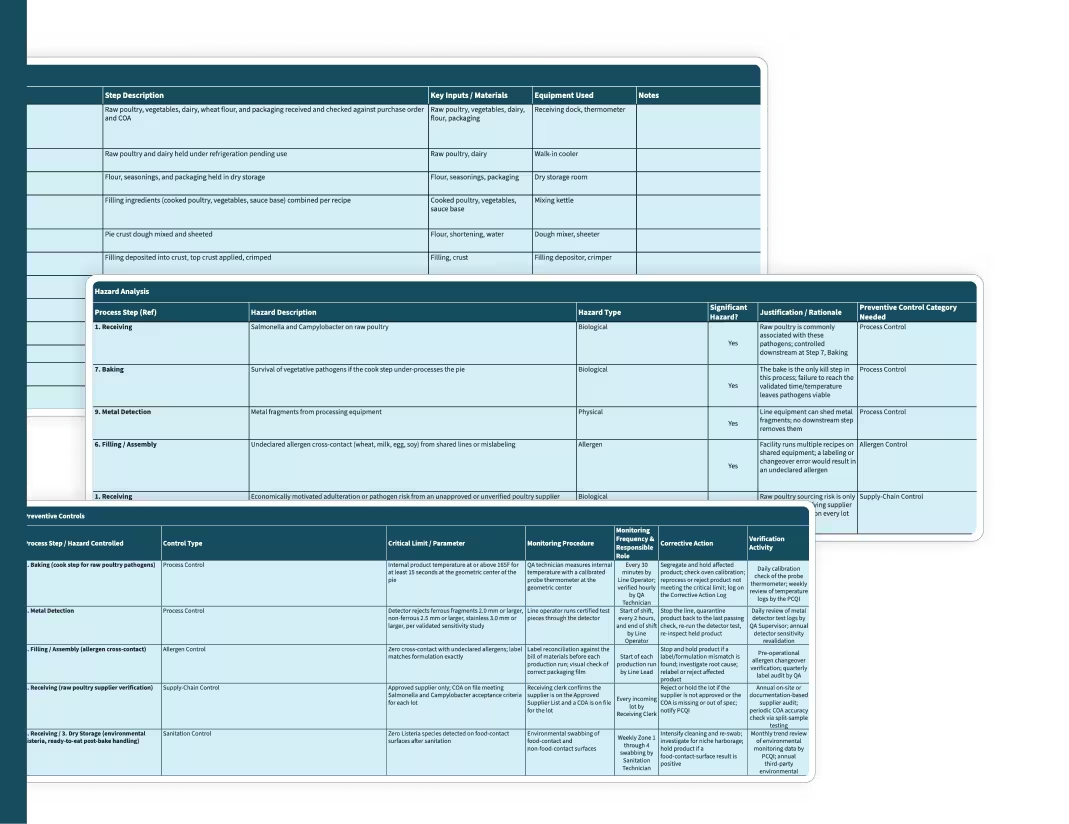
The easiest way to use this list is to walk your process flow from receiving dock to shipping dock with it in hand. At each step, ask which of the eight routes applies and which type of contamination could come in that way. Receiving brings raw material and transport risks, open processing brings environment and people, and packaging brings label mix-ups. The gaps you find become entries in your hazard analysis or fixes to a prerequisite program.
Which program controls each type of contamination
Each type of contamination has an owning program, and each program produces a record an auditor will ask to see.
| Type | Preventive control or prerequisite program | The record that proves it's working |
|---|---|---|
| Biological | Sanitation (SSOPs), environmental monitoring, cook or kill step, cold chain | Sanitation checklists, pre-op inspections, EMP swab log, cook and temperature logs |
| Chemical | Chemical control, supplier approval | Approved chemical list, sanitizer concentration checks, supplier CoAs |
| Physical | Foreign material and glass control, preventive maintenance | Glass and brittle plastic register checks, metal detector verification, maintenance hygiene clearance |
| Allergen cross-contact | Allergen program, production scheduling, label control | Changeover verification, allergen swab results, label checks |
Most of these sit in your prerequisite programs, with the higher-risk ones elevated to preventive controls by your hazard analysis. Auditors check the records, and a failed check needs a documented corrective action.
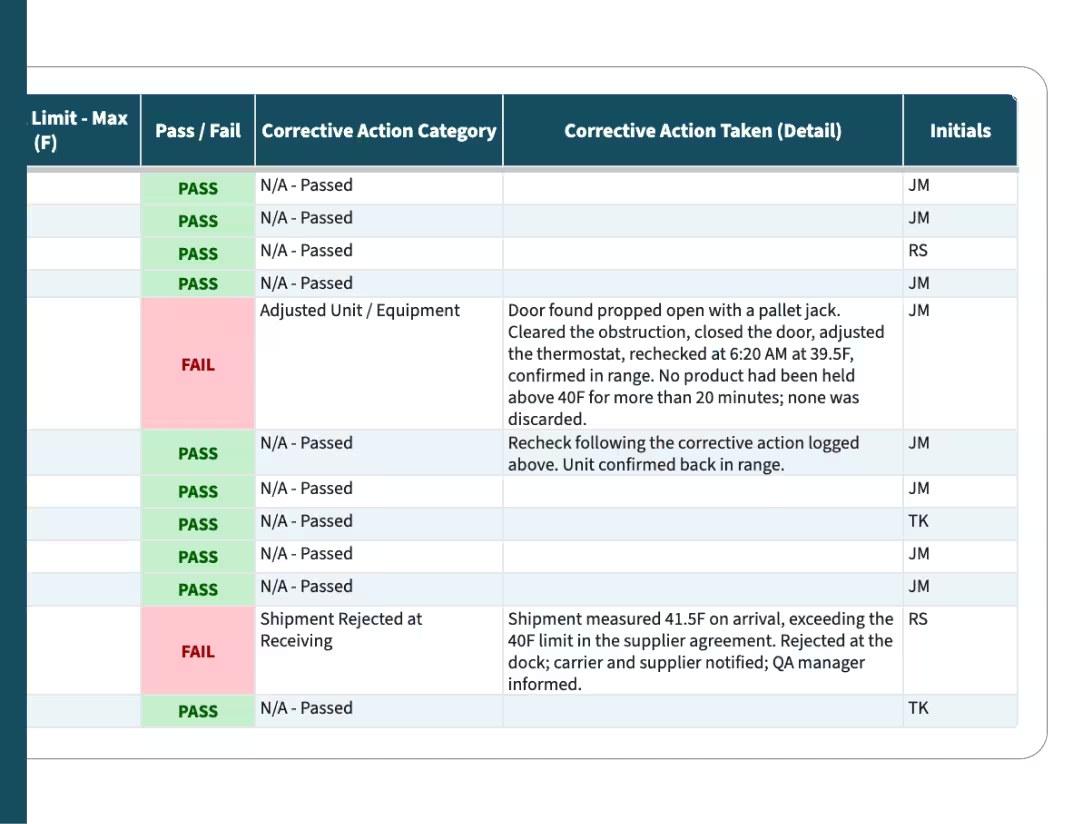
When an auditor picks ten days at random and asks for the records behind one of these programs, the gaps tend to look the same: a pre-op inspection missing for one shift, a sanitizer concentration check written down but never signed, or a failed metal detector verification with nothing showing what happened to the product made since the last good check. None of those is a contamination event, but each one leaves you unable to prove the control worked.
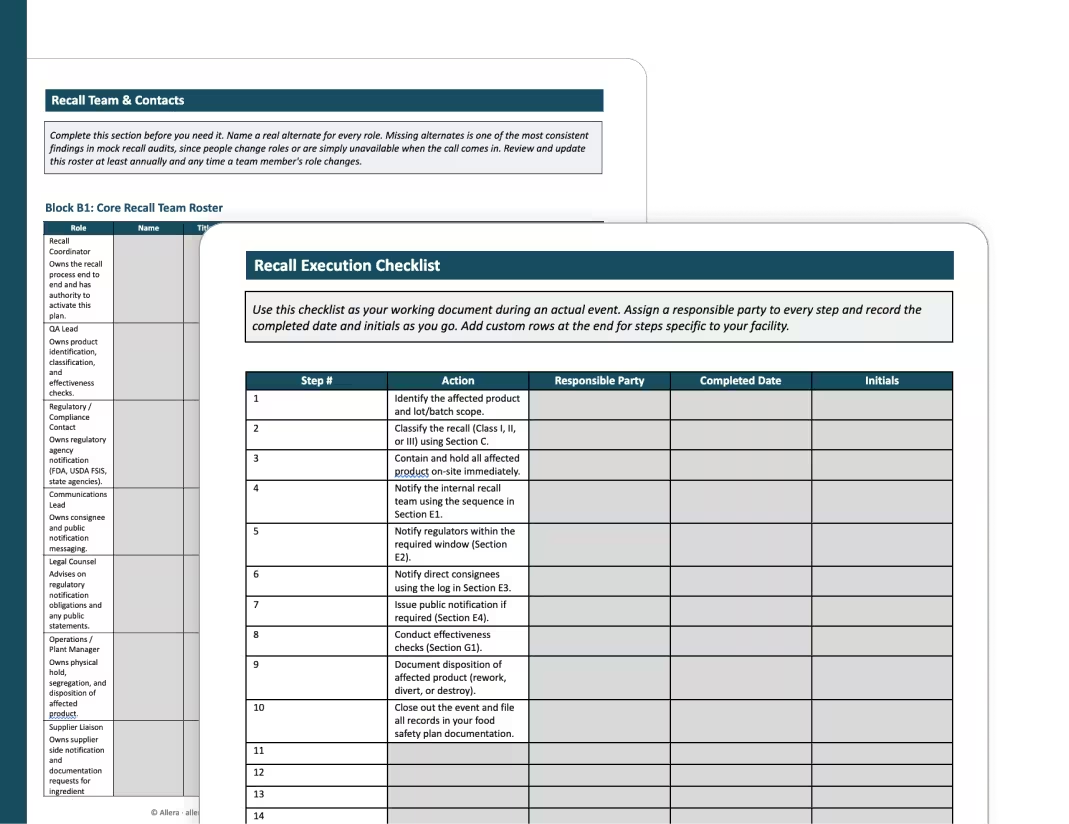
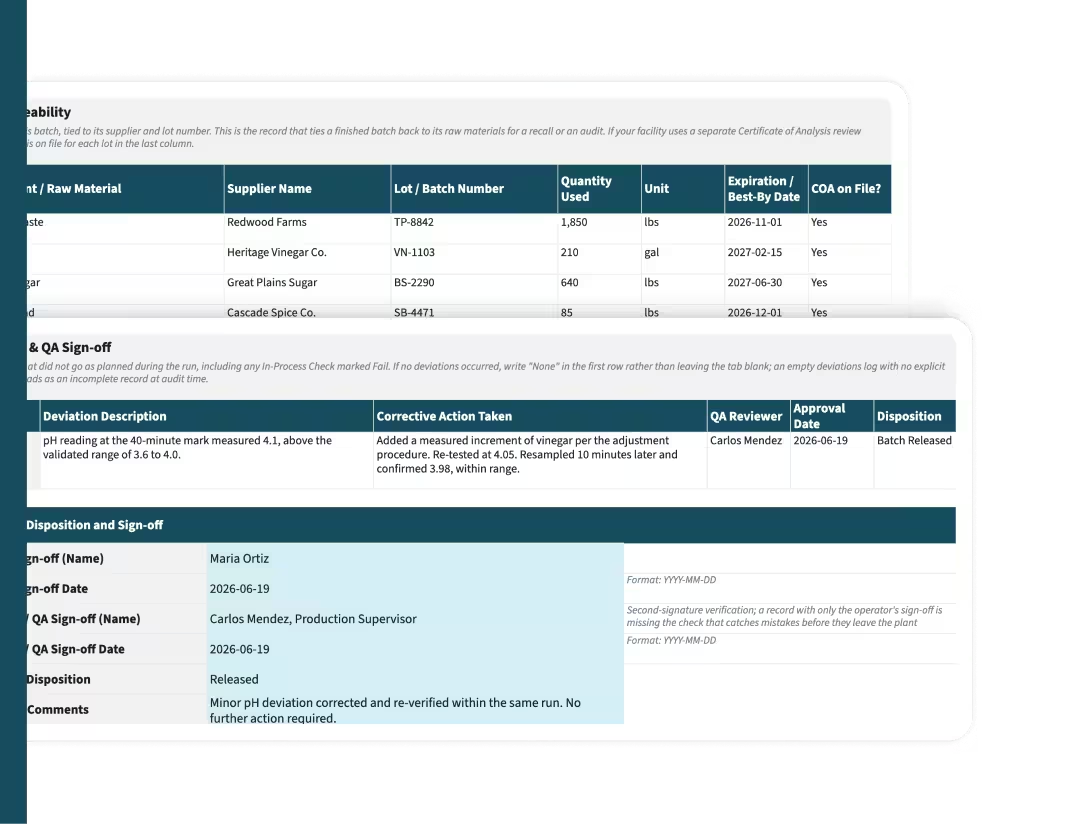
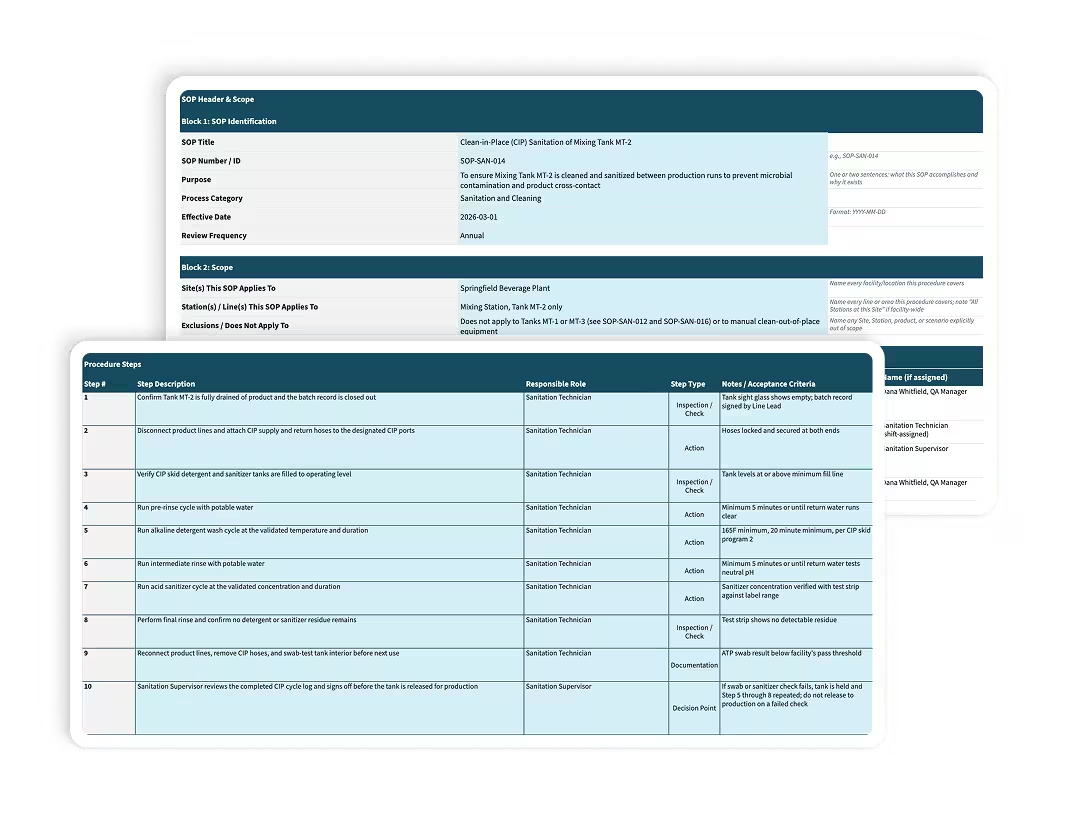
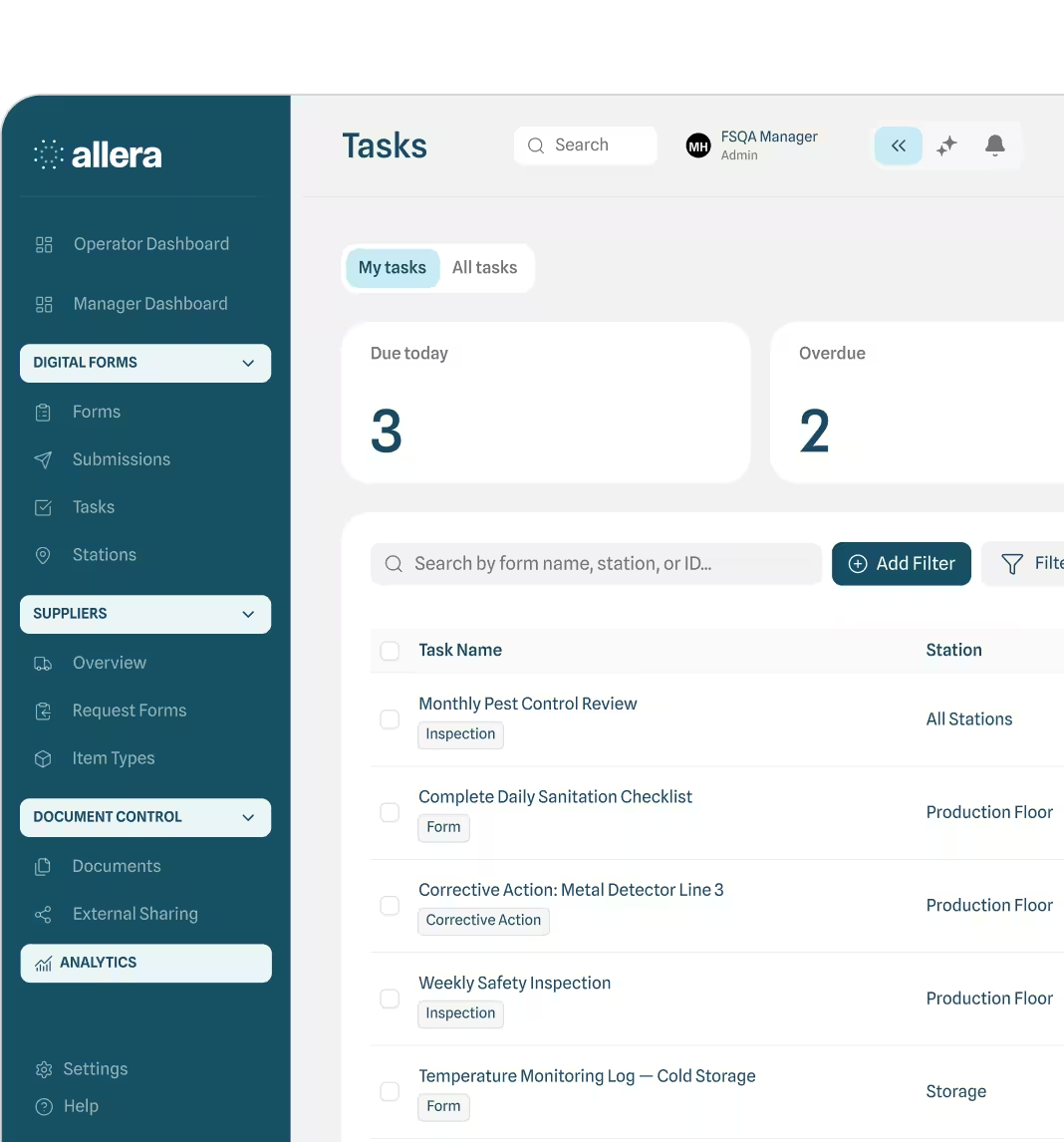
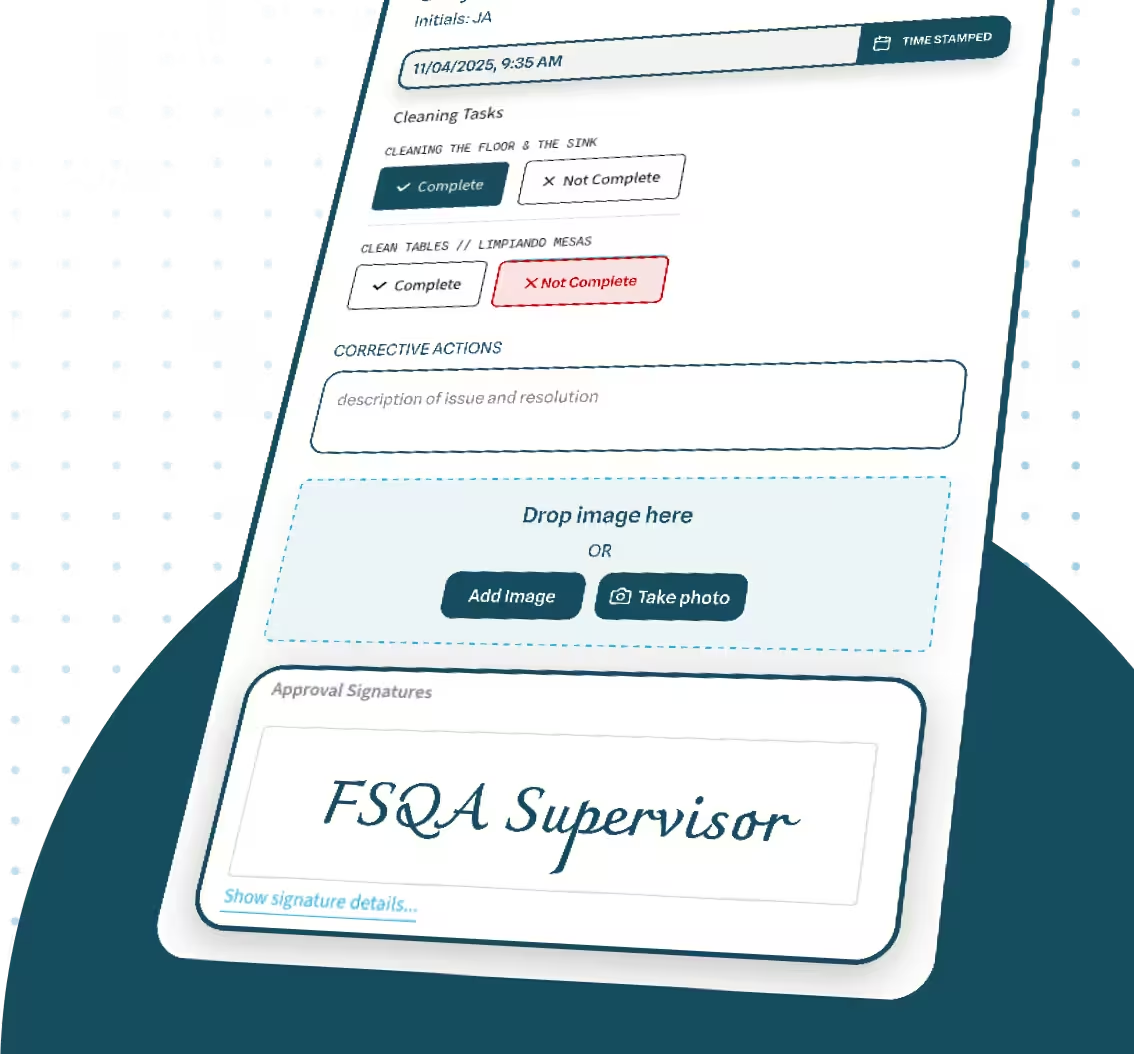
Every control in that table comes down to a check someone did, on time, and signed. Allera turns those checks into Digital Forms with a Signature field and assigned approvals. When a reading fails a rule, a Corrective Action is created automatically, and the records stay audit ready. See how Allera keeps food safety checks on track.
How each type of contamination is usually found
Each type has its usual detection methods:
- Biological: finished product micro testing and environmental swabs from your EMP.
- Chemical: supplier CoAs, lab residue testing and sanitizer concentration checks.
- Physical: metal detection, X-ray and visual inspection.
- Allergen cross-contact: allergen-specific protein swabs after changeover. ATP swabs show general cleanliness but don't detect specific allergens.
Customer complaints catch all four, usually too late. Testing tells you contamination is there, while the programs above are what keep it out. Our guide to food safety testing methods covers how each test works and when to use it.
What happens when contamination reaches the market
Contaminated food can be legally adulterated under the FD&C Act. An undeclared allergen is usually a labeling problem, which makes the food misbranded. FDA's allergen compliance policy adds that cross-contact from shared equipment or production sequencing "may be insanitary conditions" that adulterate the food as well.
FDA or USDA FSIS then classifies any recall by health risk. A Class 1 recall means a reasonable probability of serious adverse health consequences or death, the same threshold behind SAHCODHA. Undeclared allergens and Listeria in RTE food are frequent Class I causes.
Plants get through an investigation faster when they can pull up their records quickly: which lots ran, which checks passed, and what was done when one failed. Knowing the four types is the easy part. Proving to an auditor that each control ran on every shift is harder. See how food manufacturers keep that evidence audit ready in Allera.
FAQs
Is environmental contamination a fifth type of food contamination?
Not under US rules. Some industry lists add "environmental" as a fifth type, but the hazard itself is still biological, chemical or physical. Environmental pathogens such as Listeria monocytogenes and Salmonella are biological hazards that persist in the plant. If ready-to-eat food is exposed before packaging without a later kill step, 21 CFR 117.130(c)(1)(ii) requires your hazard evaluation to cover them.
What are the most common sources of food contamination in a manufacturing plant?
Contamination usually gets into a plant through one of these routes:
- raw materials and ingredients
- people
- facility and equipment design
- the environment, including air, water, condensate and drains
- pests
- processing and rework
- packaging and labeling
- storage and transport
These line up closely with the factors FDA requires you to consider in your hazard evaluation under 21 CFR 117.130(c)(2).
What is radiological contamination of food?
Radiological contamination is the presence of radionuclides, such as cesium-137 or iodine-131, in food at levels that could harm health. It is rare in day-to-day production and is mostly a concern for imported foods after a nuclear incident. 21 CFR 117.130 counts radiological hazards inside the chemical category, and FDA sets guidance levels for radionuclides in domestic and imported foods.
Why are allergens classed as a chemical hazard?
Because 21 CFR 117.130(b)(1)(ii) lists food allergens among chemical hazards, alongside pesticide and drug residues, natural toxins and unapproved additives. Allergens are proteins, and no cook or kill step makes them safe for an allergic consumer. That is why most plants still run a separate allergen control program built on segregation, validated changeover cleaning and label control. The US recognizes nine major food allergens, including sesame since January 1, 2023.
Is cross-contamination a type of food contamination?
No. Cross-contamination is the way a contaminant moves from one surface, food or person to another, so it can carry any of the four types. A hose spraying Listeria from a drain onto a food-contact surface is cross-contamination of a biological hazard. When the contaminant is a food allergen, the regulatory term is allergen cross-contact, and the controls are different.
Are there 3 or 4 types of food contamination?
Both answers are in use. FDA's hazard analysis rule, 21 CFR 117.130, names three hazard types: biological, chemical (which includes allergens and radiological hazards) and physical. USDA's 9 CFR 417.1 uses the same three. Food safety training usually lists allergens as a fourth type because they need such different controls. Use the regulatory three in your written hazard analysis and teach the four on the floor.
What are the 4 types of food contamination?
The four types usually taught are biological, chemical, physical and allergen cross-contact.
- Biological: bacteria, viruses, parasites and molds, such as Listeria or Salmonella
- Chemical: cleaning residues, pesticide residues, natural toxins and non-food-grade lubricants
- Physical: hard or sharp foreign objects such as metal, glass and hard plastic
- Allergen cross-contact: an allergen getting into a food that isn't meant to contain it
Under US regulation, allergens are counted inside the chemical category.