

SAHCODHA: What It Means and What It Triggers Under FSMA

SAHCODHA stands for serious adverse health consequences or death to humans or animals, FDA's shorthand for a hazard with a reasonable probability of causing that outcome. FDA doesn't publish a list of SAHCODHA hazards, so the call is yours to make and defend. That call switches on four obligations: an annual onsite supplier audit, the same audit for foreign suppliers under FSVP, a 24-hour report to FDA's Reportable Food Registry, and Class I recall territory. This guide covers what the term means, FDA's own examples, and the exceptions most summaries leave out.
What Does SAHCODHA Mean?
SAHCODHA describes a situation where there is a reasonable probability that use of, or exposure to, a food or a hazard in it will cause serious adverse health consequences or death to humans or animals. FDA's FSVP guidance puts it plainly: "SAHCODHA is the acronym for serious adverse health consequence or death to humans or animals."
The acronym is shorthand used in FDA guidance. The rules themselves spell out the full phrase. You'll find it in the supply-chain program requirements for human food (21 CFR 117.430(b)) and animal food (21 CFR 507.130(b)), in the FSVP rule (21 CFR 1.506(d)(2)), and in three sections of the FD&C Act: registration suspension (§415(b)), the Reportable Food Registry (§417) and mandatory recall (§423).
For a human food plant, SAHCODHA sits inside the preventive controls framework FSMA added in 21 CFR Part 117. Our HARPC vs HACCP comparison shows where the supply-chain program fits.
SAHCODHA vs SAHCODH: Why FDA's Human Food Guidance Drops the "A"
Read the human food rule closely and you'll see it stops at "death to humans." Section 117.430(b)(1) covers human food only, so animals are out of scope. The FSVP rule and the animal food rule (21 CFR 507.130) both say "humans or animals."
That's why FDA's draft Chapter 15 supply-chain program guidance for human food defines a "SAHCODH hazard" instead. It's the same test with a narrower scope. If an audit report or supplier questionnaire uses either acronym, read it as the same question about severity and probability.
SAHCODHA and Class I Recalls
FDA ties the term directly to recall classification. Both the FSVP guidance and Chapter 15 say SAHCODHA hazards are those for which a recall of a violative product would be designated Class I under 21 CFR 7.3(m)(1).
| Recall class | Definition in 21 CFR 7.3(m) | Relationship to SAHCODHA |
|---|---|---|
| Class I | A reasonable probability that use of, or exposure to, a violative product will cause serious adverse health consequences or death | The same standard |
| Class II | May cause temporary or medically reversible adverse health consequences, or the probability of serious consequences is remote | Usually not SAHCODHA |
| Class III | Not likely to cause adverse health consequences | Not SAHCODHA |
FDA's recalls background and definitions page uses the same wording. FDA assigns the class, not the recalling firm, so your own Class I recall assessment is a prediction you document in advance.
Which Hazards Are SAHCODHA? Examples From FDA
FDA doesn't publish a complete list, but its mandatory food recall Q&A guidance comes closest. In FDA's words, situations that generally represent a SAHCODHA risk include "Listeria monocytogenes (Lm) or Salmonella spp. in Ready-to-eat foods, certain undeclared allergens in food products, E. coli O157:H7 in leafy greens, and botulinum toxin found in food products."
The same guidance lists past Class I food recalls that represented this risk:
- Peanut butter, alfalfa sprouts and deli products contaminated with Salmonella
- Under-processed canned chili containing Clostridium botulinum toxin
- Smoked salmon and pumpkin seeds contaminated with L. monocytogenes
- Products with undeclared allergens such as milk, peanuts or eggs
- Baby food that posed a choking hazard
- Animal foods: horse feed with elevated monensin, pet foods with melamine and cyanuric acid or with Salmonella or L. monocytogenes, and sheep feed with elevated copper
The table below works through nine common cases. The last column is the part most guides skip: what the answer actually triggers for you.
| Hazard | Food and context | Usually SAHCODHA? | Why | What it triggers |
|---|---|---|---|---|
| L. monocytogenes | Cheese you buy for an RTE product; the supplier pasteurizes and controls sanitation | Yes | FDA's own Chapter 15 example | The onsite audit default, plus a review of the supplier's environmental monitoring. See ready-to-eat foods and environmental monitoring program |
| Salmonella | Raw peanuts that you roast | Yes, as a hazard | You apply the kill step yourself | No supplier audit default. The control is your own validated roast |
| Salmonella | Roasted peanuts from a sister plant under the same corporate food safety system | Yes | FDA's own written determination example | A documented written determination can replace annual audits |
| Undeclared major allergen, such as milk | Finished product label error | Often | FDA says "certain" undeclared allergens, and openFDA records show both Class I and Class II | A possible 24-hour RFR report and a recall. See allergen control program |
| C. botulinum toxin | Under-processed low-acid canned food | Yes | On FDA's list | Class I territory and the RFR. See retort processing |
| E. coli O157:H7 | Imported covered leafy greens bought through a consolidator | Yes | On FDA's list | The annual onsite audit default for the foreign suppliers, even through a consolidator (FSVP guidance F.18) |
| Pesticide residue | Imported produce | Usually not | FSVP guidance F.13 uses "a pesticide that is not a SAHCODHA hazard" as its example | Review of the supplier's food safety plan plus sampling and testing. See chemical hazards in food |
| Patulin | Apple juice | Usually not | All 50 openFDA enforcement records citing patulin are Class II | Normal supplier verification |
| Metal fragments | General adult food | Usually not | No Class I among openFDA records citing metal fragments | Normal controls. Baby food is different: FDA lists a choking hazard in baby food as Class I. See physical contamination |
The openFDA figures come from a keyword search of FDA's food enforcement data run on 2 November 2026. They count product records rather than recall events, so treat them as a direction of travel rather than a rate.
Why the Same Hazard Can Be SAHCODHA in One Product and Not Another
Practitioners have long argued about whether recall class is a reliable test. In openFDA's records, Listeria and Salmonella recalls are mostly Class I but not always, and undeclared milk and sesame records split between Class I and Class II. The same named hazard doesn't always produce the same answer.
FDA's mandatory recall guidance explains why. When FDA judges SAHCODHA risk, the evidence it considers includes:
- The vulnerability of the people who eat the food, such as infants, toddlers, the elderly, pregnant women, medically compromised people, certain pets and young livestock
- The nature of the product: ready-to-eat, raw or cooked
- Sample results, including environmental swabs from the facility
- Epidemiological data linking the food to illness
- Reportable Food Registry data and consumer or trade complaints
Recall history is a good starting point for your own call. Context decides the answer, so record the context along with the conclusion.
The Four Places SAHCODHA Changes What You Have to Do
Most explanations of SAHCODHA only talk about importers. A US plant buying from US suppliers has the same audit default under Part 117, and every registered facility carries the reporting duty. Here are all four obligations.
| Obligation | Rule | Applies to | Requires | Main exception |
|---|---|---|---|---|
| Supply-chain program | 21 CFR 117.430(b), or 507.130(b) for animal food | Receiving facilities | An onsite audit of the supplier before first use and at least annually | A written determination; alternatives for qualified facilities, non-covered farms and small shell egg producers |
| FSVP | 21 CFR 1.506(d)(2) | Importers | Conduct or obtain documentation of an onsite audit before first import and at least annually | An adequate written determination |
| Reportable Food Registry | FD&C Act §417 (21 U.S.C. 350f) | The registrant of the facility | A report to FDA within 24 hours of determining the food is reportable | The adulteration originated with you, was caught before transfer, and was corrected or destroyed |
| Recall | 21 CFR 7.3(m)(1); FD&C Act §423 (21 U.S.C. 350l) | The responsible party | Class I classification, and FDA can order a recall if you don't act voluntarily | None, though FDA must first offer a voluntary recall |
1. Supply-Chain Program: The Annual Onsite Supplier Audit (21 CFR 117.430(b))
The trigger is narrower than most people assume. Section 117.430(b) applies when a hazard in a raw material or other ingredient "will be controlled by the supplier" and is a SAHCODH hazard. If you apply the control yourself, that hazard needs no supply-chain program (21 CFR 117.405(a)(1)). Your supplier approval program and certification scheme still expect you to approve that supplier, but the FSMA audit default doesn't apply.
When the supplier does control it, the rule makes an onsite audit the appropriate verification activity, conducted before you first use the ingredient and at least annually after that. FDA's Chapter 15 guidance says it doesn't expect to take action if the gap between audits is "reasonably close to one year (e.g., within 13-14 months)."
The audit has rules of its own under 21 CFR 117.435:
- A qualified auditor must perform it. That can be one of your own employees, provided they meet the qualified auditor definition.
- It must consider applicable FDA food safety regulations and review the supplier's written food safety plan, and its implementation, for the hazard.
- Written results of an FDA, USDA or state inspection of the supplier conducted within 1 year of the audit's due date can substitute for it.
- An audit conducted by the supplier itself doesn't count (21 CFR 117.415(b)). A third-party audit the supplier hands you can count if a qualified auditor conducted it under 117.435 and no payment was tied to the results.
That answers a common question about GFSI certificates. An SQF, BRCGS or FSSC 22000 audit can serve as your onsite audit if it meets 117.435. The certificate alone doesn't show that, so ask for the full audit report and check its scope against the hazard.
The written determination exception. Under 117.430(b)(2), the annual audit default doesn't apply if there's a written determination that other verification activities, less frequent audits, or both give adequate assurance. FDA's guidance says the determination is part of your food safety plan, so it must be prepared by or overseen by your PCQI. You document it under 21 CFR 117.475(c)(11).
FDA still recommends some auditing for most suppliers outside your corporate structure, "such as every 2 or 3 years." Its own example is a long-standing supplier audited every two years, with quarterly sampling and testing for the hazard in the year between. Back your determination with evidence: years of performance history, test results, past audit findings and your supplier scorecard.
Alternatives for small suppliers. Under 117.430(c) to (e), written assurances can replace the audit when the supplier is a qualified facility, a farm not covered by the produce safety rule, or a shell egg producer with fewer than 3,000 laying hens. Each alternative needs a written assurance of the supplier's status before approval and every year after, plus a second written assurance at least every 2 years.
2. FSVP: The Annual Onsite Audit of a Foreign Supplier (21 CFR 1.506(d)(2))
If you import food and your foreign supplier controls a SAHCODHA hazard, 21 CFR 1.506(d)(2) requires you to "conduct or obtain documentation of an onsite audit of the foreign supplier before initially importing the food and at least annually thereafter." An adequate written determination can replace that with other activities or less frequent audits.
FDA's FSVP guidance reads "annual" as every 365 days, allows for practical delays, and applies the default to covered produce even when you buy through a consolidator. If you're also a receiving facility, FSVP verification can stand in for Part 117 supplier verification. Everything else sits in our Foreign Supplier Verification Program guide.
3. Reportable Food Registry: The 24-Hour Report (FD&C Act §417)
A reportable food is an article of food, other than infant formula, with a reasonable probability of causing serious adverse health consequences or death to humans or animals (21 U.S.C. 350f(a)(2)). FDA's guidance also leaves dietary supplements out of the registry. In practice, a food containing a SAHCODHA hazard is a reportable food.
The responsible party is the person who registered the facility. Once you determine a food is reportable, you have "as soon as practicable, but in no case later than 24 hours" to report through FDA's Safety Reporting Portal, linked from the Reportable Food Registry for Industry page. You also have to investigate the cause if the adulteration may have originated with you.
The exemption almost everyone misses is in 350f(d)(2). You don't need to report if the adulteration originated with you, you detected it before transferring the food to anyone else, and you corrected it or destroyed the food. Product you contaminated yourself, caught on hold and destroyed before shipping, is the typical case.
The registry came from the Food and Drug Administration Amendments Act of 2007, not FSMA. Rehearse the 24-hour clock during each mock recall so everyone knows who makes the "reportable" call and when the clock starts.
4. Recalls: Class I and FDA's Mandatory Recall Authority (FD&C Act §423)
A SAHCODHA hazard in distributed product puts you in Class I recall territory under 21 CFR 7.3(m)(1). Section 423 of the FD&C Act, added by FSMA in 2011, goes further (21 U.S.C. 350l). FDA can use it when there's a reasonable probability that a food is adulterated under §402, or misbranded for an undeclared major allergen under §403(w), and that it will cause SAHCODHA.
FDA must first give you the chance to stop distribution and recall voluntarily. If you don't, it can order you to cease distribution and, after offering an informal hearing, order a recall. Your recall plan should name who makes recall decisions, so your team never ends up waiting for the order.
Other Places the Phrase Appears
The same standard lets FDA suspend a facility's registration under FD&C Act §415(b) (21 U.S.C. 350d). Food from a suspended facility can't enter interstate or intrastate commerce.
Keeping track of annual supplier audits, renewals and the evidence behind each written determination is a records job as much as a food safety one. See how Allera keeps supplier verification records audit ready.
How to Decide Whether a Hazard Is SAHCODHA (and Document It)
Work through these six steps for each hazard your hazard analysis identifies as requiring a preventive control.
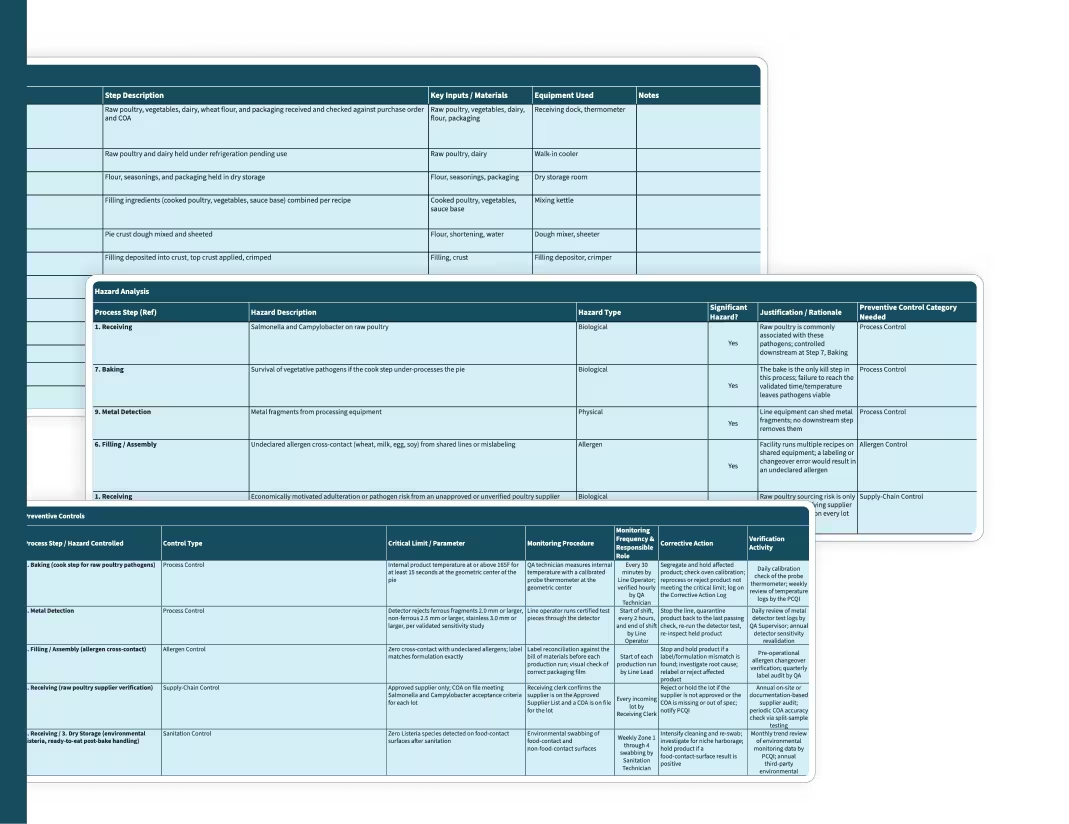
- Start from the hazard evaluation. 21 CFR 117.130(c)(1)(i) requires you to assess the severity of the illness or injury and the probability the hazard will occur in the absence of preventive controls. A SAHCODHA conclusion is a high-severity, reasonable-probability result from that evaluation.
- Ask the Class I question. If this hazard reached distributed product, would the recall be Class I? Check FDA's examples above, Reportable Food Registry annual reports and openFDA records for the same hazard and food.
- Adjust for who eats it and how. An RTE product, an infant food or a pet food can reach SAHCODHA territory where a cooked adult product wouldn't.
- Identify who controls it. That's you, your supplier or your customer. Only supplier control triggers the audit default under 117.430(b) or 1.506(d)(2). If your customer applies the control, 21 CFR 117.136 sets its own disclosure and written assurance requirements.
- Write the conclusion and rationale into the hazard analysis. If the supplier controls the hazard and you won't audit annually, write the determination under PCQI oversight and keep it with your supply-chain program records.
- Revisit it when something changes. A new supplier, a new intended use, a recall or outbreak in the category, or a poor audit result should all reopen the decision.
Common SAHCODHA Gaps Auditors and FDA Investigators Find
These are the gaps that turn a reasonable SAHCODHA call into a finding:
- A supplier-controlled pathogen with no audit and no determination. The hazard analysis lists Listeria in an RTE ingredient as supplier-controlled, but there's no audit or written determination on file.
- An audit well past a year. FDA's 13 to 14 month tolerance covers a delayed audit. It doesn't cover a supplier nobody has audited since onboarding.
- The supplier's own audit accepted as verification. Section 117.415(b) rules it out.
- A written determination with nothing behind it. One line saying "low risk supplier," with no performance history or test results.
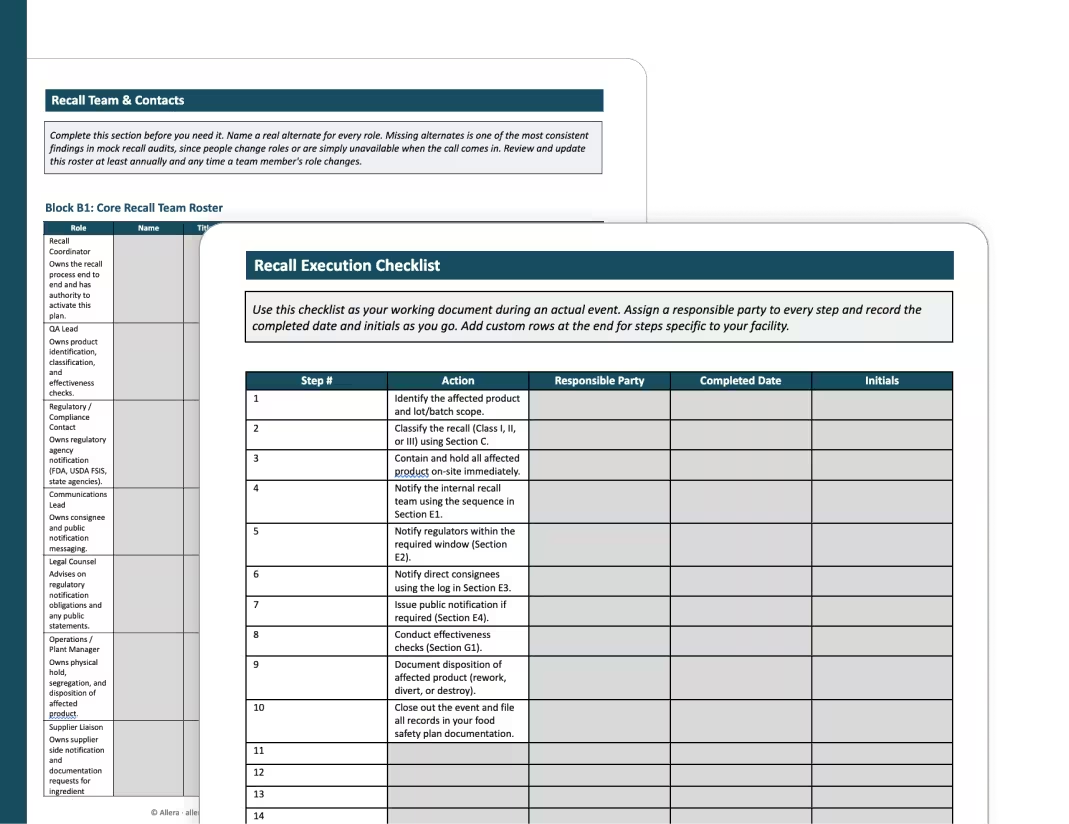
- No owner for the 24-hour clock. The recall plan doesn't name who decides a food is reportable.
- Audit findings with no follow-up. Section 117.475(c)(7)(v) requires you to document corrective actions taken in response to significant deficiencies, so route them through a supplier corrective action request.
Keeping SAHCODHA Decisions Audit-Ready
When an FDA investigator or your certification auditor asks about SAHCODHA, they want three things: the hazard analysis that names the hazard, an audit report or written determination for every supplier that controls it, and proof the schedule is up to date. If those records live in binders, inboxes and a spreadsheet only one person understands, pulling them up takes days.
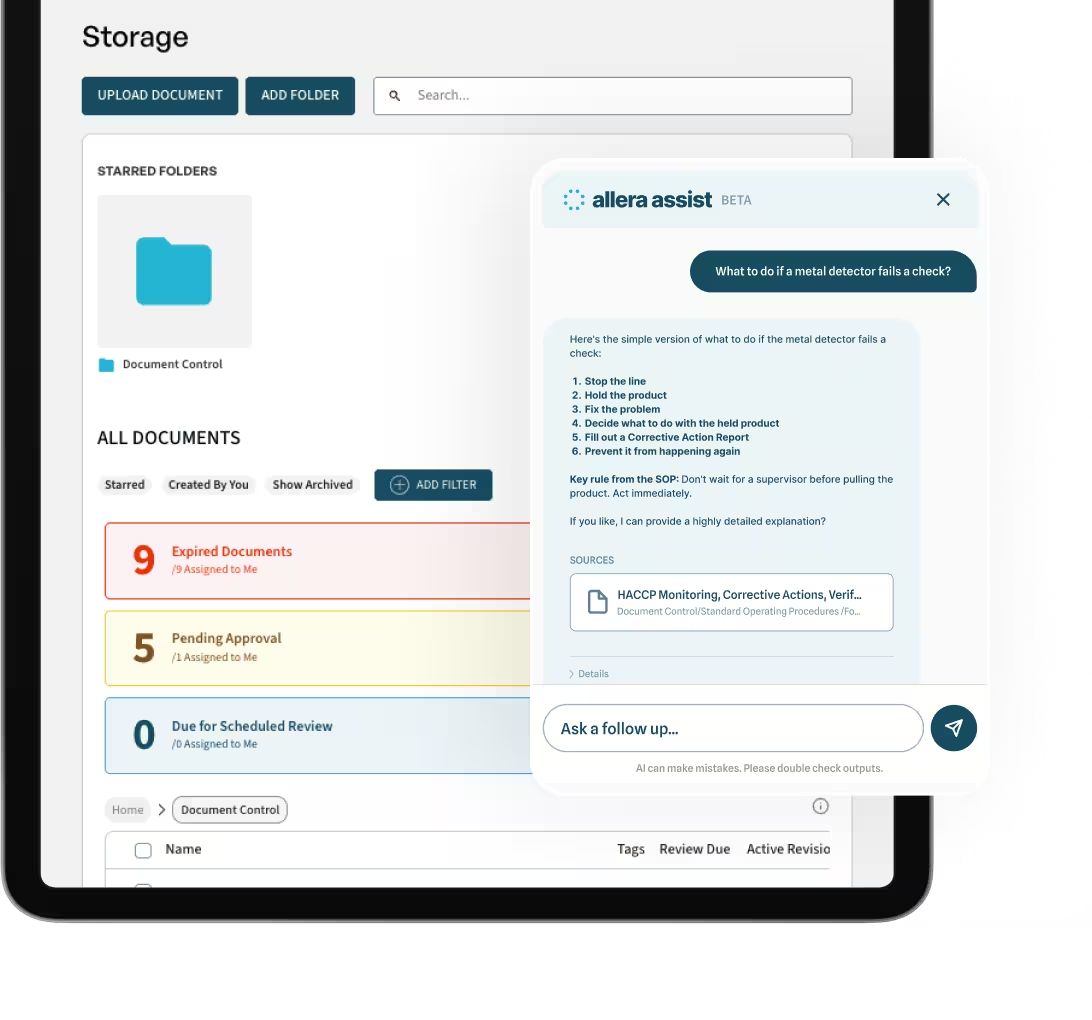
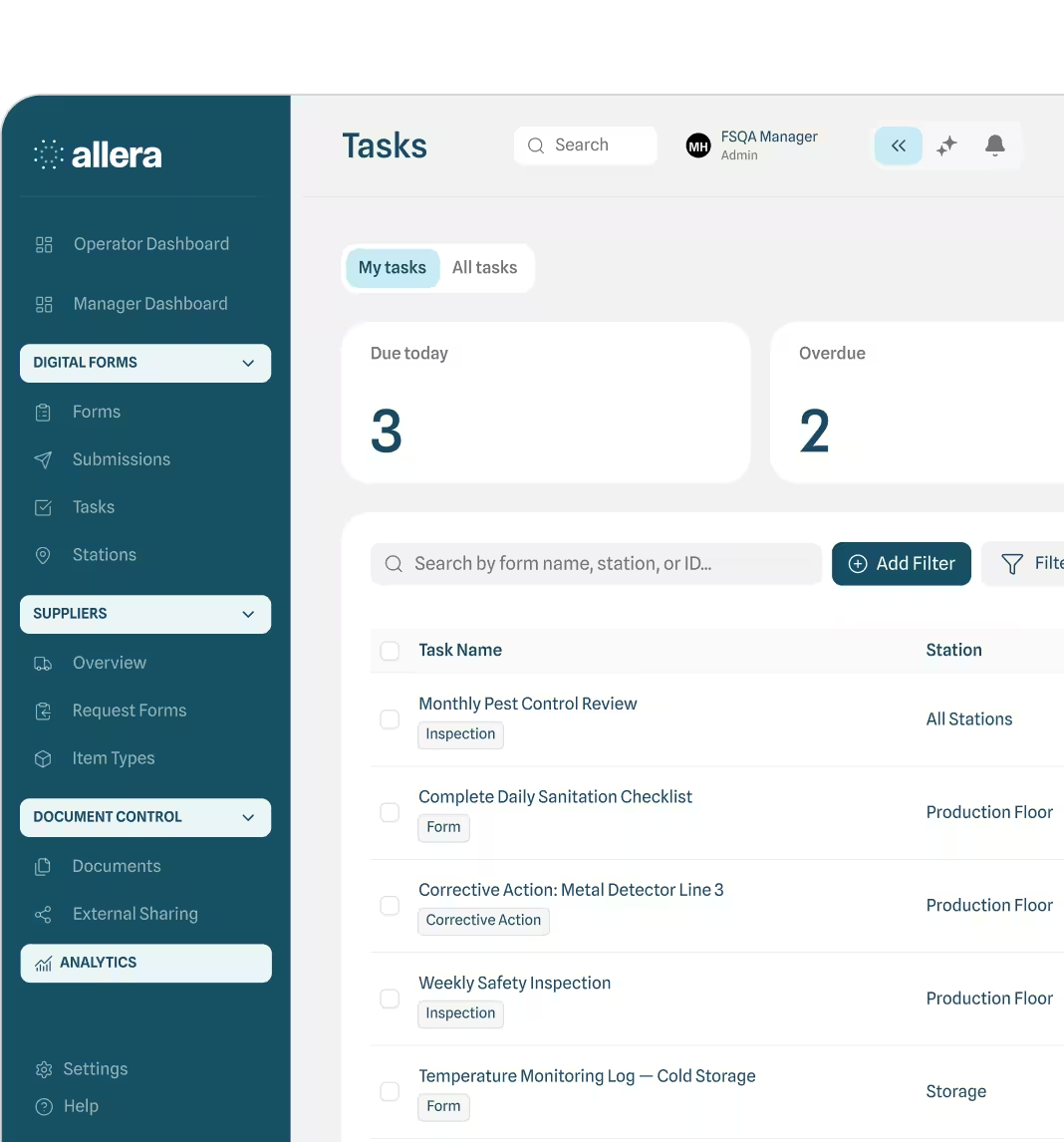
In Allera's Supplier Management, you can build a Request Form for the annual audit report, or for the evidence behind a written determination, and send it to each supplier. You approve each submission with a signature or send it back for revision. The Renewal workflow re-requests the report, pre-filled from the last approved submission, and flags overdue renewals automatically.
In Document Control, a Scheduled Review forces an annual re-approval of each written determination, and the Audit Trail export shows who approved it and when. Your PCQI still makes the SAHCODHA call, and Allera keeps track of the evidence behind it. See how Allera handles supplier audit reports and renewals.
Volpi Foods, a specialty cured meats manufacturer, moved its supplier documentation out of spreadsheets and into Allera and has onboarded more than 50 suppliers. If your supplier records are still scattered, start with the ones an investigator will ask for first. Explore Allera's food quality management software.
FAQs